The artwork displayed on this page is protected by copyright law, which means we cannot legally create or sell an identical reproduction. This protection is enforced under international agreements such as the Berne Convention and by national laws, including those outlined by the U.S. Copyright Law - Title 17.
This method fully complies with copyright regulations because it does not involve copying or duplicating the protected artwork. Instead, it is a creative reinterpretation - a new painting that is influenced by the original but not identical to it.
Museum-quality giclée or canvas print with fast production and flexible finish options. ( Buy Hand Made Painting Switch to Digital Image)





























Pick from our preset sizes that match the artwork's original proportions.

Type the width and the height you need, to fit your frame or your wall. A print can only be cut, never made bigger than the picture, so a size with a different shape loses a part of the image. We send you a digital mockup to approve before we print anything. The picture shown on this page does not show the real cut — only the mockup does.
Worldwide Delivery () in 2 weeks instead of standard 4/5 weeks. (24 October)
untitled (1885)
Reproduction Size
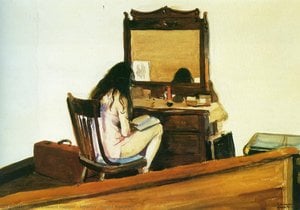
In the quiet corners of American realism, few works capture the profound tension between presence and absence as poignantly as Edward Hopper’s "Untitled (1885)". This evocative canvas serves as a masterful distillation of the anxieties and aspirations inherent in the modern experience, offering a scene that feels both intimately familiar and hauntingly distant. At first glance, the painting presents a serene moment: a man and a woman positioned on the porch of a house, bathed in the diffused, gentle glow of daytime sunlight. Yet, beneath this tranquil surface lies a complex psychological landscape. As their gazes drift outward toward the bustling city street below, an immediate sense of separation emerges, creating a palpable boundary between the private sanctuary of the porch and the vibrant, indifferent activity of the urban world.
Hopper’s signature technique is on full display here, showcasing a meticulous realism that avoids the mere imitation of life in favor of a deeper, more symbolic truth. Eschewing the fleeting, light-drenched impressions of the Impressionists, Hopper employs a deliberate simplification of form and a controlled palette to convey mood. The composition is anchored by muted tones—predominantly deep blues and earthy browns—which reinforce an atmosphere of quiet melancholy. By utilizing geometric shapes, particularly the stark rectangles of architectural elements, he creates a sense of spatial restraint that mirrors the emotional containment of his subjects. This structural precision does not merely define the setting; it builds a cage of sorts, emphasizing the isolation felt by the figures within the frame.
To understand this piece is to understand the historical currents of an era marked by rapid industrialization and the rise of the American metropolis. "Untitled (1885)" emerges from a period where the growth of cities fostered new, complex feelings of alienation and detachment. The painting acts as a mirror to this cultural preoccupation with solitude. While the background reveals other individuals engaged in the rhythmic, daily activities of the city street, they remain secondary to the central emotional weight of the couple on the porch. This contrast between the lively, collective movement of the crowd and the still, introspective state of the protagonists creates a powerful symbolic resonance, touching upon themes that would later define modernist movements such as Surrealism and Expressionism.
For the discerning collector or interior designer, this work offers more than just aesthetic beauty; it provides a profound emotional anchor for a space. The painting’s ability to evoke nostalgia, stillness, and contemplation makes it an extraordinary centerpiece for environments that value depth and storytelling. Whether placed in a contemporary gallery setting or a classic study, the reproduction of such a masterpiece invites viewers to pause and reflect. It is a piece that does not demand attention through loudness, but rather commands it through its quiet, enduring strength—a timeless window into the human condition that continues to resonate with every passing generation.
The luminance recorded for "untitled (1885)" by Edward Hopper is gentle luminance.
A reproduction of "untitled (1885)" by Edward Hopper is recommended for accent. This suggestion follows from the work's subject, mood and colors.
The melancholic emotion of "untitled (1885)" accompanies its American Realism style.


1931 - 1967 , United States of America

Explore 10 defining masterpieces of Contemporary Realism! Discover Lucian Freud, Chuck Close & more. Uncover stories behind iconic paintings and find museum-quality art reproductions to elevate your home decor on .

Explore 25 iconic Edward Hopper paintings & their stories. Discover American realism, urban loneliness, and timeless beauty through his masterpieces. Find museum-quality art reproductions & curated decor ideas at WahooArt.com.

Explore 10 defining American Realism masterpieces – Hopper, Homer & more. Discover the stories behind these iconic paintings and bring timeless art to your home with WahooArt's museum-quality reproductions. Explore the full collection online.

Explore the profound beauty of American Realism. From the Ashcan School's urban grit to intimate portraits, discover how artists captured the authentic soul of a nation through unvarnished truth and masterful observation.

Explore the powerful social commentary & artistic representation of American Realism. Discover key artists like Bellows & Sloan, and understand the movement's lasting impact on 20th-century art history.

 Preview
 Send
Send Share
Share
 Details
 Guide
Guide

 Download
 Similars
 X-Ray
X-Ray Diaporama
 Stats
Stats

 Read More









 Glass option is only available in size under 110 CM