The artwork displayed on this page is protected by copyright law, which means we cannot legally create or sell an identical reproduction. This protection is enforced under international agreements such as the Berne Convention and by national laws, including those outlined by the U.S. Copyright Law - Title 17.
This method fully complies with copyright regulations because it does not involve copying or duplicating the protected artwork. Instead, it is a creative reinterpretation - a new painting that is influenced by the original but not identical to it.
Museum-quality giclée or canvas print with fast production and flexible finish options. ( Buy Hand Made Painting Switch to Digital Image)





























Pick from our preset sizes that match the artwork's original proportions.

Type the width and the height you need, to fit your frame or your wall. A print can only be cut, never made bigger than the picture, so a size with a different shape loses a part of the image. We send you a digital mockup to approve before we print anything. The picture shown on this page does not show the real cut — only the mockup does.
Worldwide Delivery () in 2 weeks instead of standard 4/5 weeks. (25 October)
the el station
Reproduction Size
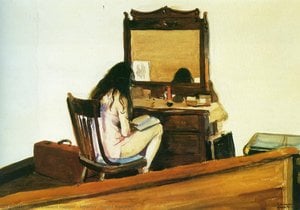
In the quiet, heavy atmosphere of Edward Hopper’s “The El Station,” we are invited into a moment suspended in time, where the bustling energy of the American metropolis is distilled into a singular, poignant observation of stillness. The painting presents a quintessential urban landscape, capturing a train station platform bathed in the muted, melancholic glow of late afternoon light. At its heart, the work depicts a scene that feels both deeply familiar and hauntingly distant; several figures inhabit the space, yet they exist in separate worlds. There is no shared glance, no whispered conversation—only the quiet dignity of individuals absorbed in their own private rhythms. This tableau of modern life serves as a profound meditation on the nature of presence and absence within the crowded architecture of the city.
Hopper’s mastery lies in his ability to manipulate light to evoke what he termed “luminosity.” Eschewing the frantic, broken brushstrokes of the Impressionists, he employs a signature style of stark realism that prioritizes form and structural clarity. Through a deliberate use of shadow, he creates a sense of depth that is as much psychological as it is physical. The technique involves a meticulous layering of oil paints on canvas, building up tonal gradations that breathe life into the weathered red brick of the station’s façade and the diffused, amber light that spills across the platform. This precision allows the texture of the urban environment—the grit of the station, the weight of the architecture—to feel palpable, inviting the viewer to step into the scene and feel the cool, evening air.
Painted in 1927, “The El Station” emerged during a period of seismic shifts in the American consciousness. As industrialization and rapid urbanization transformed the landscape, they simultaneously birthed a new kind of social anxiety: the fear of anonymity. The painting captures this tension perfectly, acting as a window into the Jazz Age’s more introspective side. While the era is often remembered for its frantic energy, Hopper focuses on the shadow cast by progress—the sense of being alone even when surrounded by others. The solitary figures on the platform become symbols of the modern condition, representing individuals adrift in the vastness of an expanding world, grappling with the unspoken emotions of a life lived in transit.
For the discerning collector or interior designer, this piece offers more than mere decoration; it provides a focal point of profound emotional resonance. The painting’s palette of muted earth tones and dramatic shadows makes it a versatile and sophisticated addition to any curated space, particularly those seeking to introduce a sense of contemplative calm or intellectual depth. Whether placed in a contemporary gallery setting or a classic study, “The El Station” commands attention through its quiet strength. It is an invitation to pause, to reflect, and to find beauty in the subtle, often overlooked nuances of the human experience.
Statistics about "the el station" by Edward Hopper are on the artwork's Stats page: monthly visits of the artwork, visits of the artist's works, and country and language breakdowns of recent visitors.
The color composition of "the el station" by Edward Hopper combines a statement contrast with a strong color unity harmony.
Historically, "the el station" is an American Realism work of the broader Modern era.


1931 - 1967 , United States of America

Explore the profound beauty of American Realism. From Winslow Homer’s rural landscapes to the dignity of everyday life, discover how master artists captured the soul of a nation through evocative oil paintings and timeless fine art techniques.

 Preview
 Send
Send Share
Share
 Details
 Guide
Guide

 Download
 Similars
 X-Ray
X-Ray Diaporama
 Stats
Stats

 Read More









 Glass option is only available in size under 110 CM