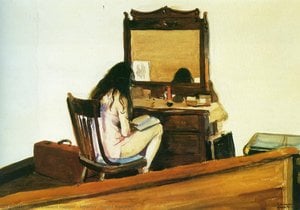
Oil On CanvasWallArtNew Realism
 1903Renaissance
 51.0 x 41.0 cm
The artwork displayed on this page is protected by copyright law, which means we cannot legally create or sell an identical reproduction. This protection is enforced under international agreements such as the Berne Convention and by national laws, including those outlined by the U.S. Copyright Law - Title 17.
As a respectful and legal alternative, we offer custom, hand-painted artworks inspired by the original. Our skilled and professional artists carefully study the original's style, mood, and artistic essence to create a new, unique piece that evokes the same feeling - while remaining an original creation in its own right.
This method fully complies with copyright regulations because it does not involve copying or duplicating the protected artwork. Instead, it is a creative reinterpretation - a new painting that is influenced by the original but not identical to it.
Hand-painted oil on canvas in your size and frame, made to order by our artists. ( Switch to Print Switch to Digital Image)





























Pick from our preset sizes that match the artwork's original proportions.

You may enter your own dimensions to fit a specific frame or space. If your selected size does not match the original image's proportions, we will either crop the artwork or extend the painting with additional hand-painted elements. A digital mockup will be sent for your approval before production begins.
Please note that the on-screen preview does not reflect the actual cropping or extension. Only the mockup will accurately show the final composition.
While custom sizes are available, we recommend selecting a dimension from the predefined list to preserve the original proportions.
Worldwide Delivery () in 3/4 weeks instead of standard 5 weeks. (12 October). No compromise on quality.
Self-Portrait
Reproduction Size
Edward Hopper's 1903 “Self-Portrait” isn’t a flamboyant declaration of ego, but rather a profoundly intimate glimpse into the artist’s soul. Rendered in oil on canvas with a deliberate simplicity that belies its emotional depth, this work immediately draws the viewer into a space of quiet contemplation. The stark black background serves not as mere absence, but as an active participant, amplifying the subject's presence and intensifying the sense of isolation—a hallmark of Hopper’s mature style. The photograph depicts a man with a thoughtful expression, his dark hair neatly combed, a brown beard and mustache framing a face etched with a subtle melancholy. He wears a tie, suggesting a professional life, yet there’s an undeniable air of detachment, as if observing the world rather than actively participating in it.
Painted during Hopper's formative years at the New York School of Art under the tutelage of William Merritt Chase and Robert Henri, this self-portrait represents a crucial transition. While influenced by the realism championed by Henri – particularly his emphasis on capturing fleeting moments and the psychological states of individuals – Hopper quickly developed a unique voice. The work demonstrates an early mastery of observation, mirroring the meticulous detail evident in his childhood sketches (as documented in biographies like “A Solitude Observed”). Notice the loose brushstrokes, reminiscent of Impressionism, yet combined with a distinctly modern sensibility; Hopper wasn’t simply replicating what he saw, but distilling it into its essential elements – light, shadow, and mood. The composition itself is carefully constructed, guiding the eye across the face and subtly hinting at an inner world.
The pose of the subject is particularly revealing. He’s not gazing directly at the viewer with a welcoming smile; instead, his gaze is averted, directed inward. This subtle shift in perspective invites us to share in his solitude, to feel the weight of unspoken thoughts. The tie, a symbol of formality and societal expectation, feels slightly out of place, further emphasizing the sense of detachment. The dark hair and mustache contribute to an air of seriousness, suggesting a contemplative nature—a man accustomed to introspection. Hopper’s use of light is masterful; it illuminates his face without overwhelming it, creating a luminous quality that simultaneously highlights his features and casts subtle shadows that deepen the mood.
“Self-Portrait” foreshadows the themes that would dominate Hopper’s career: loneliness, isolation, and the alienation of modern urban life. While painted at a relatively early stage in his artistic development, it already possesses the hallmarks of his future style – a poignant depiction of individuals adrift in a vast and impersonal world. The painting speaks to a universal human experience—the feeling of being alone even amidst crowds, the quiet yearning for connection. It’s a remarkably prescient work, anticipating the anxieties and uncertainties that would come to define much of 20th-century American art. The piece serves as a powerful reminder of Hopper's ability to capture not just appearances, but the underlying emotions that shape our lives.
A reproduction of "Self-Portrait" fits well in a living room.
"Self-Portrait" by Edward Hopper is a portrait composition measuring 51 x 41 cm in the original.
"Self-Portrait" carries a melancholic emotional tone within the New Realism movement.
The colors of "Self-Portrait" form an earthy palette. This classification describes the dominant color families.
The New Realism work "Self-Portrait" was made by an artist born in United States of America.
The color analysis of "Self-Portrait" by Edward Hopper records a gentle contrast and a strong color unity harmony.
To get a print of "Self-Portrait" by Edward Hopper, simply order it on this page: a fine art print on cotton canvas or archival canvas paper.
"Self-Portrait" is recorded as iconic among the New Realism works in the catalog.


1931 - 1967 , United States of America

Explore the profound beauty of American Realism. From Winslow Homer’s rural landscapes to the dignity of everyday life, discover how master artists captured the soul of a nation through evocative oil paintings and timeless fine art techniques.

 Preview
 Send
Send Share
Share
 Details
 Guide
Guide

 Download
 Similars
 X-Ray
X-Ray Diaporama
 Stats
Stats Read More









 Glass option is only available in size under 110 CM