The artwork displayed on this page is protected by copyright law, which means we cannot legally create or sell an identical reproduction. This protection is enforced under international agreements such as the Berne Convention and by national laws, including those outlined by the U.S. Copyright Law - Title 17.
This method fully complies with copyright regulations because it does not involve copying or duplicating the protected artwork. Instead, it is a creative reinterpretation - a new painting that is influenced by the original but not identical to it.
Museum-quality giclée or canvas print with fast production and flexible finish options. ( Buy Hand Made Painting Switch to Digital Image)





























Pick from our preset sizes that match the artwork's original proportions.

Type the width and the height you need, to fit your frame or your wall. A print can only be cut, never made bigger than the picture, so a size with a different shape loses a part of the image. We send you a digital mockup to approve before we print anything. The picture shown on this page does not show the real cut — only the mockup does.
Worldwide Delivery () in 2 weeks instead of standard 4/5 weeks. (10 November)
night windows
Reproduction Size
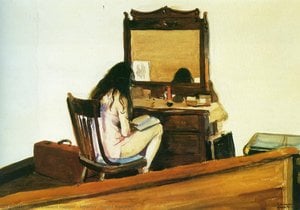
In the quietude of a dimly lit room, where the boundaries between the interior soul and the external world begin to blur, lies the profound essence of Edward Hopper’s Night Windows. This evocative piece serves as a poignant meditation on the human condition, capturing a moment of stillness that feels both deeply personal and universally recognizable. The composition is anchored by two windows that dominate the scene, acting as frames for an unseen, sprawling cityscape that exists just beyond the reach of the viewer. At the heart of this domestic stage sits a solitary figure, positioned between these portals of light and shadow. This central presence, seated in quiet contemplation, embodies a sense of detachment, inviting us to share in their silent observation of the world passing by.
Hopper’s technical prowess is on full display through his signature blend of meticulous realism and expressive simplification. The painting utilizes a muted, almost monochromatic palette—dominated by shades of gray, white, and deep shadows—to heighten the atmospheric tension. Every brushstroke serves to emphasize texture, from the subtle grain of wooden furniture to the heavy drape of fabric, yet there is an intentional economy of detail that prevents the scene from feeling cluttered. This technique creates a sense of "still life" within a living space, where the light does not merely illuminate objects but seems to breathe life into the very concept of silence. The interplay of artificial glow against the expansive darkness outside creates a chiaroscuro effect that is both haunting and beautiful.
Created in 1942, during the height of World War II, Night Windows carries the heavy, unspoken anxieties of an era defined by uncertainty. As part of the American Regionalism movement, Hopper sought to document the authentic, often unvarnished reality of American life. In this work, the darkness pressing against the glass symbolizes more than just the night; it represents the psychological distance and the pervasive sense of isolation felt by many navigating a world in turmoil. The windows themselves act as powerful symbols of both connection and separation—they are gateways to the unknown, yet they simultaneously serve as barriers that keep the inhabitant safely, if lonely, tucked away from the external chaos.
For the discerning collector or interior designer, this painting offers much more than mere decoration; it provides an emotional anchor for a space. The artwork’s ability to evoke themes of introspection and modern existence makes it a profound addition to any curated collection. Whether placed in a quiet study or as a focal point in a contemporary living area, the piece commands attention through its understated elegance. It is a masterpiece of mood, reminding us that even in our most solitary moments, there is a haunting beauty to be found in the shadows. To possess a reproduction of such a work is to invite a sense of timeless contemplation into one's home, celebrating the complex, quiet beauty of the human spirit.
Use (mood) and space (living room) are the two recommendations recorded for "night windows" by Edward Hopper.
The copyright status of "night windows" - still protected by copyright - follows from the artist's death in 1967.
Hand-painted copies of "night windows" by Edward Hopper are sold on this website: a hand-painted oil reproduction on linen canvas, ordered from its Hand-Painted Reproduction page.

Edward Hopper was born in Upper Nyack, United States of America. His early years were spent observing the world with a steady eye, a habit that began with childhood sketches meticulously dated and signed. While his parents suggested a practical path in commercial illustration, his focus remained on fine art. He studied at the New York School of Art under William Merritt Chase and Robert Henri. These years taught him the technical skill required to depict the world unvarnished and honest. He did not seek the fleeting brushstrokes of the Impressionists he encountered in Paris. Instead, he developed a way of seeing that favored the stillness of a moment over the movement of a crowd.
His work often centers on the mundane. He looked at houses, diners, offices, and hotel rooms. He stripped away unnecessary details to find the underlying emotional truth of a scene. In House by the Railroad (1925), a simple composition reveals a sense of mystery and isolation. He used light and shadow not merely to describe a room, but to set a mood. The precise rendering of a shadow on a wall or the way light hits a window became his way of communicating the psychological state of his subjects.
The way light enters a space is a central character in his paintings. In Nighthawks (1942), the stark fluorescent light of a late-night diner cuts through the darkness of a deserted urban street. The figures inside are physically close but appear lost in their own thoughts, disconnected from one another. This sense of anonymity in a crowded city became a recurring theme. He captured the tension of being alone in a public place, a feeling that resonates in works like Automat and Office in a Small City. He was interested in the way artificial light interacts with the natural darkness of the night.
His wife, Josephine Nivison Hopper, was a constant presence. She was a fellow artist and often served as his model. Her presence is felt in the characterization of many of his female figures. Together, they lived a modest life, often spending summers in New England, which influenced the landscapes he painted. His depictions of the American landscape, both rural and urban, often emphasize a certain starkness or emptiness. Whether it is a roadside gas station in Gas (1940) or a quiet room in a hotel, the subject is always the intersection of a physical place and a private, internal experience.
Hopper’s influence extends into the visual language of film and literature. His ability to create a sense of psychological tension through composition has been noted by many who study the way stories are told through images. His paintings remain in major museums worldwide, held in collections such as the Whitney Museum of American Art and the Museum of Fine Arts, Boston. He did not aim for grand historical narratives. He found his subject matter in the quiet corners of everyday life, turning a simple window or a passing stranger into a study of the human condition. His work remains a study of the silence that exists between people.

1931 - 1967 , United States of America

Explore 10 defining American Realism masterpieces – Hopper, Homer & more. Discover the stories behind these iconic paintings and bring timeless art to your home with WahooArt's museum-quality reproductions. Explore the full collection online.

Explore the world of Grant Wood & American Regionalism with WahooArt. Discover the symbolism behind 'American Gothic', recurring themes, and the movement's lasting impact on art history. High-quality reproductions available.
Explore 10 iconic white paintings by Monet, Whistler & Rothko! Discover the stories behind these serene masterpieces and their impact on art history. Find museum-quality reproductions for your home decor at .

Explore 25 iconic Edward Hopper masterpieces of American Realism. Discover the full collection online at WahooArt.com.

Explore 10 iconic paintings dominated by black tones, from Rembrandt’s chiaroscuro to Goya's dark expressions. Discover the stories behind these masterpieces & find museum-quality art reproductions for your home at .
 Preview
 Send
Send Share
Share
 Details
 Guide
Guide

 Download
 Similars
 X-Ray
X-Ray Diaporama
 Q&A
Q&A
 Stats
Stats

 Read More









 Glass option is only available in size under 110 CM