Giclée PrintDigitalContemporary Realism
 1921
1921 18.0 x 21.0 cm
 Philadelphia Museum of Art
The artwork displayed on this page is protected by copyright law, which means we cannot legally create or sell an identical reproduction. This protection is enforced under international agreements such as the Berne Convention and by national laws, including those outlined by the U.S. Copyright Law - Title 17.
This method fully complies with copyright regulations because it does not involve copying or duplicating the protected artwork. Instead, it is a creative reinterpretation - a new painting that is influenced by the original but not identical to it.
Museum-quality giclée or canvas print with fast production and flexible finish options. ( Buy Hand Made Painting Switch to Digital Image)
Pick from our preset sizes that match the artwork's original proportions.

Type the width and the height you need, to fit your frame or your wall. A print can only be cut, never made bigger than the picture, so a size with a different shape loses a part of the image. We send you a digital mockup to approve before we print anything. The picture shown on this page does not show the real cut — only the mockup does.
Worldwide Delivery () in 2 weeks instead of standard 4/5 weeks. (23 October)
Night Shadows
Reproduction Size
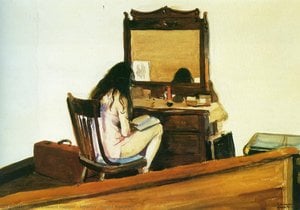
Edward Hopper's "Night Shadows," etched in 1921, isn’t merely a depiction of a street at night; it’s a distilled essence of American loneliness and the quiet drama inherent in everyday existence. The stark black and white etching immediately establishes an atmosphere of profound stillness – a palpable sense of isolation that speaks volumes without uttering a single word. Hopper, a master of capturing fleeting moments of human experience, expertly utilizes light and shadow to create a scene both familiar and unsettlingly detached. The image draws us in with its simple composition: a solitary figure walking down the street, his elongated shadow stretching before him like an extension of his solitude. This isn’t a bustling urban landscape; it's a carefully constructed tableau designed to evoke introspection.
Hopper’s etching technique is remarkably precise, revealing the meticulous hand that shaped this iconic image. Notice the deliberate hatching and cross-hatching employed to render the textures of the pavement, the subtle gradations in the shadows, and the delicate lines defining the architecture. The artist's control over line weight contributes significantly to the overall mood – heavier lines emphasize areas of darkness and solidity, while lighter lines suggest distance or ambiguity. The placement of the two chairs and bench further anchors the scene, providing a sense of place without disrupting the feeling of detachment. These elements aren’t merely decorative; they subtly invite us into the narrative, suggesting potential encounters that never materialize.
"Night Shadows" emerged during a pivotal period in American history—the early 20th century, a time of rapid industrialization, urbanization, and profound social change. Hopper’s work reflects the anxieties and uncertainties of this era, capturing the growing sense of alienation felt by many individuals within increasingly impersonal urban environments. The solitary figure walking alone at night embodies this theme – a symbol of disconnection and the struggle to find meaning in a rapidly changing world. The chairs and bench hint at moments of potential connection, yet they remain unoccupied, reinforcing the image’s underlying message of isolation. It's important to remember that Hopper was deeply influenced by the literary works of writers like Henry James, whose explorations of psychological states resonated strongly with his artistic vision.
Beyond its technical brilliance and historical context, “Night Shadows” possesses a remarkable emotional depth. The image doesn’t scream for attention; instead, it quietly invites contemplation. There's a palpable sense of longing within the scene—a yearning for connection or perhaps simply for understanding. The darkness itself isn’t menacing but rather suggestive, hinting at hidden stories and unspoken emotions. It’s this ability to evoke such profound feelings through seemingly simple imagery that has cemented Hopper’s place as one of America's most enduring artists. A reproduction of “Night Shadows” offers a powerful opportunity to bring this evocative scene into your home, serving as a constant reminder of the beauty and melancholy inherent in the human experience.
Works similar to "Night Shadows" are listed on the artwork's Similars page.
"Night Shadows" by Edward Hopper is a landscape composition. The proportions are worth checking before choosing a print size.
"Night Shadows" belongs to the Contemporary Realism movement, and its creator worked in the Modern era.


1931 - 1967 , United States of America

Explore the profound artistry of black and white photography. From historical mastery to the interplay of light and shadow, discover how monochrome captures timeless emotion and form through a sophisticated lens of art history.
Explore the intricate world of etching and intaglio printmaking. Discover how masters use acid and metal to create profound textures and lines, from Romanticism to modern era, through an expert lens of art history and technical mastery.

 Send
Send Share
Share
 Details
 Guide
Guide

 Download
 Similars
 Diaporama
 Stats
Stats Read More






































 Glass option is only available in size under 110 CM