The artwork displayed on this page is protected by copyright law, which means we cannot legally create or sell an identical reproduction. This protection is enforced under international agreements such as the Berne Convention and by national laws, including those outlined by the U.S. Copyright Law - Title 17.
As a respectful and legal alternative, we offer custom, hand-painted artworks inspired by the original. Our skilled and professional artists carefully study the original's style, mood, and artistic essence to create a new, unique piece that evokes the same feeling - while remaining an original creation in its own right.
This method fully complies with copyright regulations because it does not involve copying or duplicating the protected artwork. Instead, it is a creative reinterpretation - a new painting that is influenced by the original but not identical to it.
Hand-painted oil on canvas in your size and frame, made to order by our artists. ( Switch to Print Switch to Digital Image)





























Pick from our preset sizes that match the artwork's original proportions.

Type the width and the height you need, to fit your frame or your wall. This is hand-painted, so for a size with a different shape the artist can paint a bit more around the picture, or cut a bit — you choose. We send you a digital mockup to approve before the painting starts. The picture shown on this page does not show the real result — only the mockup does.
Worldwide Delivery () in 3/4 weeks instead of standard 5 weeks. (20 October). No compromise on quality.
Manhattan Bridge Loop
Reproduction Size
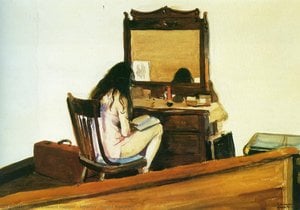
In the quiet, pre-dawn stillness of 1928, Edward Hopper captured more than just a New York City streetscape; he distilled the very essence of modern existence. Manhattan Bridge Loop serves as a profound meditation on the paradox of urban life—the experience of being surrounded by millions yet remaining profoundly alone. As the early morning light filters through the hazy atmosphere of the metropolis, it illuminates a scene that feels both monumental and deeply intimate. The composition, anchored by the sweeping architectural presence of the bridge, invites the viewer to step into a moment frozen in time, where the rhythmic pulse of the city has momentarily slowed to a contemplative heartbeat.
The technical mastery of this piece lies in Hopper’s ability to use chiaroscuro to sculpt emotion. Through the dramatic interplay of light and shadow, the artist breathes life into the cold textures of brick, steel, and pavement. His palette is a sophisticated study in restraint, utilizing muted browns, somber grays, and weathered, rusty hues that evoke the grit and grandeur of the Jazz Age. These colors do not merely represent the physical environment; they set a psychological tone of quiet melancholy. The deliberate, controlled brushstrokes create a sense of stillness so palpable that one can almost hear the distant echo of footsteps against the concrete, making it an ideal centerpiece for those seeking to bring a sense of thoughtful depth and historical gravity to a curated interior.
Beyond its visual allure, the painting functions as a symbolic landscape of the human condition. The two figures positioned within the frame—one walking away into the shadows, the other gazing toward the horizon—act as avatars for the viewer’s own reflections on connection and detachment. They are not protagonists in a grand drama, but rather quiet observers of an indifferent cityscape. This sense of urban isolation is heightened by the towering skyscrapers that loom over the street, creating a scale that emphasizes the vulnerability of the individual against the immensity of the modern machine. For the collector, this work offers a window into the post-World War I era, reflecting the widespread disillusionment and the shifting social landscapes of an America grappling with rapid industrialization.
For interior designers and art enthusiasts alike, Manhattan Bridge Loop offers a timeless aesthetic that transcends fleeting trends. Its monochromatic undertones and structural composition provide a sophisticated anchor for contemporary spaces, blending seamlessly with minimalist or classic decor. To possess a reproduction of this masterpiece is to hold a piece of American history—a fragment of a time when the world was changing irrevocably, captured through the eyes of a master who found beauty in the shadows and poetry in the lonely corners of the city.
Edward Hopper is also known as Hopper.
The copyright answer for "Manhattan Bridge Loop" by Edward Hopper: the work is still protected by copyright. This determines whether reproductions of the image may be freely made.
"Manhattan Bridge Loop" by Edward Hopper combines urban landscape, isolation, architecture, light & shadow, city street, bridge scene, minimalism, quietude with a calm atmosphere.

1931 - 1967 , United States of America

Explore 25 iconic Fernand Léger paintings that defined the Machine Age & Cubism. Discover the stories behind his bold colors, geometric forms & avant-garde style. Find museum-quality art reproductions on WahooArt.com.

Explore the vibrant world of Stuart Davis, a pioneer of American Modernism. Discover his jazz-inspired paintings, signature style & investment potential. Expert insights for art collectors.

Discover the pulse of urban culture with our guide to Street Vibes & Urban Motion. Explore high-impact Pop Art, bold street aesthetics, and trend-driven decor to transform your space into a dynamic gallery of contemporary motion and color.
Explore the evolution of cityscape painting with WahooArt. Discover key artists from Realism to contemporary movements & invest in timeless urban visions. Expert guidance, museum-quality reproductions.

Explore 25 iconic Edward Hopper paintings & their stories. Discover American realism, urban loneliness, and timeless beauty through his masterpieces. Find museum-quality art reproductions & curated decor ideas at WahooArt.com.

 Preview
 Send
Send Share
Share
 Details
 Guide
Guide

 Download
 Similars
 X-Ray
X-Ray Diaporama
 Stats
Stats

 Read More









 Glass option is only available in size under 110 CM