x


 Oil On CanvasWallArtContemporary Realism
 1952High Medieval
 79.0 x 102.0 cm
Hand-painted oil on canvas in your size and frame, made to order by our artists. ( Buy Print Buy Image)





























Pick from our preset sizes that match the artwork's original proportions.

You may enter your own dimensions to fit a specific frame or space. If your selected size does not match the original image's proportions, we will either crop the artwork or extend the painting with additional hand-painted elements. A digital mockup will be sent for your approval before production begins.
Please note that the on-screen preview does not reflect the actual cropping or extension. Only the mockup will accurately show the final composition.
While custom sizes are available, we recommend selecting a dimension from the predefined list to preserve the original proportions.
Worldwide Delivery () in 3/4 weeks instead of standard 5 weeks. (29 August). No compromise on quality.


Hotel by a Railroad
Reproduction Size
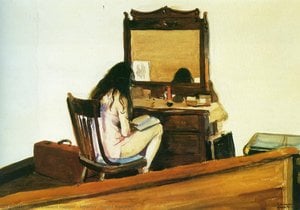
Edward Hopper's "Hotel by a Railroad," painted in 1952, isn’t merely a depiction of an interior scene; it’s a carefully constructed meditation on loneliness, isolation, and the subtle anxieties of modern American life. This oil-on-canvas masterpiece, measuring a substantial 101.9 x 79.3 cm, resides within the Hirshhorn Museum's collection, offering viewers a poignant glimpse into Hopper’s signature style – a world rendered with stark realism and an undercurrent of melancholic beauty.
The painting immediately draws the eye to its central figures: a man and a woman positioned within a dimly lit hotel room. The woman, seated at the left, is absorbed in reading a book, her posture suggesting quiet contemplation. Across from her, the man stands near an open doorway, holding a cigarette between his fingers – a gesture that simultaneously conveys both weariness and a yearning for something beyond the confines of the room. Notably, they don’t acknowledge each other; their gazes are directed outwards, hinting at separate worlds and unspoken distances. The perspective is subtly flattened, creating a sense of claustrophobia despite the presence of an open window, suggesting that even in connection, true intimacy remains elusive.
Hopper's mastery lies not just in his subject matter but also in his meticulous technique. He employs a restrained palette dominated by muted browns, grays, and earthy greens, contributing to the painting’s somber atmosphere. The lighting is dramatic, originating from the exterior light streaming through the doorway – a powerful source that casts sharp shadows and highlights key elements like the man's face and hands. Lines are used with precision to define shapes—particularly in the architectural details of the room and the figures’ forms—creating a sense of solidity and realism. The brushstrokes themselves are visible, adding texture and a slightly rough surface that enhances the painting’s tactile quality.
The use of reflected light is particularly noteworthy. The mirror on the wall subtly amplifies the exterior light, creating an echo within the room and further emphasizing the contrast between interior gloom and external brightness. This clever manipulation of light not only adds depth to the scene but also reinforces the theme of isolation – the figures are trapped in their own private worlds, separated by both physical distance and emotional barriers.
"Hotel by a Railroad" firmly places Hopper within the tradition of American Realism. Influenced by artists like George Bellows and Winslow Homer, Hopper sought to depict everyday life with unflinching honesty, capturing the psychological complexities of his subjects rather than focusing on grand narratives or idealized beauty. The painting’s quiet intensity invites viewers to contemplate the unspoken stories behind the figures' actions—their loneliness, their disappointments, and their yearning for connection.
Interestingly, Hopper himself described the painting as a reflection of “the loneliness of a large city,” suggesting that he wasn’t simply depicting a specific location but rather capturing a universal feeling. The painting’s enduring appeal lies in its ability to resonate with viewers on an emotional level—to evoke a sense of familiarity and recognition despite its seemingly simple subject matter.
The inclusion of the cigarette is a subtle yet significant detail. It represents a moment of contemplation, a brief escape from the confines of the room, or perhaps even a silent plea for connection. It’s a small gesture that speaks volumes about the man's internal state—his weariness and his desire to find solace in something beyond his immediate surroundings. The cigarette also subtly connects him to the outside world, reminding us of the vastness of the city and the potential for both opportunity and isolation.
Furthermore, the open doorway acts as a visual metaphor for possibility – a gateway to the unknown, but one that remains perpetually closed to the figures within. “Hotel by a Railroad” is more than just a painting; it’s a poignant reminder of the complexities of human relationships and the enduring search for meaning in an increasingly impersonal world.

1931 - 1967 , United States of America

Explore the profound beauty of American Realism. From Winslow Homer’s rural landscapes to the dignity of everyday life, discover how master artists captured the soul of a nation through evocative oil paintings and timeless fine art techniques.


Stay updated with the latest art news, exclusive offers, and decoration ideas.
Tell us about your project and our art experts will provide you with 3 personalized art suggestions.
Let Us Curate 3 Options Just for You - Free!

 Preview
 Send
Send Share
Share
 Details

 Download
 Similars
 X-Ray
X-Ray Diaporama
 Read More







 Glass option is only available in size under 110 CM