Acrylic On CanvasWallArtContemporary Realism
 1924
1924 34.0 x 70.0 cm
The artwork displayed on this page is protected by copyright law, which means we cannot legally create or sell an identical reproduction. This protection is enforced under international agreements such as the Berne Convention and by national laws, including those outlined by the U.S. Copyright Law - Title 17.
This method fully complies with copyright regulations because it does not involve copying or duplicating the protected artwork. Instead, it is a creative reinterpretation - a new painting that is influenced by the original but not identical to it.
Museum-quality giclée or canvas print with fast production and flexible finish options. ( Buy Hand Made Painting Switch to Digital Image)





























Pick from our preset sizes that match the artwork's original proportions.

Type the width and the height you need, to fit your frame or your wall. A print can only be cut, never made bigger than the picture, so a size with a different shape loses a part of the image. We send you a digital mockup to approve before we print anything. The picture shown on this page does not show the real cut — only the mockup does.
Worldwide Delivery () in 2 weeks instead of standard 4/5 weeks. (23 October)
Gloucester Mansion
Reproduction Size
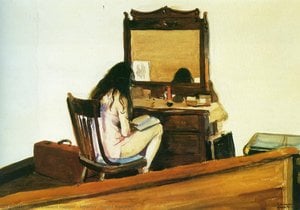
Edward Hopper's “Gloucester Mansion,” completed in 1924, stands as a quintessential example of American Realism—a genre that sought to depict the everyday realities of life with unflinching honesty and subtle psychological insight. More than just a depiction of buildings; it’s a meditation on solitude, memory, and the quiet dignity of rural America during the early years of the 20th century.
Painted during Hopper’s formative years as an artist, “Gloucester Mansion” reflects the broader artistic currents of its time—particularly the influence of Symbolism and Expressionism. Hopper was deeply affected by writers like Ernest Hemingway and Marcel Proust, whose explorations of consciousness and memory resonated with his own artistic sensibilities. The painting's quiet contemplation aligns perfectly with the prevailing mood of disillusionment that characterized the post-war period.
The painting’s composition is carefully constructed to evoke a specific emotional response. The central house dominates the frame, positioned against a backdrop of muted greens and blues—colors chosen to reinforce the sense of serenity and isolation. Notice how Hopper utilizes atmospheric perspective—reducing detail in distant objects to create depth and suggesting an expansive horizon. The subtle highlights on the rooftops illuminate the buildings, casting shadows that deepen the mood.
"Gloucester Mansion" continues to captivate viewers with its understated beauty and profound psychological depth. It speaks to a universal yearning for connection amidst the complexities of modern life—a theme that remains powerfully relevant today. Hopper’s masterful rendering of light, shadow, and texture elevates this seemingly simple scene into an enduring emblem of American artistic heritage.
"Gloucester Mansion" has an augmented reality preview: the artwork's AR Preview page shows it in your own space on a compatible device.
"Gloucester Mansion" was created in 1924 as a work of the Contemporary Realism movement. Date and movement anchor the artwork in art history.
The copyright answer for "Gloucester Mansion" by Edward Hopper: the work is still protected by copyright. This determines whether reproductions of the image may be freely made.


1931 - 1967 , United States of America

Explore the captivating world of watercolor painting! Discover its rich history, essential techniques, influential artists & collecting tips from art experts. A comprehensive guide for enthusiasts.

Journey through 10 legendary watercolor masterpieces by Sargent, Turner & Homer! Explore iconic landscapes, portraits & floral art that redefined history. Find museum-quality reproductions and curated decor ideas at WahooArt.com.

Explore 10 defining American Realism masterpieces – Hopper, Homer & more. Discover the stories behind these iconic paintings and bring timeless art to your home with WahooArt's museum-quality reproductions. Explore the full collection online.

Explore 25 iconic Edward Hopper paintings & their stories. Discover American realism, urban loneliness, and timeless beauty through his masterpieces. Find museum-quality art reproductions & curated decor ideas at WahooArt.com.

Explore the captivating world of watercolor painting! Discover its rich history, essential techniques, influential artists & collecting tips. A comprehensive guide for art enthusiasts from WahooArt.

 Preview
 Send
Send Share
Share
 Details
 Guide
Guide

 Download
 Similars
 X-Ray
X-Ray Diaporama
 Stats
Stats Read More









 Glass option is only available in size under 110 CM