Preview AR preview Buy Hand Made Painting Switch to Digital Image Send
Details Guide Add to favorites Download Similars X-Ray Diaporama Stats

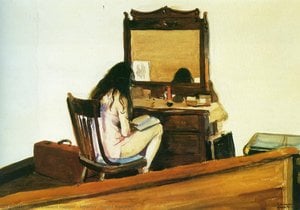
From Williamsburg Bridge

Hopper's 'From Williamsburg Bridge' captures urban solitude with austere buildings & a lone figure. A poignant glimpse into early 20th-century city life.

Edward Hopper: A master of American realism, capturing solitude and urban life with evocative light & shadow. Explore his iconic paintings like Nighthawks and Monhegan Houses.

The artwork displayed on this page is protected by copyright law, which means we cannot legally create or sell an identical reproduction. This protection is enforced under international agreements such as the Berne Convention and by national laws, including those outlined by the U.S. Copyright Law - Title 17.

This method fully complies with copyright regulations because it does not involve copying or duplicating the protected artwork. Instead, it is a creative reinterpretation - a new painting that is influenced by the original but not identical to it.

Giclée / Art Print

Museum-quality giclée or canvas print with fast production and flexible finish options. ( Buy Hand Made Painting Switch to Digital Image)

Corner sample of the P118B picture frame: moulded polystyrene, 5 cm wide and 3 cm thick
P118B $10
Corner sample of the P118H picture frame: moulded polystyrene, 5 cm wide and 3 cm thick
P118H $10
Corner sample of the P118W picture frame: moulded polystyrene, 5 cm wide and 3 cm thick
P118W $10
Corner sample of the P438Z picture frame: moulded polystyrene, 5.5 cm wide and 3.5 cm thick
P438Z $10
Corner sample of the P508JH picture frame: moulded polystyrene, 7 cm wide and 3.5 cm thick
P508JH $12
Corner sample of the P508YH picture frame: moulded polystyrene, 7 cm wide and 3.5 cm thick
P508YH $12
Corner sample of the P805H picture frame: moulded polystyrene, 5 cm wide and 3.5 cm thick
P805H $10
Corner sample of the P805Z picture frame: moulded polystyrene, 5 cm wide and 3.5 cm thick
P805Z $10
Corner sample of the P919BZ picture frame: moulded polystyrene, 7 cm wide and 3.5 cm thick
P919BZ $10
Corner sample of the P919G picture frame: moulded polystyrene, 7 cm wide and 3.5 cm thick
P919G $10
Corner sample of the P919XJ picture frame: moulded polystyrene, 7 cm wide and 3.5 cm thick
P919XJ $10
Corner sample of the P959ZH picture frame: moulded polystyrene, 5 cm wide and 3 cm thick
P959ZH $10
Corner sample of the P968JZ picture frame: moulded polystyrene, 6 cm wide and 4 cm thick
P968JZ $12
Corner sample of the W106C picture frame: solid wood, 5 cm wide and 3 cm thick
W106C $8
Corner sample of the W218G picture frame: solid wood, 5 cm wide and 3 cm thick
W218G $10
Corner sample of the W218JH picture frame: solid wood, 5 cm wide and 3 cm thick
W218JH $8
Corner sample of the W218Y picture frame: solid wood, 5 cm wide and 3 cm thick
W218Y $10
Corner sample of the W307PJ picture frame: solid wood, 6 cm wide and 3 cm thick
W307PJ $10
Corner sample of the W316G picture frame: solid wood, 6 cm wide and 3 cm thick
W316G $10
Corner sample of the W316PJ picture frame: solid wood, 6 cm wide and 3 cm thick
W316PJ $8
Corner sample of the W316Y picture frame: solid wood, 6 cm wide and 3 cm thick
W316Y $10
Corner sample of the W398PJ picture frame: solid wood, 5 cm wide and 3 cm thick
W398PJ $8
Corner sample of the W4111J picture frame: solid wood, 6.5 cm wide and 3.5 cm thick
W4111J $10
Corner sample of the W500HY picture frame: solid wood, 7 cm wide and 5 cm thick
W500HY $15
Corner sample of the W500JH picture frame: solid wood, 7 cm wide and 5 cm thick
W500JH $15
Corner sample of the W692G picture frame: solid wood, 8 cm wide and 4 cm thick
W692G $12
Corner sample of the W849H picture frame: solid wood, 5 cm wide and 3 cm thick
W849H $8
Corner sample of the W940BG picture frame: solid wood, 7.5 cm wide and 4.5 cm thick
W940BG $15
Corner sample of the W953PJ picture frame: solid wood, 6 cm wide and 3.5 cm thick
W953PJ $8

Standard
custom
CM
INCH

Pick from our preset sizes that match the artwork's original proportions.

width
height

Type the width and the height you need, to fit your frame or your wall. A print can only be cut, never made bigger than the picture, so a size with a different shape loses a part of the image. We send you a digital mockup to approve before we print anything. The picture shown on this page does not show the real cut — only the mockup does.

Worldwide Delivery () in 2 weeks instead of standard 4/5 weeks. (22 October)

Free Worldwide Express Shipping
High-Quality Linen Canvas
Full Shipping Insurance
Customs Tax Refund Guarantee
True Color Matching Guarantee
100-Day Return Policy (Defects Only)
100% Money-Back Guarantee
Bulk Discount Offer

Total Price

$ 69

From Williamsburg Bridge

Giclée / Art Print

Reproduction Size

-

Total Price

$ 69

Quick Facts

  • Artistic style: Realism/Photorealism
  • Medium: Oil on canvas
  • Year: 1928
  • Influences:
    • Édouard Manet
    • Edgar Degas
  • Subject or theme: Urban life, alienation

Art Quiz

There is only one correct answer for each question.

Question 1:
What is the primary subject depicted in Edward Hopper’s ‘From Williamsburg Bridge’?
Question 2:
What is notable about the atmosphere created in this painting?
Question 3:
Approximately when was ‘From Williamsburg Bridge’ completed?
Question 4:
What artistic style best aligns with the painting's realistic depiction of its subject matter?
Question 5:
How does Hopper utilize the bridge itself in the composition?

Edward Hopper's "From Williamsburg Bridge": An Urban Vista of Solitude

  • Overview: Edward Hopper’s “From Williamsburg Bridge,” painted in 1928, is a poignant oil painting that captures the essence of urban life and solitude. It depicts a row of brownstone apartment buildings viewed from the vantage point of the Williamsburg Bridge, with a single figure – a woman—isolated in a top-floor window. The artwork exemplifies Hopper’s signature style of American Realism, characterized by its stark realism, quiet observation, and exploration of themes like alienation and anonymity within the modern city.

Visual Description and Technique

  • Composition: The painting is horizontally oriented, emphasizing the linear arrangement of the buildings. Hopper employs a slightly elevated perspective, providing a street-level view with depth created by receding rows of windows and architectural details. The Williamsburg Bridge itself is subtly indicated by an unobtrusive railing along the bottom edge, minimizing its prominence compared to the urban landscape.
  • Color Palette: A muted and nostalgic atmosphere pervades the scene thanks to a predominantly earthy color palette—browns, reds, and creams dominate. This subdued coloration contributes to the painting's overall sense of quiet observation and melancholy.
  • Style & Technique: Hopper’s style aligns with Realism or Photorealism, aiming for a faithful representation of the subject matter. He skillfully layers oil paint to build up color and form, creating subtle gradations in tone. Precise lines define building facades, window frames, and rooflines, while geometric shapes reflect the architectural forms of the brownstones. The brushstrokes suggest rough surfaces like brick and stone, adding texture to the canvas.

Historical Context and Hopper's Vision

  • The Williamsburg Bridge: Completed in 1903, the Williamsburg Bridge connected Brooklyn with Manhattan. Rather than focusing on the bridge’s function as a conduit for movement, Hopper uses it as a backdrop to explore the human condition within the urban environment.
  • Urban Alienation: Painted during the interwar period, "From Williamsburg Bridge" reflects the growing sense of alienation and anonymity experienced by individuals in rapidly expanding cities. The single figure in the window serves as a powerful symbol of isolation amidst the bustling metropolis.
  • Hopper's Influences: Hopper was deeply influenced by writers like Ralph Waldo Emerson, which instilled in him a sense of individualism and observation. He also admired French Impressionists such as Édouard Manet and Edgar Degas, though his style diverged significantly towards a more stark and realistic portrayal of American life.

Symbolism and Emotional Impact

  • The Woman in the Window: The solitary woman is arguably the most compelling element of the painting. She represents introspection, loneliness, and perhaps a quiet yearning for connection within the impersonal urban landscape.
  • Architectural Repetition: The repetitive structure of the buildings suggests stability and order but also hints at monotony and uniformity—a recurring theme in Hopper’s work.
  • Overall Mood: "From Williamsburg Bridge" evokes a sense of quiet contemplation, nostalgia, and perhaps a touch of melancholy. It invites viewers to reflect on the complexities of urban life and the human desire for connection in an increasingly impersonal world.

Questions & Answers

Is "From Williamsburg Bridge" by Edward Hopper a painting, a drawing or a print?

"From Williamsburg Bridge" is a wall art piece.

From which era does "From Williamsburg Bridge" date?

"From Williamsburg Bridge" by Edward Hopper dates from the Modern period. The period gives the historical context of the work.

Who created "From Williamsburg Bridge"?

"From Williamsburg Bridge" was created by Edward Hopper. The information on this page describes Edward Hopper's original work.


Artist Biography

A Solitude Observed: The Life and Art of Edward Hopper

Edward Hopper, a name inextricably linked to the quietude and subtle melancholy that permeated 20th-century American life, wasn’t simply a painter of scenes; he was a poet of light and shadow, a chronicler of modern isolation. Born in Nyack, New York, in 1882, to middle-class parents of Dutch ancestry, Hopper's early years provided a stable upbringing that nurtured his artistic inclinations. From childhood sketches meticulously dated and signed, it became evident that keen observation and an innate talent for drawing were central to his being. Though initially encouraged towards commercial illustration – a pragmatic suggestion from his parents – Hopper’s ambitions leaned toward fine art, leading him to the New York School of Art where he studied under William Merritt Chase and Robert Henri. These formative years instilled not only technical skill but also an appreciation for realism and a commitment to depicting the world as he saw it—unvarnished and honest. The writings of Ralph Waldo Emerson resonated deeply with Hopper, reinforcing his sense of individualism and acute observation – qualities that would become hallmarks of his artistic vision. Early travels to Paris exposed him to Impressionism, yet Hopper quickly diverged from its fleeting brushstrokes, forging a path uniquely his own.

Finding His Voice: Realism and the American Scene

Hopper’s artistic journey wasn't immediate or effortless. He grappled with discovering his distinctive voice, experimenting with various styles before settling into the realism that would define his career. This wasn’t mere replication of reality; it was a distillation of its essence, stripping away extraneous detail to reveal underlying emotional truths. His paintings began to focus on everyday scenes – houses, diners, offices, hotel rooms – imbued with a sense of stillness and often, loneliness. He possessed an extraordinary ability to capture the psychological states of his subjects, hinting at narratives without explicitly stating them. The precise rendering of light and shadow became crucial, not merely as descriptive elements but as emotional cues, creating atmospheres that were both captivating and unsettling. House by the Railroad (1925), an early masterpiece, exemplifies this approach—a seemingly simple composition radiating a profound sense of isolation and mystery. Hopper’s printmaking, often overlooked, ran parallel to his painting, sharing similar themes and stylistic qualities, demonstrating his mastery across mediums. He wasn't interested in grand historical narratives or allegorical symbolism; he focused on the mundane, elevating it through careful observation and emotional resonance.

Iconic Visions: Nighthawks and Beyond

While Hopper’s career unfolded gradually, certain works catapulted him to widespread recognition. Nighthawks (1942), arguably his most famous painting, became an instant icon of American culture. The late-night diner scene, bathed in stark fluorescent light, perfectly encapsulates the alienation and anonymity of modern urban life. The figures within are lost in their own thoughts, disconnected from one another despite their proximity—a poignant commentary on the human condition. Gas (1940), with its striking portrayal of a roadside gas station, showcases Hopper’s fascination with American landscapes and the burgeoning automobile culture. Other notable works like *Automat*, *Office in a Small City*, and *Summertime* each offer unique insights into the complexities of 20th-century American society. These paintings weren't merely depictions of places; they were explorations of mood, psychology, and the subtle dramas unfolding within ordinary settings. His wife, Josephine Nivison Hopper, played a vital role not only as his lifelong companion but also as a frequent model, contributing significantly to the characterization of his female figures.

Themes and Legacy: A Lasting Influence

Several recurring themes permeate Hopper’s oeuvre. Urban isolation is perhaps the most prominent—the sense of loneliness experienced by individuals even amidst crowds. He explored the American landscape, both rural and urban, often emphasizing its starkness and emptiness. His work delves into psychological realism, probing the inner lives of his subjects with a sensitivity that transcends mere representation. There’s also an undercurrent of nostalgia for a simpler past, juxtaposed with an acknowledgement of the complexities and anxieties of modern life. Hopper's influence on subsequent artists is undeniable. His unique style has inspired countless painters, including Pierre Sanford Ross, and continues to resonate with contemporary artists seeking to capture the essence of human experience. His paintings remain highly sought after by collectors and are exhibited in major museums worldwide, solidifying his place as a pivotal figure in American art history. More than just an artist, Edward Hopper was a visual philosopher, offering profound insights into the human condition through his masterful use of light, shadow, and composition.
  • His legacy lies not only in the beauty of his paintings but also in their enduring ability to provoke thought, evoke emotion, and remind us of the quiet solitude that often defines our lives.
  • Hopper’s work continues to captivate audiences because it speaks to universal themes of loneliness, isolation, and the search for meaning in a rapidly changing world.
  • His paintings have become iconic representations of American culture, often used to symbolize the anxieties and aspirations of the 20th century—and beyond.
  • Hopper’s aesthetic has profoundly influenced filmmakers (like Alfred Hitchcock) and writers, inspiring countless works that explore similar themes of alienation and psychological tension.
Edward Hopper's ability to capture the essence of modern American life with honesty, sensitivity, and a distinctive artistic vision ensures his place as one of the most important artists of the 20th century.
Edward Hopper

Edward Hopper

1931 - 1967 , United States of America

Quick Facts

  • Artistic Movement Or Style: American Realism
  • Artists Or Movements Influenced By This Artist: ['Pierre Sanford Ross']
  • Artists Who Influenced This Artist:
    • William Merritt Chase
    • Robert Henri
    • Degas
    • Manet
  • Full Name: Edward Hopper
  • Nationality: American
  • Notable Artworks:
    • Nighthawks
    • Gas
    • House by the Railroad
    • City Sunlight
  • Place Of Birth: Upper Nyack, United States of America
  • Date Of Birth: 1931
  • Date Of Death: 1967
Explore artworks organized by themes, styles, and characteristics.