The artwork displayed on this page is protected by copyright law, which means we cannot legally create or sell an identical reproduction. This protection is enforced under international agreements such as the Berne Convention and by national laws, including those outlined by the U.S. Copyright Law - Title 17.
This method fully complies with copyright regulations because it does not involve copying or duplicating the protected artwork. Instead, it is a creative reinterpretation - a new painting that is influenced by the original but not identical to it.
Museum-quality giclée or canvas print with fast production and flexible finish options. ( Buy Hand Made Painting Switch to Digital Image)





























Pick from our preset sizes that match the artwork's original proportions.

Type the width and the height you need, to fit your frame or your wall. A print can only be cut, never made bigger than the picture, so a size with a different shape loses a part of the image. We send you a digital mockup to approve before we print anything. The picture shown on this page does not show the real cut — only the mockup does.
Worldwide Delivery () in 2 weeks instead of standard 4/5 weeks. (28 October)
Four Lane Road
Reproduction Size
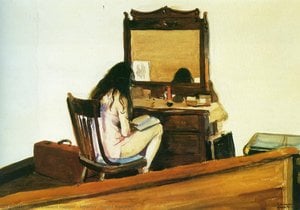
Edward Hopper's "Four Lane Road," painted in 1956, isn’t merely a depiction of a roadside scene; it’s a distilled essence of the American experience – a poignant meditation on solitude, isolation, and the quiet dignity of everyday life. The painting immediately draws the viewer into a meticulously rendered tableau: a sparsely populated rural landscape dominated by a weathered gas station and two figures caught in moments of detached contemplation. Hopper masterfully employs horizontal lines—the road stretching endlessly towards the horizon, the starkly defined roofline of the building—to create a sense of stillness and expanse, mirroring the emotional quietude at the heart of the work.
The composition is deceptively simple yet profoundly effective. A man sits alone on a bench outside the gas station, his posture suggesting a deep introspection or perhaps a weary acceptance of circumstance. His gaze is directed towards an unseen point in the distance, while a woman stands behind the counter within the building, equally solitary and lost in her own thoughts. Hopper’s use of light is crucial to this effect; it's diffused and atmospheric, casting long shadows that emphasize the figures’ isolation and creating a subtly melancholic mood. The muted color palette—primarily blues, greens, and browns—further contributes to the painting’s somber tone, evoking the feeling of a late afternoon in a small American town.
Hopper's style is often categorized as “American Realism,” but it transcends simple representation. He wasn’t interested in merely depicting what he saw; instead, he sought to capture the *feeling* of a place and its inhabitants. This is evident in his meticulous attention to detail—the worn texture of the gas station building, the subtle variations in the pavement, the precise rendering of the figures' faces—combined with an intuitive understanding of how light and shadow can shape perception. Hopper’s work frequently explores themes of urban alienation and the disconnect between individuals within a rapidly changing society.
The painting’s roots lie firmly in Hopper’s personal experiences and observations of American life, particularly his time spent in New York City and later on Cape Cod. He was fascinated by the rhythms of everyday existence—the solitary figures going about their routines, the quiet moments of reflection, the sense of detachment that could permeate even the most familiar surroundings. “Four Lane Road” embodies this fascination, offering a glimpse into a world where connection seems elusive and loneliness is a pervasive presence.
While seemingly straightforward, "Four Lane Road" is rich in symbolic meaning. The gas station itself represents a point of transition—a place where travelers pause to refuel both their vehicles and their spirits. The figures’ isolation speaks to the broader theme of alienation in modern society, suggesting a sense of disconnection from community and a yearning for something more. The road stretching into the distance symbolizes the journey of life, with its inherent uncertainties and challenges.
The painting's narrative is deliberately ambiguous, inviting viewers to project their own interpretations onto the scene. Who are these figures? What are they thinking about? What lies ahead for them? Hopper intentionally avoids providing definitive answers, allowing the viewer to engage in a dialogue with the artwork and draw their own conclusions. The lack of overt drama or conflict contributes to the painting’s enduring power—it's a quiet, understated portrait of human experience that resonates deeply with viewers on an emotional level.
"Four Lane Road" remains one of Edward Hopper’s most iconic works, celebrated for its evocative atmosphere and profound insights into the American psyche. Its influence can be seen in countless subsequent paintings and films that explore themes of loneliness, isolation, and the complexities of modern life. Reproductions of this masterpiece offer a remarkable opportunity to bring Hopper's vision into your home or office, adding a touch of understated elegance and emotional depth to any space.
Consider commissioning a high-quality hand-painted reproduction from WahooArt.com – a faithful recreation that captures the nuances of Hopper’s original technique and color palette. It’s more than just a print; it's a tangible connection to one of America’s greatest artists, allowing you to experience the enduring power of “Four Lane Road” for years to come.
"Four Lane Road" by Edward Hopper conveys a melancholic feeling within an overall calm mood.
"Four Lane Road" by Edward Hopper combines the oil technique with the Contemporary Realism style. Technique and movement describe the making and the style of the work.
"Four Lane Road" by Edward Hopper is still protected by copyright. Copyright terms are measured from the artist's death, and Edward Hopper died in 1967.


1931 - 1967 , United States of America

Explore the profound beauty of American Realism. From Winslow Homer’s rural landscapes to the dignity of everyday life, discover how master artists captured the soul of a nation through evocative oil paintings and timeless fine art techniques.

 Preview
 Send
Send Share
Share
 Details
 Guide
Guide

 Download
 Similars
 X-Ray
X-Ray Diaporama
 Q&A
Q&A Stats
Stats
 Read More









 Glass option is only available in size under 110 CM