The artwork displayed on this page is protected by copyright law, which means we cannot legally create or sell an identical reproduction. This protection is enforced under international agreements such as the Berne Convention and by national laws, including those outlined by the U.S. Copyright Law - Title 17.
This method fully complies with copyright regulations because it does not involve copying or duplicating the protected artwork. Instead, it is a creative reinterpretation - a new painting that is influenced by the original but not identical to it.
Museum-quality giclée or canvas print with fast production and flexible finish options. ( Buy Hand Made Painting Switch to Digital Image)





























Pick from our preset sizes that match the artwork's original proportions.

Type the width and the height you need, to fit your frame or your wall. A print can only be cut, never made bigger than the picture, so a size with a different shape loses a part of the image. We send you a digital mockup to approve before we print anything. The picture shown on this page does not show the real cut — only the mockup does.
Worldwide Delivery () in 2 weeks instead of standard 4/5 weeks. (25 October)
Eleven AM
Reproduction Size
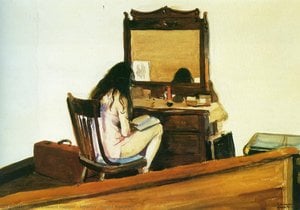
Edward Hopper, a master of American realism, possessed an uncanny ability to distill the essence of modern life – its quiet desperation, its pervasive loneliness, and its fleeting moments of beauty – onto canvas. “Eleven A.M.”, painted in 1926, is a particularly poignant example of this skill. The painting depicts a solitary woman seated by a window, bathed in a soft yet revealing light that seems to simultaneously illuminate and isolate her. It’s not a scene of dramatic action, but rather one of profound stillness, inviting the viewer into an intimate contemplation of interiority and the human condition.
The composition is deceptively simple: a woman in a blue armchair, positioned near a window that offers a glimpse of the world outside. However, it’s within this simplicity that Hopper's genius resides. The room itself is modestly furnished – a dresser, a framed picture, and a lamp all contribute to a sense of everyday life, yet they also underscore the woman’s isolation. She isn’t actively engaged with her surroundings; instead, she appears lost in thought, her gaze directed outwards but seemingly unfocused. The careful arrangement of objects within the room doesn't feel cluttered or busy, but rather deliberately sparse, emphasizing the emptiness that surrounds the figure. Hopper masterfully uses light and shadow to sculpt the form of the woman and define the space around her, creating a dramatic contrast that draws the eye and heightens the emotional impact.
Hopper's technique in “Eleven A.M.” is characterized by a meticulous attention to detail and a masterful command of oil paint. His brushstrokes are relatively smooth, creating a realistic depiction of form and texture. The light streaming through the window isn’t merely illumination; it’s a character in itself, shaping the mood and revealing subtle nuances of emotion. Notice how the light catches on the woman's skin, highlighting her vulnerability, while simultaneously casting deep shadows that suggest a sense of melancholy or introspection. The color palette is restrained – blues, browns, and muted reds dominate the scene – further contributing to the painting’s somber atmosphere. This isn’t a vibrant, celebratory depiction of life; it’s a quiet, introspective study of human emotion.
To understand “Eleven A.M.” fully, it's essential to consider the historical context in which it was created. The 1920s were a period of rapid social change in America – urbanization, industrialization, and shifting societal norms all contributed to a sense of alienation and disillusionment. Hopper’s work often reflects these anxieties, capturing the loneliness and isolation that many people experienced in the modern world. The window in “Eleven A.M.” is particularly symbolic; it represents a connection to the outside world, yet the woman's position within the room suggests a barrier between her and that world. She is both present and absent, connected and disconnected. The painting invites us to consider the complexities of human experience – our longing for connection, our fear of isolation, and our search for meaning in a rapidly changing world.
Hopper’s artistic influences are also apparent in “Eleven A.M.” While he developed his own unique style, he was deeply influenced by French Impressionists like Édouard Manet and Edgar Degas, as well as American artists such as Robert Henri. Like these predecessors, Hopper sought to capture the realities of modern life with honesty and sensitivity. However, he went beyond mere representation; he imbued his paintings with a psychological depth that resonated with viewers on an emotional level. “Eleven A.M.” is not simply a depiction of a woman in a room; it’s a powerful exploration of the human condition – a timeless meditation on solitude, introspection, and the search for meaning.
The color that stands out most in "Eleven AM" is phthalo green (#252324). The dominant color is useful when matching an artwork to an interior.
The calm atmosphere of "Eleven AM" by Edward Hopper matches its recommended space: a living room.
The diaporama of "Eleven AM" can be watched on the artwork's Diaporama page.

1931 - 1967 , United States of America

Explore the profound beauty of American Realism. From Winslow Homer’s rural landscapes to the dignity of everyday life, discover how master artists captured the soul of a nation through evocative oil paintings and timeless fine art techniques.

 Preview
 Send
Send Share
Share
 Details
 Guide
Guide

 Download
 Similars
 X-Ray
X-Ray Diaporama
 Stats
Stats

 Read More









 Glass option is only available in size under 110 CM