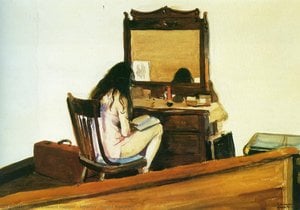
el palacio (1946) by Edward Hopper, hand-painted oil painting reproduction by a master artist
Preview AR preview Switch to Print Switch to Digital Image Send
Details Guide Add to favorites Download Similars X-Ray Diaporama Q&A Presentation Stats

el palacio Hand-painted oil painting reproduction

Edward Hopper's "El Palacio" captures urban solitude with striking realism—a black-and-white depiction of a city street, evoking quiet contemplation and the essence of American modern life.

A master of American realism, he captured solitude in Nighthawks. Discover his iconic paintings and evocative light and shadow today.

The artwork displayed on this page is protected by copyright law, which means we cannot legally create or sell an identical reproduction. This protection is enforced under international agreements such as the Berne Convention and by national laws, including those outlined by the U.S. Copyright Law - Title 17.

As a respectful and legal alternative, we offer custom, hand-painted artworks inspired by the original. Our skilled and professional artists carefully study the original's style, mood, and artistic essence to create a new, unique piece that evokes the same feeling - while remaining an original creation in its own right.

This method fully complies with copyright regulations because it does not involve copying or duplicating the protected artwork. Instead, it is a creative reinterpretation - a new painting that is influenced by the original but not identical to it.

Hand Made Oil Reproduction

Hand-painted oil on canvas in your size and frame, made to order by our artists. ( Switch to Print Switch to Digital Image)

Corner sample of the P118B picture frame: moulded polystyrene, 5 cm wide and 3 cm thick
P118B $10
Corner sample of the P118H picture frame: moulded polystyrene, 5 cm wide and 3 cm thick
P118H $10
Corner sample of the P118W picture frame: moulded polystyrene, 5 cm wide and 3 cm thick
P118W $10
Corner sample of the P438Z picture frame: moulded polystyrene, 5.5 cm wide and 3.5 cm thick
P438Z $10
Corner sample of the P508JH picture frame: moulded polystyrene, 7 cm wide and 3.5 cm thick
P508JH $12
Corner sample of the P508YH picture frame: moulded polystyrene, 7 cm wide and 3.5 cm thick
P508YH $12
Corner sample of the P805H picture frame: moulded polystyrene, 5 cm wide and 3.5 cm thick
P805H $10
Corner sample of the P805Z picture frame: moulded polystyrene, 5 cm wide and 3.5 cm thick
P805Z $10
Corner sample of the P919BZ picture frame: moulded polystyrene, 7 cm wide and 3.5 cm thick
P919BZ $10
Corner sample of the P919G picture frame: moulded polystyrene, 7 cm wide and 3.5 cm thick
P919G $10
Corner sample of the P919XJ picture frame: moulded polystyrene, 7 cm wide and 3.5 cm thick
P919XJ $10
Corner sample of the P959ZH picture frame: moulded polystyrene, 5 cm wide and 3 cm thick
P959ZH $10
Corner sample of the P968JZ picture frame: moulded polystyrene, 6 cm wide and 4 cm thick
P968JZ $12
Corner sample of the W106C picture frame: solid wood, 5 cm wide and 3 cm thick
W106C $8
Corner sample of the W218G picture frame: solid wood, 5 cm wide and 3 cm thick
W218G $10
Corner sample of the W218JH picture frame: solid wood, 5 cm wide and 3 cm thick
W218JH $8
Corner sample of the W218Y picture frame: solid wood, 5 cm wide and 3 cm thick
W218Y $10
Corner sample of the W307PJ picture frame: solid wood, 6 cm wide and 3 cm thick
W307PJ $10
Corner sample of the W316G picture frame: solid wood, 6 cm wide and 3 cm thick
W316G $10
Corner sample of the W316PJ picture frame: solid wood, 6 cm wide and 3 cm thick
W316PJ $8
Corner sample of the W316Y picture frame: solid wood, 6 cm wide and 3 cm thick
W316Y $10
Corner sample of the W398PJ picture frame: solid wood, 5 cm wide and 3 cm thick
W398PJ $8
Corner sample of the W4111J picture frame: solid wood, 6.5 cm wide and 3.5 cm thick
W4111J $10
Corner sample of the W500HY picture frame: solid wood, 7 cm wide and 5 cm thick
W500HY $15
Corner sample of the W500JH picture frame: solid wood, 7 cm wide and 5 cm thick
W500JH $15
Corner sample of the W692G picture frame: solid wood, 8 cm wide and 4 cm thick
W692G $12
Corner sample of the W849H picture frame: solid wood, 5 cm wide and 3 cm thick
W849H $8
Corner sample of the W940BG picture frame: solid wood, 7.5 cm wide and 4.5 cm thick
W940BG $15
Corner sample of the W953PJ picture frame: solid wood, 6 cm wide and 3.5 cm thick
W953PJ $8

Standard
custom
CM
INCH

Pick from our preset sizes that match the artwork's original proportions.

width
height

Type the width and the height you need, to fit your frame or your wall. This is hand-painted, so for a size with a different shape the artist can paint a bit more around the picture, or cut a bit — you choose. We send you a digital mockup to approve before the painting starts. The picture shown on this page does not show the real result — only the mockup does.

Examples of what can be changed: Replace face with customer photo; Add pet (e.g., replace cat with dog); Include hidden message in background; Change background landscape or elements.
After order, WahooArt.com team will email client for instructions and provide a mockup preview

Worldwide Delivery () in 3/4 weeks instead of standard 5 weeks. (9 November). No compromise on quality.

Free Worldwide Express Shipping
High-Quality Linen Canvas
Full Shipping Insurance
Customs Tax Refund Guarantee
True Color Matching Guarantee
100-Day Return Policy (Defects Only)
100% Money-Back Guarantee
Bulk Discount Offer

Total Price

$ 272

el palacio

Reproduction Medium

Reproduction Size

-

Total Price

$ 272

Quick Facts

  • Notable elements: Signs, urban street
  • Year: 1946
  • Medium: Oil on canvas
  • Style: Urban realism
  • Influences: Hemingway

Art Quiz

There is only one correct answer for each question.

Question 1:
What is the primary subject depicted in Edward Hopper’s ‘El Palacio’?
Question 2:
The painting ‘El Palacio’ was created in which year?
Question 3:
What is prominently displayed on one of the signs visible in ‘El Palacio’?
Question 4:
Edward Hopper is most known for his paintings that capture which theme?
Question 5:
Based on the image description, what is the overall atmosphere conveyed by ‘El Palacio’?

A Silent Cityscape: Unveiling Edward Hopper's "El Palacio"

Edward Hopper’s 1946 painting, “El Palacio,” isn’t merely a depiction of a city street; it’s a carefully constructed tableau of urban solitude and the quiet anxieties of modern life. Rendered in stark black and white, the image immediately draws the viewer into a scene brimming with understated tension. The composition is dominated by towering buildings on either side, their windows like watchful eyes observing the few figures that populate the street below. The painting’s power lies not in dramatic action or vibrant color—rather, it resides in the subtle details and the palpable sense of detachment that permeates every element.

Hopper masterfully employs light and shadow to create a mood of melancholic introspection. The strong directional lighting emphasizes the textures of the buildings and casts deep shadows, contributing to the painting’s overall feeling of confinement. The open windows invite glimpses into private lives, yet they simultaneously reinforce the sense that these individuals are isolated within their own worlds. The signs visible in the scene—including the prominent “El Palacio”—add a layer of mystery, hinting at a grand establishment and perhaps suggesting a world beyond the immediate view.

The Painter’s Palette: Technique and Style

“El Palacio” exemplifies Hopper's signature style – a blend of realism and psychological insight. He was known for his ability to capture fleeting moments of human experience, often focusing on scenes of loneliness or alienation. Hopper’s technique is characterized by precise observation and meticulous detail. The buildings are rendered with remarkable accuracy, capturing their architectural forms and the subtle variations in surface texture. His use of line is particularly noteworthy; he employs clean, confident lines to define shapes and create a sense of solidity, while simultaneously suggesting movement through the arrangement of elements within the composition.

The painting’s monochromatic palette—a deliberate choice by Hopper—heightens its emotional impact. The absence of color forces the viewer to focus on form, light, and shadow, intensifying the feeling of isolation and emphasizing the starkness of the urban environment. Hopper's approach was rooted in a desire to represent reality as he perceived it, unburdened by sentimentality or romanticism. He sought to capture the essence of American life—its beauty, its challenges, and its inherent loneliness—with unflinching honesty.

Historical Context: The Post-War Landscape

“El Palacio” was created in 1946, a period marked by significant social and cultural shifts following World War II. America was grappling with the aftermath of conflict, experiencing rapid urbanization, and confronting new anxieties about identity and purpose. Hopper’s work resonated deeply with this mood, reflecting the growing sense of alienation and disillusionment that characterized the post-war era. The painting can be seen as a commentary on the changing nature of American society—a world increasingly defined by anonymity, isolation, and the breakdown of traditional social structures.

Interestingly, Hopper himself described the scene as “suggested by a restaurant on Greenwich Avenue where two streets meet.” This anecdote reveals his meticulous approach to composition and his desire to capture not just a literal representation but also an emotional truth. The painting’s enduring appeal lies in its ability to evoke a sense of familiarity—a recognition of the quiet, often overlooked moments that shape our lives.

Symbolism and Emotional Resonance

Beyond its realistic depiction of a city street, “El Palacio” is rich in symbolic meaning. The towering buildings represent the impersonal forces of urban life, while the open windows symbolize both opportunity and isolation. The figures within the scene—their faces obscured by shadow—suggest a sense of anonymity and detachment. Hopper’s masterful use of light and shadow creates a powerful emotional atmosphere, evoking feelings of loneliness, longing, and perhaps even a touch of melancholy.

Ultimately, “El Palacio” is a poignant meditation on the human condition – a reminder that even in the midst of bustling urban environments, we can still experience profound solitude. It’s a painting that invites contemplation and encourages us to consider our own place within the larger narrative of American life.

Questions & Answers

What technique was used for "el palacio", and when was it created?

"el palacio" was made in 1946, in acrylic on canvas.

What does the 1946 date of "el palacio" correspond to in Edward Hopper's career?

Given its 1946 date, "el palacio" falls in Edward Hopper's Mature Period.

What is the color identity of "el palacio" by Edward Hopper?

The color identity of "el palacio" by Edward Hopper: a neutrals palette, dominated by gray (#89907f).


Artist Biography

The Quietude of the American Scene

Edward Hopper was born in Upper Nyack, United States of America. His early years were spent observing the world with a steady eye, a habit that began with childhood sketches meticulously dated and signed. While his parents suggested a practical path in commercial illustration, his focus remained on fine art. He studied at the New York School of Art under William Merritt Chase and Robert Henri. These years taught him the technical skill required to depict the world unvarnished and honest. He did not seek the fleeting brushstrokes of the Impressionists he encountered in Paris. Instead, he developed a way of seeing that favored the stillness of a moment over the movement of a crowd.

His work often centers on the mundane. He looked at houses, diners, offices, and hotel rooms. He stripped away unnecessary details to find the underlying emotional truth of a scene. In House by the Railroad (1925), a simple composition reveals a sense of mystery and isolation. He used light and shadow not merely to describe a room, but to set a mood. The precise rendering of a shadow on a wall or the way light hits a window became his way of communicating the psychological state of his subjects.

Light and the Urban Interior

The way light enters a space is a central character in his paintings. In Nighthawks (1942), the stark fluorescent light of a late-night diner cuts through the darkness of a deserted urban street. The figures inside are physically close but appear lost in their own thoughts, disconnected from one another. This sense of anonymity in a crowded city became a recurring theme. He captured the tension of being alone in a public place, a feeling that resonates in works like Automat and Office in a Small City. He was interested in the way artificial light interacts with the natural darkness of the night.

His wife, Josephine Nivison Hopper, was a constant presence. She was a fellow artist and often served as his model. Her presence is felt in the characterization of many of his female figures. Together, they lived a modest life, often spending summers in New England, which influenced the landscapes he painted. His depictions of the American landscape, both rural and urban, often emphasize a certain starkness or emptiness. Whether it is a roadside gas station in Gas (1940) or a quiet room in a hotel, the subject is always the intersection of a physical place and a private, internal experience.

A Legacy of Observation

Hopper’s influence extends into the visual language of film and literature. His ability to create a sense of psychological tension through composition has been noted by many who study the way stories are told through images. His paintings remain in major museums worldwide, held in collections such as the Whitney Museum of American Art and the Museum of Fine Arts, Boston. He did not aim for grand historical narratives. He found his subject matter in the quiet corners of everyday life, turning a simple window or a passing stranger into a study of the human condition. His work remains a study of the silence that exists between people.

Edward Hopper

Edward Hopper

1931 - 1967 , United States of America

Quick Facts

  • Artistic Movement Or Style: American realism
  • Artists Or Movements Influenced By This Artist: ['Pierre Sanford Ross']
  • Artists Who Influenced This Artist:
    • William Merritt Chase
    • Robert Henri
    • Edgar Degas
    • Édouard Manet
  • Full Name: Edward Hopper
  • Nationality: American
  • Notable Artworks:
    • Nighthawks
    • Gas
    • House by the Railroad
    • Automat
    • Office in a Small City
    • Summertime
  • Place Of Birth: Upper Nyack, United States of America
  • Date Of Birth: 1931
  • Date Of Death: 1967
Explore artworks organized by themes, styles, and characteristics.