Giclée PrintDigitalContemporary Realism
 1922Modern
 20.0 x 24.0 cm
The artwork displayed on this page is protected by copyright law, which means we cannot legally create or sell an identical reproduction. This protection is enforced under international agreements such as the Berne Convention and by national laws, including those outlined by the U.S. Copyright Law - Title 17.
This method fully complies with copyright regulations because it does not involve copying or duplicating the protected artwork. Instead, it is a creative reinterpretation - a new painting that is influenced by the original but not identical to it.
Museum-quality giclée or canvas print with fast production and flexible finish options. ( Buy Hand Made Painting Switch to Digital Image)
Pick from our preset sizes that match the artwork's original proportions.

Type the width and the height you need, to fit your frame or your wall. A print can only be cut, never made bigger than the picture, so a size with a different shape loses a part of the image. We send you a digital mockup to approve before we print anything. The picture shown on this page does not show the real cut — only the mockup does.
Worldwide Delivery () in 2 weeks instead of standard 4/5 weeks. (25 October)
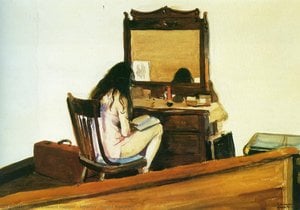
East Side Interior
Reproduction Size
Edward Hopper’s “East Side Interior,” rendered in 1922, is more than just a depiction of a room; it’s a distilled essence of American loneliness and the poignant beauty found within moments of solitary contemplation. This meticulously crafted black and white drawing captures a scene brimming with understated drama – a woman seated by a window, lost in observation, surrounded by the quiet formality of an upper-class dining space. The image immediately evokes a sense of detachment, a feeling that is central to Hopper’s enduring appeal and a hallmark of American art during the early 20th century.
Hopper's technique in “East Side Interior” is characterized by a precise realism, honed through his training under William Merritt Chase. The drawing showcases a remarkable attention to detail – the texture of the fabric on the chairs, the sheen of the vase, the subtle variations in light and shadow. This meticulous approach isn’t merely about accurate representation; it's about capturing the *essence* of the scene, imbuing it with a palpable sense of atmosphere. Hopper’s style aligns perfectly with the broader Realist movement, but he elevates it through his ability to convey complex emotional states within seemingly simple compositions.
The use of black and white further intensifies the drawing's impact, stripping away any distractions and focusing attention on form, light, and shadow. This monochrome palette contributes significantly to the artwork’s melancholic mood, a signature element of Hopper’s oeuvre.
"East Side Interior" was created during a period of significant social and cultural change in America – the rise of industrialization, urbanization, and increasing mobility. Hopper's work reflects this shift by portraying individuals grappling with feelings of alienation and displacement within modern urban environments. The dining room itself can be interpreted as a symbol of domesticity and tradition, yet the woman’s solitary presence suggests a disconnect from these values. The clock, a recurring motif in Hopper’s art, adds another layer of symbolism – a reminder of the relentless passage of time and the inevitability of mortality.
“East Side Interior” resonates with viewers precisely because it taps into universal human emotions – loneliness, contemplation, and a yearning for connection. Hopper’s ability to evoke these feelings through seemingly mundane scenes is what has cemented his place as one of America's most important artists. This drawing exemplifies the quiet power of Hopper’s vision, offering a timeless meditation on the complexities of modern life and the enduring human need for solace and understanding. Its compact size (20 x 24 cm) makes it an ideal addition to any collection or interior space, providing a constant reminder of Hopper's profound insights.
"East Side Interior" by Edward Hopper shows a monochromatic color intensity.
The color of "East Side Interior" is muted in saturation and monochromatic in intensity.
The medium of "East Side Interior" by Edward Hopper is giclée print. Reproductions aim to render the appearance of this technique.


1931 - 1967 , United States of America

Explore the profound artistry of black and white photography. From historical mastery to the interplay of light and shadow, discover how monochrome captures timeless emotion and form through a sophisticated lens of art history.

Explore the profound artistry of graphite drawing. Discover professional techniques for mastering depth, texture, and detail through a lens of art history, from classical sketches to modern masterpieces. Elevate your understanding of the pencil medium with our expert guide.

Elevate your most cherished memories with WahooArt’s bespoke service. We transform your personal photos into breathtaking, hand-painted black & white oil masterpieces. Experience museum-quality craftsmanship and timeless elegance for your private collection. Discover the art of legacy.

Elevate your artistic practice with this expert guide to mastering the line. Discover advanced techniques in graphite, charcoal, and contour drawing designed for art students seeking technical precision and expressive depth in their fine art studies.

 Send
Send Share
Share
 Details
 Guide
Guide

 Download
 Similars
 Diaporama
 Stats
Stats Read More






































 Glass option is only available in size under 110 CM