The artwork displayed on this page is protected by copyright law, which means we cannot legally create or sell an identical reproduction. This protection is enforced under international agreements such as the Berne Convention and by national laws, including those outlined by the U.S. Copyright Law - Title 17.
This method fully complies with copyright regulations because it does not involve copying or duplicating the protected artwork. Instead, it is a creative reinterpretation - a new painting that is influenced by the original but not identical to it.
Museum-quality giclée or canvas print with fast production and flexible finish options. ( Buy Hand Made Painting Switch to Digital Image)





























Pick from our preset sizes that match the artwork's original proportions.

Type the width and the height you need, to fit your frame or your wall. A print can only be cut, never made bigger than the picture, so a size with a different shape loses a part of the image. We send you a digital mockup to approve before we print anything. The picture shown on this page does not show the real cut — only the mockup does.
Worldwide Delivery () in 2 weeks instead of standard 4/5 weeks. (26 October)
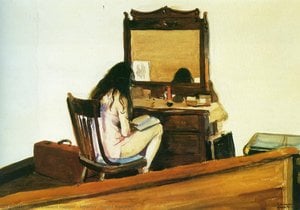
Circle Theatre
Reproduction Size
In the quiet, heavy atmosphere of Edward Hopper’s "Circle Theatre," we are invited to witness more than just a street corner in a bustling metropolis; we are invited to feel the profound weight of modern existence. Painted during a transformative era of American history, this masterpiece serves as a poignant meditation on the paradox of urban life—the way one can be surrounded by the movement of a city yet remain utterly alone. As the late afternoon light filters through the scene, it casts a diffused, almost cinematic glow over the weathered brickwork and the passing vintage automobile, creating a moment frozen in time that feels both intensely real and hauntingly dreamlike.
Hopper’s mastery of American Realism is on full display through his meticulous attention to detail and his unparalleled ability to manipulate light and shadow. Unlike the fleeting, bright impressions of the Impressionists, Hopper’s technique involves a deliberate, layered approach to oil on canvas. He renders the chrome gleam of a passing car and the stark geometry of the theater sign with such precision that the textures feel palpable to the viewer. His palette, dominated by muted yellows, deep reds, and earthy browns, does not merely decorate the scene; it builds an emotional landscape of melancholy and stillness. The way light interacts with the architectural surfaces creates a sense of depth that draws the eye into the shadows, where the true narrative of the painting resides.
To understand "Circle Theatre," one must look through the lens of the 1930s—a period defined by the Great Depression and a rapid, often disorienting shift toward urbanization. The theater itself stands as a powerful symbol of human aspiration and the desire for communal entertainment, yet in Hopper’s vision, it remains strangely vacant, a silent sentinel amidst the traffic. This disconnect between the grandeur of the urban infrastructure and the palpable emptiness within it reflects the growing anxieties of an era grappling with the impersonal nature of modern life. The presence of pedestrians and vehicles provides a rhythmic movement to the composition, yet they seem like ghosts passing through a stage, emphasizing the theme of transient connection.
For the discerning collector or interior designer, this artwork offers a sophisticated emotional anchor for any space. It is a piece that commands attention not through loud colors, but through its quiet, commanding presence. A high-quality reproduction of "Circle Theatre" brings a sense of intellectual depth and timeless elegance to a room, making it an ideal centerpiece for those who appreciate art that provokes thought and invites contemplation. Whether placed in a contemporary gallery setting or a classic study, the painting’s ability to evoke both the grandeur of the American cityscape and the intimate ache of solitude ensures its enduring relevance in the modern home.
The copyright answer for "Circle Theatre" by Edward Hopper: the work is still protected by copyright. This determines whether reproductions of the image may be freely made.
Within Edward Hopper's output, "Circle Theatre" sits in the American Realism style, alongside the themes of realist observation, modern isolation, urban atmosphere, american identity, quiet reflection.
The luminance recorded for "Circle Theatre" by Edward Hopper is gentle luminance.


1931 - 1967 , United States of America

Explore 25 iconic Edward Hopper paintings & their stories. Discover American realism, urban loneliness, and timeless beauty through his masterpieces. Find museum-quality art reproductions & curated decor ideas at WahooArt.com.

Explore the powerful social commentary & artistic representation of American Realism. Discover key artists like Bellows & Sloan, and understand the movement's lasting impact on 20th-century art history.

Explore the evolution of cityscape painting from Realism to contemporary art with WahooArt. Discover key artists & invest in timeless urban visions. Expert guidance, museum-quality reproductions.

Explore 10 defining American Realism masterpieces – Hopper, Homer & more. Discover the stories behind these iconic paintings and bring timeless art to your home with WahooArt's museum-quality reproductions. Explore the full collection online.

Explore the profound beauty of American Realism. From the Ashcan School's urban grit to intimate portraits, discover how artists captured the authentic soul of a nation through unvarnished truth and masterful observation.

 Preview
 Send
Send Share
Share
 Details
 Guide
Guide

 Download
 Similars
 X-Ray
X-Ray Diaporama
 Stats
Stats

 Read More









 Glass option is only available in size under 110 CM