The artwork displayed on this page is protected by copyright law, which means we cannot legally create or sell an identical reproduction. This protection is enforced under international agreements such as the Berne Convention and by national laws, including those outlined by the U.S. Copyright Law - Title 17.
This method fully complies with copyright regulations because it does not involve copying or duplicating the protected artwork. Instead, it is a creative reinterpretation - a new painting that is influenced by the original but not identical to it.
Museum-quality giclée or canvas print with fast production and flexible finish options. ( Buy Hand Made Painting Switch to Digital Image)





























Pick from our preset sizes that match the artwork's original proportions.

Type the width and the height you need, to fit your frame or your wall. A print can only be cut, never made bigger than the picture, so a size with a different shape loses a part of the image. We send you a digital mockup to approve before we print anything. The picture shown on this page does not show the real cut — only the mockup does.
Worldwide Delivery () in 2 weeks instead of standard 4/5 weeks. (27 October)
Cape Cod Sunset
Reproduction Size
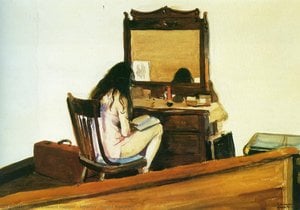
In the vast landscape of American Realism, few moments capture the heavy, cinematic silence of a fading day as poignantly as Edward Hopper’s “Cape Cod Sunset.” To gaze upon this work is to step into a space where time seems to suspend itself, caught in the delicate transition between light and shadow. The painting presents a deceptively simple tableau: a solitary white house, anchored by its red-trimmed roof, stands as a silent sentinel against the encroaching dusk. Hopper meticulously balances the composition, drawing the viewer’s eye upward toward an expansive, breathing sky, while simultaneously grounding us with the horizontal weight of the porch and the sturdy architecture of the building façade. It is a scene that invites intimacy, pulling the observer into a domestic world that feels both profoundly familiar and hauntingly distant.
The technical mastery of Hopper is most evident in his use of tonal painting, a method where subtle gradations of color dictate the emotional temperature of the canvas. Rather than relying on sharp, jarring contrasts, he employs a muted yet warm palette—rich yellows, soft oranges, and deep, melancholic reds—to replicate the fleeting atmosphere of twilight. This technique allows the light to feel as though it is physically receding from the house, leaving behind a sense of cooling air and lengthening shadows. The presence of open windows and chimneys adds a layer of architectural charm, suggesting a lived-in reality, yet the lack of human figures imbues the scene with a characteristic Hopperesque stillness. It is a masterclass in using light not merely to illuminate, but to narrate the passing of time.
Beyond its visual serenity, “Cape Cod Sunset” serves as a profound exploration of the American psyche during the mid-20th century. Painted in 1950, the work emerged from a period marked by the tension between postwar prosperity and a growing sense of urban alienation. The solitary house becomes a powerful symbol; it is at once a sanctuary of comfort and a vessel of confinement. The open windows suggest an invitation to contemplate the world beyond, yet they simultaneously emphasize the detachment of the unseen occupant from the external landscape. This duality—the tension between connection and isolation—is the heartbeat of Hopper’s oeuvre.
For the discerning collector or interior designer, this piece offers more than mere decoration; it provides an emotional anchor for a room. The painting’s ability to evoke melancholy, longing, and peace makes it a versatile centerpiece for spaces designed for reflection and quietude. Whether placed in a sun-drenched gallery or a moody, dimly lit study, a high-quality reproduction of this masterpiece brings with it the heavy, electric tension of a moment frozen in time. It is an invitation to pause, to breathe, and to find beauty in the profound stillness of the American landscape.
The Guide page of "Cape Cod Sunset" by Edward Hopper offers a printable two-sheet factsheet: the artwork with its identity table, a decade band placing it in the artist's lifetime, other works by the artist, the measured color palette, and ready-to-copy citations in four styles.
Edward Hopper's recurring themes include realist observation, urban isolation, domestic reflection, american identity, quiet contemplation; "Cape Cod Sunset" focuses on sunset landscape, coastal residence, domestic tranquility, evening light, rural architecture, solitude, american scene.
"Cape Cod Sunset" is made in oil on canvas, in the American Realism style.


1931 - 1967 , United States of America

Explore the profound beauty of American art history. From the Hudson River School to iconic landscapes, discover a curated journey through the masterpieces that defined a nation's spirit and the enduring legacy of American Romanticism.

 Preview
 Send
Send Share
Share
 Details
 Guide
Guide

 Download
 Similars
 X-Ray
X-Ray Diaporama
 Stats
Stats

 Read More









 Glass option is only available in size under 110 CM