The artwork displayed on this page is protected by copyright law, which means we cannot legally create or sell an identical reproduction. This protection is enforced under international agreements such as the Berne Convention and by national laws, including those outlined by the U.S. Copyright Law - Title 17.
This method fully complies with copyright regulations because it does not involve copying or duplicating the protected artwork. Instead, it is a creative reinterpretation - a new painting that is influenced by the original but not identical to it.
Museum-quality giclée or canvas print with fast production and flexible finish options. ( Buy Hand Made Painting Switch to Digital Image)





























Pick from our preset sizes that match the artwork's original proportions.

Type the width and the height you need, to fit your frame or your wall. A print can only be cut, never made bigger than the picture, so a size with a different shape loses a part of the image. We send you a digital mockup to approve before we print anything. The picture shown on this page does not show the real cut — only the mockup does.
Worldwide Delivery () in 2 weeks instead of standard 4/5 weeks. (25 October)
Barber Shop
Reproduction Size
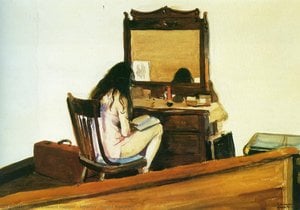
Edward Hopper’s “Barber Shop,” painted in 1931, is more than just a depiction of a commonplace American scene; it’s a masterclass in conveying profound emotional resonance through meticulous observation and masterful technique. This work, characteristic of Hopper's mature style, exemplifies his ability to capture the subtle anxieties and quiet loneliness that defined much of modern urban life. The painting presents a realistic tableau within a bustling barber shop, yet the figures are rendered with an almost detached stillness, creating a palpable sense of isolation despite their shared physical space.
Hopper's technique in "Barber Shop" is defined by a precise realism combined with an expressive use of color and form. He employed a meticulous approach to rendering details, from the worn surfaces of the furniture to the textures of clothing, reflecting his commitment to portraying the world as he saw it – with unwavering accuracy. His brushwork is generally smooth and controlled, contributing to the painting’s polished appearance. The palette is restrained, dominated by muted tones of brown, gray, and ochre, further enhancing the somber mood. Hopper's style aligns perfectly with the broader trends of American Realism that emerged in the early 20th century, but he infused it with a uniquely introspective sensibility.
"Barber Shop" resonates with broader themes of modernity—the alienation of urban life, the decline of traditional social structures, and the individual’s struggle for identity in a rapidly changing world. The woman reading her book represents a retreat from engagement, while the men occupy separate spheres of attention. The objects within the scene – the bottles, the chair, the cup – are not merely props but symbols of domesticity and routine, further highlighting the sense of quiet desperation. Hopper’s work is often interpreted as reflecting the anxieties of the Jazz Age and the early years of the Great Depression, a period marked by social upheaval and uncertainty.
"Barber Shop" continues to captivate viewers with its evocative atmosphere and profound emotional depth. Hopper’s ability to distill complex human emotions into a single, carefully constructed image is a testament to his artistic genius. This painting exemplifies the enduring appeal of Hopper's work – a poignant reminder of the quiet moments of solitude that define the human experience. A hand-painted reproduction offers an exceptional opportunity to bring this iconic artwork into your home or office, allowing you to contemplate its timeless themes and appreciate Hopper’s masterful technique.
The dominant color of "Barber Shop" by Edward Hopper is gray (#958881).
The diaporama of "Barber Shop" can be watched on the artwork's Diaporama page.
The format of "Barber Shop" is landscape. This is useful when planning where a reproduction will be placed.


1931 - 1967 , United States of America

Explore the profound beauty of American Realism. From Winslow Homer’s rural landscapes to the dignity of everyday life, discover how master artists captured the soul of a nation through evocative oil paintings and timeless fine art techniques.

 Preview
 Send
Send Share
Share
 Details
 Guide
Guide

 Download
 Similars
 X-Ray
X-Ray Diaporama
 Stats
Stats

 Read More









 Glass option is only available in size under 110 CM