The artwork displayed on this page is protected by copyright law, which means we cannot legally create or sell an identical reproduction. This protection is enforced under international agreements such as the Berne Convention and by national laws, including those outlined by the U.S. Copyright Law - Title 17.
This method fully complies with copyright regulations because it does not involve copying or duplicating the protected artwork. Instead, it is a creative reinterpretation - a new painting that is influenced by the original but not identical to it.
Museum-quality giclée or canvas print with fast production and flexible finish options. ( Buy Hand Made Painting Switch to Digital Image)





























Pick from our preset sizes that match the artwork's original proportions.

Type the width and the height you need, to fit your frame or your wall. A print can only be cut, never made bigger than the picture, so a size with a different shape loses a part of the image. We send you a digital mockup to approve before we print anything. The picture shown on this page does not show the real cut — only the mockup does.
Worldwide Delivery () in 2 weeks instead of standard 4/5 weeks. (25 October)
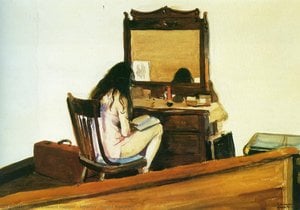
Automat (small)
Reproduction Size
Edward Hopper’s “Automat” (small), a deceptively simple depiction of a woman seated alone at a cafe table, is a masterclass in conveying the profound sense of solitude that characterized much of 20th-century American life. Painted during a period of rapid urbanization and social change, this work resonates with a quiet melancholy that speaks to the alienation inherent in modern existence. Hopper’s ability to capture fleeting moments of human experience – the unspoken thoughts, the lingering gestures – elevates this painting beyond mere representation into a powerful statement about the human condition.
The woman herself becomes a cipher, an emblem of urban loneliness. Her posture – slightly slumped, her gaze averted – suggests introspection and detachment. The presence of the table, the cup, and the surrounding chairs create a stage for this silent drama, inviting the viewer to contemplate her unspoken thoughts and feelings. Notably, the two clocks in the background—one closer to the top right corner and another further down towards the center-left area of the image—are a recurring motif in Hopper’s work, often symbolizing the relentless passage of time and the anxieties associated with it. They reinforce the sense that this moment is fleeting, suspended in an eternal present.
“Automat” was created in 1938, a year marked by economic hardship and social unrest in America. The rise of industrialization and urbanization had led to a growing sense of displacement and anonymity among individuals. Hopper's work reflects this broader societal trend, capturing the anxieties and uncertainties of modern life with remarkable sensitivity. Hopper’s focus on solitary figures within urban landscapes anticipated the themes explored by later generations of artists grappling with the complexities of post-war America. His paintings are not simply representations of places; they are profound meditations on human experience, exploring the quiet dramas of everyday existence.
A preview of "Automat (small)" by Edward Hopper is available on the artwork's Preview page.
The color analysis of "Automat (small)" by Edward Hopper records a bold contrast and a softly mixed palette harmony.
The color that stands out most in "Automat (small)" is phthalo green (#2b2a2c). The dominant color is useful when matching an artwork to an interior.

1931 - 1967 , United States of America

Elevate your design projects with WahooArt's premium canvas prints and hand-painted reproductions. From Giclée excellence to bespoke oil commissions, we provide professional decorators with museum-quality, affordable art solutions delivered worldwide with a 100% satisfaction guarantee.

Discover the excellence of WahooArt.com premium poster prints. Designed for elite collectors, our museum-quality Giclée reproductions offer unmatched durability and archival precision to elevate your luxury interiors with high-impact, sophisticated art decor.

Master the nuances of Giclée printing with our expert guide. Discover how pigment-based inks and museum-grade substrates create fade-resistant, high-fidelity art reproductions designed for discerning collectors seeking unparalleled quality and longevity.

 Preview
 Send
Send Share
Share
 Details
 Guide
Guide

 Download
 Similars
 X-Ray
X-Ray Diaporama
 Stats
Stats

 Read More









 Glass option is only available in size under 110 CM