Get a print-ready file that goes far beyond the web preview. Every digital image we sell comes from a high-resolution master in our stock database — usually 5,000 to 15,000 pixels wide — so you can print large, crop tightly, or reproduce fine detail with confidence.
No file leaves our studio untouched. A digital expert checks the colors against the original painting and corrects them if needed, then improves clarity and detail with professional retouching tools — always staying faithful to the artist's brushwork and style. The result is an image that looks like the painting, not like a filtered scan.
You approve before you're done: our expert sends the image by e-mail within 72 hours for your review. Not satisfied? Ask for improvements or corrections, or request a refund if the quality falls short.
This is the quality relied on by publishers, design studios, galleries and print shops.
Download a high-resolution file for personal display, printing, and creative projects. ( Switch to Print Buy Hand Made Painting)
When you choose WahooArt.com, you're not just getting an image - you're receiving a professionally enhanced digital artwork, crafted with precision and backed by a satisfaction guarantee. Here's everything that comes with your order, automatically:
Your high-resolution digital image file will be emailed to you within 72 hours of ordering - ready for immediate use.
Your artwork is professionally optimized using advanced AI tools and manual editing, ensuring maximum detail, clarity, and color accuracy.
Accidentally deleted or lost your file? No worries - we'll resend it to you anytime, free of charge.
Enjoy your artwork instantly with zero customs, duties, or delivery fees - digital downloads are always tax-free.
We ensure your digital image reflects the original colors as closely as possible using professional tools and color management.
If you're not satisfied with your digital image, we'll revise it or refund 100% within 100 days - no questions asked.
Not satisfied? Get a full refund within 100 days of receiving your digital file - no questions asked.
Buy 3 images, save 10% - Buy 5, save 15% - Buy 10+, save 20%. Great for creative projects, galleries, and agencies.
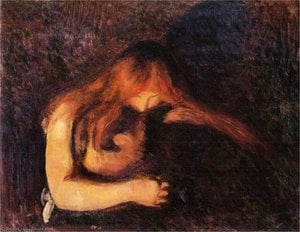
Edvard Munch's "Vampire," painted in 1894, isn’t merely a depiction of a nocturnal scene; it’s a visceral plunge into the artist’s own tormented psyche. This expressionist masterpiece, rendered in stark black and white photography, captures a moment suspended between terror and an unsettling fascination – a visual embodiment of Munch's lifelong struggle with mortality, illness, and the pervasive sense of dread that haunted his existence. The photograph itself, a faithful reproduction of the original painting, immediately draws the viewer into its shadowed world, hinting at the emotional intensity contained within.
The composition is dominated by a figure lying prone, their head turned away from the viewer, seemingly lost in contemplation or perhaps confronting an unseen horror. Two birds, wings outstretched and poised mid-flight, flank this central figure – symbols of both predatory instinct and fleeting hope. Their placement isn’t casual; they actively participate in the scene's unsettling drama, suggesting a constant threat lurking just beyond perception. The stark contrast between light and shadow is crucial to Munch’s technique, creating an atmosphere of palpable unease. He employed a limited palette, emphasizing the dramatic interplay of tones to heighten the emotional impact, foregoing detailed rendering for expressive brushstrokes that convey raw feeling.
To understand “Vampire,” one must delve into the deeply personal context of Munch’s life. The painting emerged during a period of intense psychological distress, fueled by the early deaths of his mother and sister from tuberculosis – experiences that irrevocably shaped his artistic vision. These losses weren't simply biographical events; they became foundational to his exploration of themes like sickness, death, and the fragility of human existence. His father’s strict religious beliefs further contributed to a sense of unease, creating an environment where emotional expression was often suppressed, leading Munch to find solace and release through art.
The figure in "Vampire" is widely interpreted as a self-portrait, embodying Munch's own anxieties and vulnerabilities. The averted gaze suggests a retreat from the world, a desire to escape the horrors he perceived within himself and around him. The birds, often associated with both life and death, could represent the inescapable forces of nature or perhaps even the predatory aspects of human relationships – mirroring the artist’s own feelings of being hunted by his demons.
Munch's use of symbolism is deliberately ambiguous, inviting multiple interpretations. The “vampire” itself isn’t explicitly depicted; instead, it’s implied through the atmosphere of dread and the predatory birds. This deliberate vagueness allows viewers to project their own fears and anxieties onto the scene, making "Vampire" a profoundly personal experience. The painting exemplifies key elements of Expressionism – an artistic movement that sought to convey subjective emotions rather than objective reality. Munch’s distorted forms, exaggerated lines, and intense color palette (though rendered in monochrome here) are all designed to evoke a powerful emotional response.
Furthermore, the photograph's stark black and white treatment amplifies the painting's inherent drama. The absence of color forces the viewer to focus on the composition, line, and texture – elements that contribute significantly to the work’s unsettling atmosphere. The technique mirrors Munch’s broader exploration of light and shadow as metaphors for psychological states, highlighting the interplay between darkness and illumination within the human soul.
"Vampire" remains a hauntingly relevant artwork, continuing to resonate with audiences today. It's not a comfortable image; it confronts us with our own fears about mortality, illness, and the darker aspects of human nature. As a reproduction offered by WahooArt.com, this piece provides an exceptional opportunity to experience Munch’s genius firsthand, bringing his intensely personal vision into your home or studio. The meticulous detail captured in the photograph ensures that every nuance of the original painting is faithfully reproduced, allowing you to appreciate the artist's masterful technique and profound emotional depth.
"Vampire" is available as a hand-painted oil reproduction on linen canvas. The order can be placed on its Hand-Painted Reproduction page, with a choice of sizes.
The movement associated with "Vampire" by Edvard Munch is Expressionist Painting. This classification situates the work among related artists and artworks.
In a living room, "Vampire" is suggested at a large print size.
Edvard Munch arrived in the world in 1863, born into the stark landscapes of Norway. His early years were defined by a heavy presence of grief that would later find its way onto his canvases. The deaths of his mother and his sister, Sophie, both taken by tuberculosis, left a deep mark on his young mind. These losses created a preoccupation with mortality and the fragility of life that stayed with him forever. He grew up in a household where the shadows of sickness were never far away.
His father, Christian, was a physician who struggled with intense religious devotion and mental instability. This atmosphere of dread and the vivid ghost stories told in his childhood helped shape his later visions. Munch did not merely paint what he saw; he sought to externalize his internal state. He called this approach soul painting. It was a way to translate psychological distress into visual form, using the colors and shapes of his own experience.
Munch began his formal studies at the Royal School of Art and Design in Kristiania, which is now known as Oslo. During this time, he moved within bohemian circles that challenged the strict rules of academic art. A significant influence was Hans Jæger, a nihilist who encouraged Munch to abandon conventional styles and instead focus on his own subjective emotions. This shift led him toward the development of Expressionism.
Travels through Europe brought new perspectives to his work. In Paris, he encountered the techniques of artists like Paul Gauguin and Vincent van Gogh, particularly their use of color. In Berlin, his connections with figures such as August Strindberg further pushed his investigations into psychological themes. He began to move away from naturalistic representation, opting instead for distorted forms and rhythmic lines that could communicate the tremors of human existence.
Much of his work belongs to a series he called The Frieze of Life, where he explored the recurring cycles of love, fear, death, and anxiety. Some of his most recognized paintings include:
Munch was a highly active printmaker, using techniques like etching, lithography, and woodcut to expand his reach. He possessed over one thousand paintings at the time of his death in 1944. His ability to confront the darker aspects of the human condition helped pave the way for later movements like German Expressionism. Today, much of his legacy is preserved in the Munch Museum in Oslo, where his work continues to speak to the complexities of the human psyche.

1863 - 1944 , Sweden
 Preview
 Send
Send Share
Share
 Details
 Guide
Guide

 Download
 Similars
 X-Ray
X-Ray Diaporama
 Q&A
Q&A
 Stats
Stats

 Read More