Museum-quality giclée or canvas print with fast production and flexible finish options. ( Buy Hand Made Painting Switch to Digital Image)





























Pick from our preset sizes that match the artwork's original proportions.

Type the width and the height you need, to fit your frame or your wall. A print can only be cut, never made bigger than the picture, so a size with a different shape loses a part of the image. We send you a digital mockup to approve before we print anything. The picture shown on this page does not show the real cut — only the mockup does.
Worldwide Delivery () in 2 weeks instead of standard 4/5 weeks. (21 October)
untitled (246)
Reproduction Size
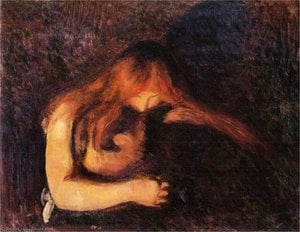
Edvard Munch's "Untitled (246)," a haunting black and white depiction of a woman cradling a cat, isn’t merely a portrait; it’s a visceral embodiment of the anxieties that defined the artist’s life and, by extension, much of modern experience. Painted in 1893 during a period of intense personal turmoil, this work transcends simple representation to become a profound meditation on grief, vulnerability, and the inescapable shadow of mortality. The painting's power lies not just in its subject matter but in Munch’s masterful manipulation of line, color (or rather, the absence thereof), and composition – elements that converge to create an atmosphere thick with unspoken sorrow.
Munch’s artistic journey was inextricably linked to his own personal tragedies. The early deaths of his mother and sister from tuberculosis cast a long shadow over his childhood, instilling in him a lifelong preoccupation with illness, loss, and the fragility of human existence. This deeply rooted emotional landscape is palpably present in “Untitled (246).” The woman’s face, rendered with an almost skeletal simplicity, conveys a profound sense of weariness and despair. Her eyes, vacant yet intensely focused, seem to stare into some distant, unbearable memory. The cat, nestled securely within her arms, offers a fleeting moment of tenderness – perhaps a symbolic representation of comfort or the last vestige of connection in a world increasingly defined by isolation.
“Untitled (246)” is a quintessential example of Munch’s signature Expressionistic style. Rejecting academic realism, he prioritized conveying inner emotional states through distorted forms and exaggerated lines. Notice how the woman's body is elongated and contorted, her limbs seemingly adrift in space. The cat, too, is rendered with an unsettling fluidity, its form dissolving into a hazy suggestion of feline presence. Munch’s use of thick, swirling brushstrokes adds to the painting’s sense of unease and instability, mirroring the turbulent emotions he sought to capture.
The deliberate absence of color – the monochrome palette of black, white, and shades of gray – is crucial to the work's impact. This starkness amplifies the emotional intensity, stripping away any superficial distractions and forcing the viewer to confront the raw core of the scene. The limited tonal range creates a dramatic chiaroscuro effect, emphasizing the contours of the figures and casting them in an almost theatrical light. It’s as if Munch is illuminating not just the physical form but also the hidden depths of the woman's soul.
“Untitled (246)” belongs to a series known as “The Frieze of Life,” a group of paintings that explored fundamental human experiences – love, anxiety, death, melancholy, and jealousy. Within this context, the painting can be interpreted as a representation of grief and the enduring struggle to find solace in the face of loss. The cat itself is often seen as a symbol of comfort and companionship, offering a brief respite from the overwhelming sadness. However, its presence also subtly underscores the isolation inherent in grief – a reminder that even in moments of tenderness, one remains fundamentally alone.
Furthermore, the painting’s composition echoes themes explored in Munch's broader artistic output. The woman’s posture suggests a state of passive resignation, mirroring the vulnerability and helplessness often associated with mourning. The overall effect is profoundly unsettling, prompting viewers to contemplate their own experiences with loss, loneliness, and the inevitable passage of time. It’s a work that demands introspection and rewards repeated viewing, revealing new layers of meaning with each encounter.
“Untitled (246)” remains a powerfully resonant artwork over a century after its creation. Its enduring appeal lies in its ability to tap into universal human emotions – grief, vulnerability, and the search for connection. Reproductions of this iconic image continue to captivate audiences worldwide, serving as a poignant reminder of the complexities of the human condition. Whether displayed in a private collection or a public gallery, “Untitled (246)” offers a profound glimpse into the artistic genius of Edvard Munch and his unflinching exploration of the darkest corners of the human psyche.
Within Edvard Munch's career, "untitled (246)" falls in the Mature Period. The phase helps compare it with the artist's other works.
"untitled (246)" leans toward an ochre to sepia tone.
"untitled (246)" by Edvard Munch can be downloaded from the artwork's Download page, as a high-resolution digital image download.
Edvard Munch arrived in the world in 1863, born into the stark landscapes of Norway. His early years were defined by a heavy presence of grief that would later find its way onto his canvases. The deaths of his mother and his sister, Sophie, both taken by tuberculosis, left a deep mark on his young mind. These losses created a preoccupation with mortality and the fragility of life that stayed with him forever. He grew up in a household where the shadows of sickness were never far away.
His father, Christian, was a physician who struggled with intense religious devotion and mental instability. This atmosphere of dread and the vivid ghost stories told in his childhood helped shape his later visions. Munch did not merely paint what he saw; he sought to externalize his internal state. He called this approach soul painting. It was a way to translate psychological distress into visual form, using the colors and shapes of his own experience.
Munch began his formal studies at the Royal School of Art and Design in Kristiania, which is now known as Oslo. During this time, he moved within bohemian circles that challenged the strict rules of academic art. A significant influence was Hans Jæger, a nihilist who encouraged Munch to abandon conventional styles and instead focus on his own subjective emotions. This shift led him toward the development of Expressionism.
Travels through Europe brought new perspectives to his work. In Paris, he encountered the techniques of artists like Paul Gauguin and Vincent van Gogh, particularly their use of color. In Berlin, his connections with figures such as August Strindberg further pushed his investigations into psychological themes. He began to move away from naturalistic representation, opting instead for distorted forms and rhythmic lines that could communicate the tremors of human existence.
Much of his work belongs to a series he called The Frieze of Life, where he explored the recurring cycles of love, fear, death, and anxiety. Some of his most recognized paintings include:
Munch was a highly active printmaker, using techniques like etching, lithography, and woodcut to expand his reach. He possessed over one thousand paintings at the time of his death in 1944. His ability to confront the darker aspects of the human condition helped pave the way for later movements like German Expressionism. Today, much of his legacy is preserved in the Munch Museum in Oslo, where his work continues to speak to the complexities of the human psyche.

1863 - 1944 , Sweden

Explore the profound artistry of black and white photography. From historical mastery to the interplay of light and shadow, discover how monochrome captures timeless emotion and form through a sophisticated lens of art history.

Elevate your most cherished memories with WahooArt’s bespoke service. We transform your personal photos into breathtaking, hand-painted black & white oil masterpieces. Experience museum-quality craftsmanship and timeless elegance for your private collection. Discover the art of legacy.

 Preview
 Send
Send Share
Share
 Details
 Guide
Guide

 Download
 Similars
 X-Ray
X-Ray Diaporama
 Stats
Stats

 Read More









 Glass option is only available in size under 110 CM