

Museum-quality giclée or canvas print with fast production and flexible finish options. ( Buy Hand Made Painting Switch to Digital Image)





























Pick from our preset sizes that match the artwork's original proportions.

Type the width and the height you need, to fit your frame or your wall. A print can only be cut, never made bigger than the picture, so a size with a different shape loses a part of the image. We send you a digital mockup to approve before we print anything. The picture shown on this page does not show the real cut — only the mockup does.
Worldwide Delivery () in 2 weeks instead of standard 4/5 weeks. (28 October)
The sick child 02
Reproduction Size
Created between 1885 and 1886, *The Sick Child 02* is a profoundly moving early masterpiece by Norwegian artist Edvard Munch. This painting isn't merely a depiction of illness; it’s a visceral exploration of loss, anxiety, and the enduring power of memory – themes that would come to define his groundbreaking artistic career.
The artwork portrays a young girl lying in bed, attended by a figure widely believed to be her mother. The scene is deeply personal, rooted in Munch’s own tragic childhood experiences. His beloved sister, Sophie, succumbed to tuberculosis at the age of fifteen, an event that left an indelible mark on the artist's psyche. This painting, and its earlier iteration, served as a direct response to this trauma, functioning almost as a memorial and a desperate attempt to grapple with overwhelming grief.
*The Sick Child 02* is considered a pivotal work in the development of Expressionism. While still exhibiting elements of Realism, Munch departs from strict representation to prioritize emotional impact. His brushwork is loose and agitated, conveying a sense of unease and psychological turmoil. The limited color palette – dominated by somber blues, greens, and muted reds – reinforces the melancholic atmosphere. Notice how the figures aren’t sharply defined; they seem to blend into their surroundings, mirroring the blurring of reality experienced during periods of intense sorrow.
The painting is rich in symbolic meaning. The sickly pallor of the child, contrasted with the worried expression of her mother, speaks volumes about vulnerability and helplessness. The darkened room suggests isolation and impending doom. Munch doesn’t simply show us a sick girl; he conveys the suffocating weight of grief and the fear of loss. The composition itself – the diagonal line created by the bed and figures – creates a sense of instability and imbalance, mirroring the emotional state of those depicted.
Owning a reproduction of this iconic work allows you to connect with Munch’s profound exploration of the human experience and bring a piece of art history into your home.
"The sick child 02" by Edvard Munch shows a balanced contrast between its light and dark areas.
"The sick child 02" connects the Expressionism movement with Sweden through its creator's birthplace.
In the catalog, "The sick child 02" by Edvard Munch is filed as wall art. The category helps find similar works.

Edvard Munch arrived in the world in 1863, born into the stark landscapes of Norway. His early years were defined by a heavy presence of grief that would later find its way onto his canvases. The deaths of his mother and his sister, Sophie, both taken by tuberculosis, left a deep mark on his young mind. These losses created a preoccupation with mortality and the fragility of life that stayed with him forever. He grew up in a household where the shadows of sickness were never far away.
His father, Christian, was a physician who struggled with intense religious devotion and mental instability. This atmosphere of dread and the vivid ghost stories told in his childhood helped shape his later visions. Munch did not merely paint what he saw; he sought to externalize his internal state. He called this approach soul painting. It was a way to translate psychological distress into visual form, using the colors and shapes of his own experience.
Munch began his formal studies at the Royal School of Art and Design in Kristiania, which is now known as Oslo. During this time, he moved within bohemian circles that challenged the strict rules of academic art. A significant influence was Hans Jæger, a nihilist who encouraged Munch to abandon conventional styles and instead focus on his own subjective emotions. This shift led him toward the development of Expressionism.
Travels through Europe brought new perspectives to his work. In Paris, he encountered the techniques of artists like Paul Gauguin and Vincent van Gogh, particularly their use of color. In Berlin, his connections with figures such as August Strindberg further pushed his investigations into psychological themes. He began to move away from naturalistic representation, opting instead for distorted forms and rhythmic lines that could communicate the tremors of human existence.
Much of his work belongs to a series he called The Frieze of Life, where he explored the recurring cycles of love, fear, death, and anxiety. Some of his most recognized paintings include:
Munch was a highly active printmaker, using techniques like etching, lithography, and woodcut to expand his reach. He possessed over one thousand paintings at the time of his death in 1944. His ability to confront the darker aspects of the human condition helped pave the way for later movements like German Expressionism. Today, much of his legacy is preserved in the Munch Museum in Oslo, where his work continues to speak to the complexities of the human psyche.

1863 - 1944 , Sweden

Explore 10 legendary 'Oil on Board' masterpieces by Van Gogh, Monet & more! Discover art history, iconic styles like Impressionism, and find museum-quality reproductions to elevate your home decor. Explore the full collection online at WahooArt.com.
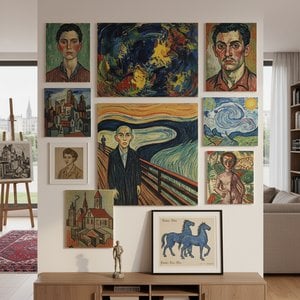
Journey into the soul of Expressionism! Explore 10 iconic paintings by Munch, Kirchner, Kandinsky & more. Discover their stories, bold colors & lasting impact. Find museum-quality art reproductions at .

Explore the enduring legacy of hand-painted oil paintings. Discover the aesthetic value, material longevity & emotional resonance that sets original art—and expertly crafted reproductions—apart. Invest in timeless beauty.
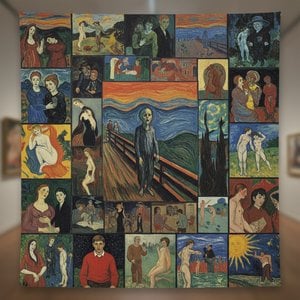
Explore 25 iconic Edvard Munch paintings, from 'The Scream' to lesser-known masterpieces. Discover the stories behind Expressionism’s most emotional works & find museum-quality art reproductions for your home at WahooArt.com.

Explore the profound world of Edvard Munch, pioneer of Expressionism. Discover the origins of 'The Scream' & his haunting depictions of anxiety, mortality, and love. Expert analysis & high-quality reproductions at WahooArt.

 Preview
 Send
Send Share
Share
 Details
 Guide
Guide

 Download
 Similars
 X-Ray
X-Ray Diaporama
 Stats
Stats

 Read More









 Glass option is only available in size under 110 CM


