
Purchase a high-resolution, enhanced digital image, far superior to the online preview.
Each file is meticulously prepared by our in-house specialists using advanced tools and expert manual retouching. We ensure every image has exceptional clarity, precise color accuracy, and fine detail.
The final file is delivered via email within 72 hours, optimized for immediate use in professional, editorial, and print environments. This is the same quality trusted by top-tier design studios, publishers, and galleries.
Download a high-resolution file for personal display, printing, and creative projects. ( Switch to Print Buy Hand Made Painting)
When you choose WahooArt.com, you're not just getting an image - you're receiving a professionally enhanced digital artwork, crafted with precision and backed by a satisfaction guarantee. Here's everything that comes with your order, automatically:

Your high-resolution digital image file will be emailed to you within 72 hours of ordering - ready for immediate use.

Your artwork is professionally optimized using advanced AI tools and manual editing, ensuring maximum detail, clarity, and color accuracy.

Accidentally deleted or lost your file? No worries - we'll resend it to you anytime, free of charge.

Enjoy your artwork instantly with zero customs, duties, or delivery fees - digital downloads are always tax-free.

We ensure your digital image reflects the original colors as closely as possible using professional tools and color management.

If you're not satisfied with your digital image, we'll revise it or refund 100% within 100 days - no questions asked.

Not satisfied? Get a full refund within 100 days of receiving your digital file - no questions asked.

Buy 3 images, save 10% - Buy 5, save 15% - Buy 10+, save 20%. Great for creative projects, galleries, and agencies.

To encounter the work of Eduardo Arroyo is to step into a world where color serves as both a celebration and a weapon. Born in Madrid in 1937, Arroyo’s early consciousness was forged within the stifling shadows of Francoist Spain, a period of intense political repression that would later become the catalyst for his lifelong commitment to artistic resistance. While his roots were firmly planted in the Leonese tradition, his spirit was inherently nomadic and rebellious. After honing his intellect through journalism studies in Madrid, the suffocating atmosphere of his homeland drove him to emigrate to Paris in 1958. This transition was far more than a mere change of scenery; it was an artistic awakening. In the heart of the French avant-garde, Arroyo found the freedom to transform his political disillusionment into a sophisticated visual language that would eventually captivate the international art scene.
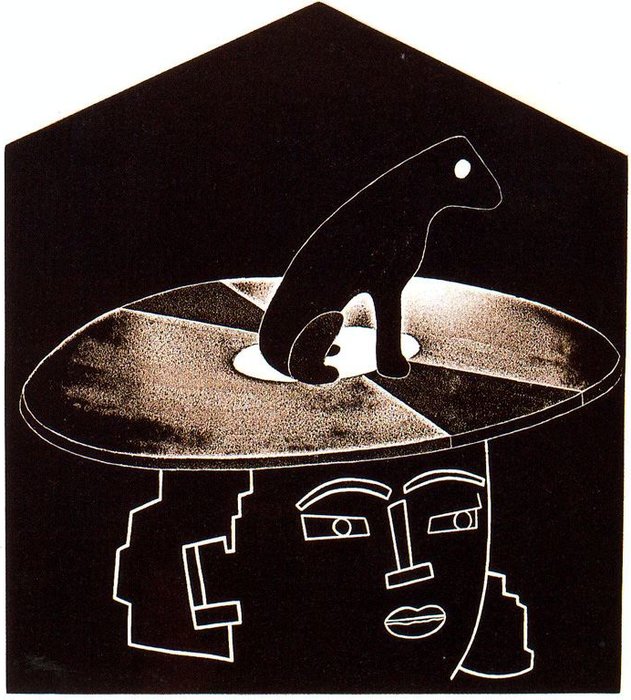
The Parisian years acted as a crucible for his developing style, placing him in direct conversation with the giants of the era. The influence of Joan Miró left an indelible mark on his sense of form and symbolic potential, while his friendship with Gilles Aillaud fostered a collaborative spirit that bridged the gap between the canvas and the stage. It was during this period that Arroyo began to master the art of Narrative Figuration, a movement that allowed him to weave complex, often ironic, social commentaries into his imagery. His work became a playground for Pop Art aesthetics, yet it remained deeply grounded in a uniquely Spanish sensibility—one that utilized vibrant, saturated hues and a deliberate flattening of perspective to strip away the illusions of depth, forcing the viewer to confront the raw, graphic truth of the subject matter.
Arroyo’s creative genius was never confined to the boundaries of a frame. He possessed a rare ability to extend his visual vocabulary into the three-dimensional realm of theater, working extensively as a set and costume designer. His collaborations with legendary directors like Klaus Michael Grüber allowed him to treat the stage as an expansive canvas, where light, shadow, and texture could orchestrating political and psychological drama. Whether designing for the Paris Opéra or the Salzburg Festival, Arroyo utilized his signature lack of spatial depth to create environments that felt both surreal and urgently present. This multidisciplinary approach enriched his paintings, infusing them with a theatrical sense of composition and a profound understanding of how visual elements can manipulate human emotion.
The technical hallmarks of his mature period are as striking as they are intellectually rigorous. His compositions often feature:
As his career progressed, Arroyo’s significance grew from that of a rising avant-garde figure to a pillar of politically committed realism. His triumph at the 1976 Venice Biennale, where he dominated the exhibition of post-Franco Spanish art, signaled his arrival as a global force. He did not merely document the changing political landscape; he interrogated it through a lens of beautiful irony. Even as he received prestigious accolades, such as Spain's National Award for Plastic Arts in 1982, his work never lost its edge or its capacity to provoke. He remained an artist who refused to settle into the comfort of tradition, constantly navigating the crossroads between nouvelle figuration and pop aesthetics.
Eduardo Arroyo passed away in 2018, leaving behind a legacy that continues to resonate with anyone who believes that art should be both aesthetically breathtaking and intellectually fearless. His ability to blend the playful with the profound, and the colorful with the critical, ensures his place in the pantheon of modern masters. Through his paintings, stage designs, and journalistic wit, he taught us that even in the most flattened of perspectives, one can find an infinite depth of meaning.

1937 - 2018

 Preview
 Send
Send Share
Share
 Details

 Download
 Similars
 X-Ray
X-Ray Diaporama
 Stats
Stats Read More


