
x


Museum-quality giclée or canvas print with fast production and flexible finish options. ( Buy Hand Made Painting Buy Image)





























Pick from our preset sizes that match the artwork's original proportions.

You may enter your own dimensions to fit a specific frame or space. If your selected size does not match the original image's proportions, we will either crop the artwork or extend the image with a mirrored or solid-fill edge. A digital mockup will be sent for your approval before production begins.
Please note that the on-screen preview does not reflect the actual cropping or extension. Only the mockup will accurately show the final composition.
While custom sizes are available, we recommend selecting a dimension from the predefined list to preserve the original proportions.
Worldwide Delivery () in 2 weeks instead of standard 4/5 weeks. (28 August)


Exotic Flower (Fleur exotique)
Reproduction Size
Édouard Manet's Olympia (1863) isn't merely a painting; it’s a seismic event in the history of art. Born from the burgeoning energy of 19th-century Paris, this work immediately polarized audiences and critics alike, forever altering the trajectory of artistic representation. It depicts Olympia, a nude woman reclining on a bed, attended by her black servant Laure who presents her with flowers – a scene that, at first glance, seems straightforward. However, beneath the surface lies a complex layering of symbolism, social commentary, and a radical departure from established academic conventions.
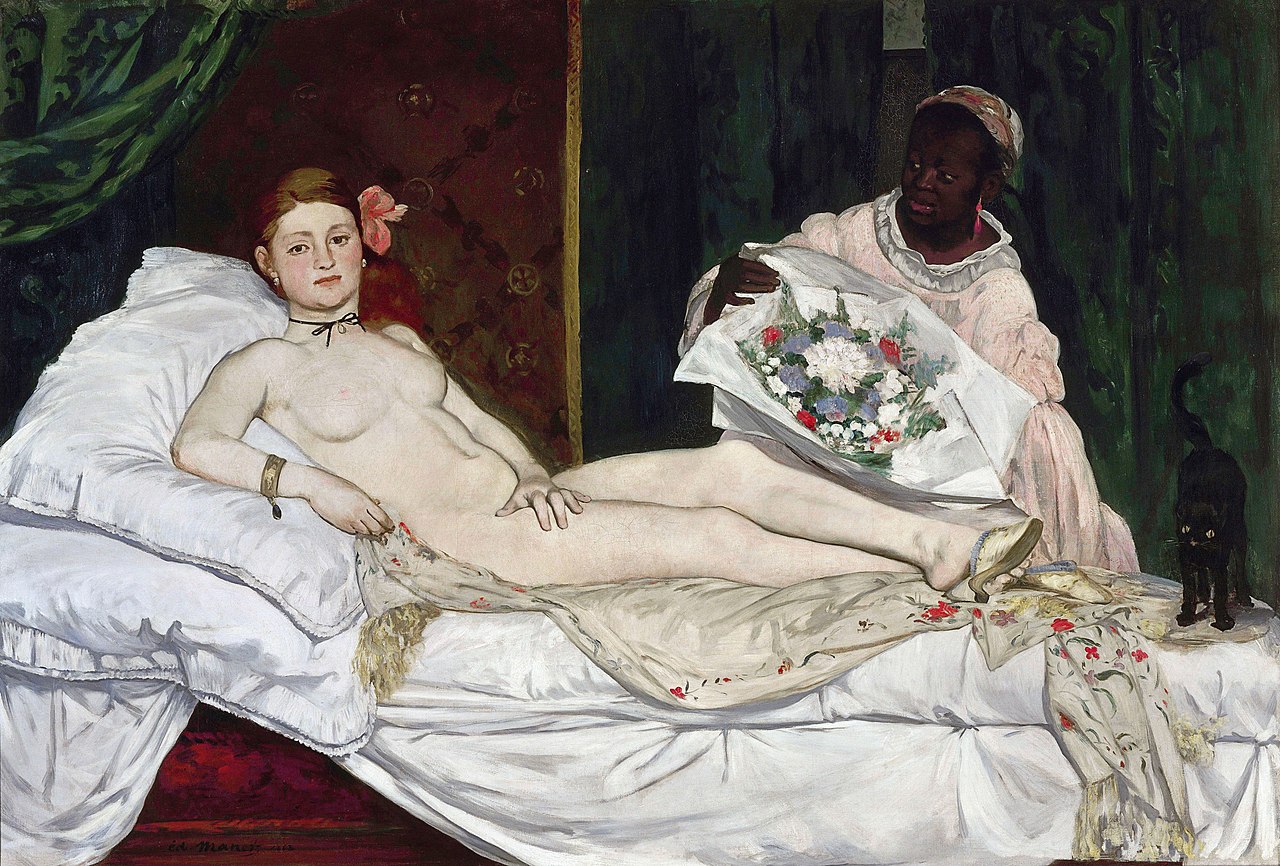
Prior to Olympia, artists were largely bound by the dictates of the French Academy, which favored idealized nudes rooted in classical mythology – figures like Venus or Psyche. Manet, however, was captivated by contemporary life, particularly the burgeoning world of Parisian nightlife and its inhabitants. He sought to capture a raw, unvarnished truth, rejecting the smooth surfaces and artificial lighting that characterized academic painting. This ambition directly challenged the established Salon, the official art exhibition where artists showcased their work. The Salon’s conservative tastes were outraged by Manet's unflinching portrayal of a modern woman – a *demi-mondaine*, or courtesan – presented with a disconcerting directness.
The painting is rife with symbolic details, each contributing to its provocative narrative. Olympia’s confrontational gaze, unlike the passive acceptance of classical nudes, suggests agency and awareness. The orchid flower in her hair, a symbol of luxury and sensuality, is presented by Laure, who holds it in a way that subtly diminishes its significance – a gesture interpreted as rejecting the superficiality of wealth. The black cat, traditionally associated with nocturnal activities and bad luck, further reinforces this sense of transgression. Even the discarded slipper symbolizes a rejection of conventional domestic roles. The stark lighting, devoid of traditional chiaroscuro, adds to the painting’s unsettling realism, emphasizing Olympia's physicality and challenging viewers to confront their own voyeuristic impulses.
Despite the initial controversy, Olympia proved profoundly influential. Its rejection of academic conventions paved the way for the rise of Impressionism, a movement that prioritized capturing fleeting moments of light and color. Manet’s bold use of brushstrokes, his focus on contemporary subjects, and his willingness to challenge societal norms inspired generations of artists. The painting remains a powerful testament to Manet's artistic vision – a revolutionary gaze that continues to captivate and provoke debate over 150 years later. It stands as a pivotal work in the transition from Realism to Modern Art, forever altering our understanding of portraiture and the role of art in society.


1832 - 1883 , France

Explore the enigmatic world of Magic Realism. From its German origins to Latin American mastery, discover how this sophisticated movement blends reality with the extraordinary—perfect for discerning collectors seeking depth and wonder in fine art.


Stay updated with the latest art news, exclusive offers, and decoration ideas.
Tell us about your project and our art experts will provide you with 3 personalized art suggestions.
Let Us Curate 3 Options Just for You - Free!

 Preview
 Send
Send Share
Share
 Details

 Download
 Similars
 X-Ray
X-Ray Diaporama
 Read More







 Glass option is only available in size under 110 CM


