


x

Museum-quality giclée or canvas print with fast production and flexible finish options.
Pick from our preset sizes that match the artwork's original proportions.

You may enter your own dimensions to fit a specific frame or space. If your selected size does not match the original image's proportions, we will either crop the artwork or extend the image with a mirrored or solid-fill edge. A digital mockup will be sent for your approval before production begins.
Please note that the on-screen preview does not reflect the actual cropping or extension. Only the mockup will accurately show the final composition.
While custom sizes are available, we recommend selecting a dimension from the predefined list to preserve the original proportions.
Worldwide Delivery () in 2 weeks instead of standard 4/5 weeks. (21 July)


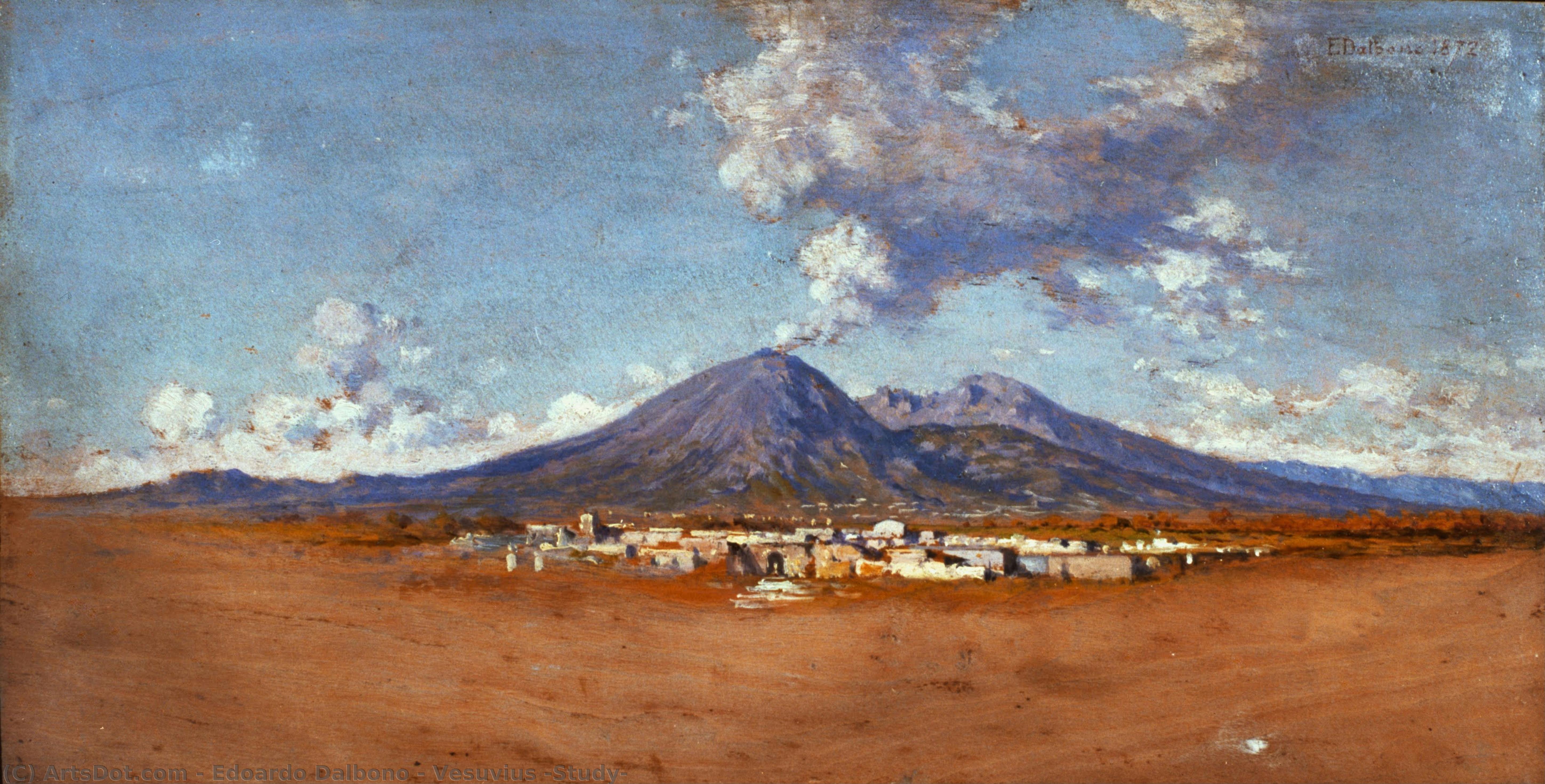
Vesuvius (Study)
Reproduction Size
Edoardo Dalbono (10 December 1841 – 23 August 1915) was an Italian painter born in Naples, a city that profoundly shaped his artistic vision. His legacy resides primarily in the luminous landscapes he created—particularly those depicting the Bay of Naples and its surrounding hills—and in evocative scenes capturing the spirit of Neapolitan life during the late Romantic era.
Born into a family steeped in intellectual pursuits – his father was a writer and art critic, and his mother a poet – Dalbono’s formative years were marked by exposure to artistic discourse. He enrolled at the Royal Institute of Fine Arts in Naples in 1853 but quickly abandoned formal training for the mentorship of Nicola Palizzi, establishing himself within the influential Scuola di Resina movement.
This school championed a revolutionary approach to painting, prioritizing direct observation of nature and employing *macchie*—patches of color—to convey emotion and atmosphere. Dalbono embraced this method wholeheartedly, rejecting academic conventions in favor of capturing the immediacy of experience. His artistic journey was fueled by an unwavering fascination with the natural world, particularly the dramatic vistas of Mount Vesuvius.
Dalbono’s prolific output included numerous landscapes, portraits, and genre scenes that offer a glimpse into the social fabric of Naples during his time. He gained recognition for his skill in portraying light and color—characteristics that define his distinctive style. His works are celebrated for their sensitivity to detail and their ability to evoke profound emotional responses.
Among Dalbono’s notable achievements were awards at prestigious exhibitions, including the silver medal at the Mostra di Belle Arti in Naples in 1859 and the bronze medal at the Vienna International Exhibition of 1873. He also established himself as a respected teacher at the Naples Academy, nurturing the talents of future artists like Carlo Brancaccio.
His artistic explorations extended beyond Neapolitan landscapes; he spent considerable time in Paris during the 1870s and 1880s, collaborating with fellow artist Giuseppe De Nittis and gaining access to the vibrant Parisian art scene. This period solidified his commitment to capturing the beauty of nature and experimenting with innovative techniques.
Dalbono’s artistic influence can be discerned in the works of subsequent generations of Italian painters who adopted his luminous palette and expressive brushwork. He remains a pivotal figure in Neapolitan art history, embodying the spirit of Romantic idealism and demonstrating the transformative power of observation.


Stay updated with the latest art news, exclusive offers, and decoration ideas.
Tell us about your project and our art experts will provide you with 3 personalized art suggestions.
Let Us Curate 3 Options Just for You - Free!
 Buy Painting
 Send
Send Share
Share
 Details

 Download
 Similars
 X-Ray
X-Ray Diaporama
 Read More




































 Glass option is only available in size under 110 CM


