Preview AR preview Switch to Print Switch to Digital Image Send
Details Guide Add to favorites Download Similars X-Ray Diaporama Stats

Blasphemous Rumours

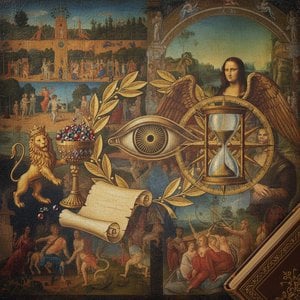
Douglas Coupland's 'Blasphemous Rumours' is a striking collage exploring themes of gossip and media saturation, featuring layered words and provocative imagery. A captivating piece by a leading contemporary artist.

Douglas Coupland: Canadian novelist & visual artist exploring Gen X, digital culture & modern life. Known for QR code art, sculptures & thought-provoking pieces exhibited globally.

The artwork displayed on this page is protected by copyright law, which means we cannot legally create or sell an identical reproduction. This protection is enforced under international agreements such as the Berne Convention and by national laws, including those outlined by the U.S. Copyright Law - Title 17.

As a respectful and legal alternative, we offer custom, hand-painted artworks inspired by the original. Our skilled and professional artists carefully study the original's style, mood, and artistic essence to create a new, unique piece that evokes the same feeling - while remaining an original creation in its own right.

This method fully complies with copyright regulations because it does not involve copying or duplicating the protected artwork. Instead, it is a creative reinterpretation - a new painting that is influenced by the original but not identical to it.

Hand Made Oil Reproduction

Hand-painted oil on canvas in your size and frame, made to order by our artists. ( Switch to Print Switch to Digital Image)

Corner sample of the P118B picture frame: moulded polystyrene, 5 cm wide and 3 cm thick
P118B $10
Corner sample of the P118H picture frame: moulded polystyrene, 5 cm wide and 3 cm thick
P118H $10
Corner sample of the P118W picture frame: moulded polystyrene, 5 cm wide and 3 cm thick
P118W $10
Corner sample of the P438Z picture frame: moulded polystyrene, 5.5 cm wide and 3.5 cm thick
P438Z $10
Corner sample of the P508JH picture frame: moulded polystyrene, 7 cm wide and 3.5 cm thick
P508JH $12
Corner sample of the P508YH picture frame: moulded polystyrene, 7 cm wide and 3.5 cm thick
P508YH $12
Corner sample of the P805H picture frame: moulded polystyrene, 5 cm wide and 3.5 cm thick
P805H $10
Corner sample of the P805Z picture frame: moulded polystyrene, 5 cm wide and 3.5 cm thick
P805Z $10
Corner sample of the P919BZ picture frame: moulded polystyrene, 7 cm wide and 3.5 cm thick
P919BZ $10
Corner sample of the P919G picture frame: moulded polystyrene, 7 cm wide and 3.5 cm thick
P919G $10
Corner sample of the P919XJ picture frame: moulded polystyrene, 7 cm wide and 3.5 cm thick
P919XJ $10
Corner sample of the P959ZH picture frame: moulded polystyrene, 5 cm wide and 3 cm thick
P959ZH $10
Corner sample of the P968JZ picture frame: moulded polystyrene, 6 cm wide and 4 cm thick
P968JZ $12
Corner sample of the W106C picture frame: solid wood, 5 cm wide and 3 cm thick
W106C $8
Corner sample of the W218G picture frame: solid wood, 5 cm wide and 3 cm thick
W218G $10
Corner sample of the W218JH picture frame: solid wood, 5 cm wide and 3 cm thick
W218JH $8
Corner sample of the W218Y picture frame: solid wood, 5 cm wide and 3 cm thick
W218Y $10
Corner sample of the W307PJ picture frame: solid wood, 6 cm wide and 3 cm thick
W307PJ $10
Corner sample of the W316G picture frame: solid wood, 6 cm wide and 3 cm thick
W316G $10
Corner sample of the W316PJ picture frame: solid wood, 6 cm wide and 3 cm thick
W316PJ $8
Corner sample of the W316Y picture frame: solid wood, 6 cm wide and 3 cm thick
W316Y $10
Corner sample of the W398PJ picture frame: solid wood, 5 cm wide and 3 cm thick
W398PJ $8
Corner sample of the W4111J picture frame: solid wood, 6.5 cm wide and 3.5 cm thick
W4111J $10
Corner sample of the W500HY picture frame: solid wood, 7 cm wide and 5 cm thick
W500HY $15
Corner sample of the W500JH picture frame: solid wood, 7 cm wide and 5 cm thick
W500JH $15
Corner sample of the W692G picture frame: solid wood, 8 cm wide and 4 cm thick
W692G $12
Corner sample of the W849H picture frame: solid wood, 5 cm wide and 3 cm thick
W849H $8
Corner sample of the W940BG picture frame: solid wood, 7.5 cm wide and 4.5 cm thick
W940BG $15
Corner sample of the W953PJ picture frame: solid wood, 6 cm wide and 3.5 cm thick
W953PJ $8

Standard
custom
CM
INCH

Pick from our preset sizes that match the artwork's original proportions.

width
height

Type the width and the height you need, to fit your frame or your wall. This is hand-painted, so for a size with a different shape the artist can paint a bit more around the picture, or cut a bit — you choose. We send you a digital mockup to approve before the painting starts. The picture shown on this page does not show the real result — only the mockup does.

Examples of what can be changed: Replace face with customer photo; Add pet (e.g., replace cat with dog); Include hidden message in background; Change background landscape or elements.
After order, WahooArt.com team will email client for instructions and provide a mockup preview

Worldwide Delivery () in 3/4 weeks instead of standard 5 weeks. (26 October). No compromise on quality.

Free Worldwide Express Shipping
High-Quality Linen Canvas
Full Shipping Insurance
Customs Tax Refund Guarantee
True Color Matching Guarantee
100-Day Return Policy (Defects Only)
100% Money-Back Guarantee
Bulk Discount Offer

Total Price

$ 272

Blasphemous Rumours

Reproduction Medium

Reproduction Size

-

Total Price

$ 272

Quick Facts

  • Influences: Contemporary culture
  • Dimensions: 36 x 28 cm (each frame)
  • Medium: Vinyl, resin, book covers
  • Artistic style: Conceptual art
  • Artist: Douglas Coupland

Art Quiz

There is only one correct answer for each question.

Question 1:
What is the primary theme explored in Douglas Coupland’s ‘Blasphemous Rumours’?
Question 2:
Which artist created ‘Blasphemous Rumours’?
Question 3:
What material is predominantly used in the construction of ‘Blasphemous Rumours’?
Question 4:
According to the description, what is a key element of Coupland’s artistic approach in this work?
Question 5:
What does the phrase ‘Blasphemous Rumours’ suggest about the artwork's intent?

A Fractured Faith: Deconstructing Divinity in “Blasphemous Rumours”

Douglas Coupland’s “Blasphemous Rumours,” a deceptively simple collage, isn't merely a visual arrangement of printed matter; it’s a carefully constructed interrogation of faith, doubt, and the unsettling dissonance between ritualistic tradition and individual experience. Created in 2007, this piece emerged from Coupland’s ongoing exploration of contemporary culture—a realm he often dissects with a sharp, almost clinical eye, revealing the anxieties and contradictions simmering beneath the surface. The artwork's power lies not in grand pronouncements but in its quiet accumulation of fragmented phrases, sourced primarily from Penguin paperbacks – those ubiquitous symbols of accessible knowledge and childhood literacy. These aren’t just random words; they are carefully selected snippets of religious texts, whispered gossip, and unsettling pronouncements, layered upon the familiar orange and black of the Penguin brand.

Coupland masterfully employs a collage technique, juxtaposing elements that initially appear discordant yet ultimately coalesce into a compelling narrative. The stark white frames surrounding each textual fragment serve to isolate them, forcing the viewer to confront their individual weight and significance. The deliberate use of vinyl lettering adds a tactile quality, grounding the digital imagery in a tangible reality—a subtle rebellion against the ephemeral nature of modern media. Coupland’s choice to utilize book covers as his primary material is particularly potent; books represent both knowledge and authority, institutions that have historically shaped belief systems. By repurposing these symbols, he subtly undermines their power, suggesting that faith itself can be a fragile construct, susceptible to doubt and reinterpretation.

Decoding the Language of Discomfort

The specific phrases chosen by Coupland are deliberately provocative. “Blasphemous Rumours,” echoing Depeche Mode’s iconic song, immediately establishes a theme of transgression and questioning. Alongside it, snippets from “Love Will Tear Us Apart” – a lament on the disintegration of relationships – introduce an element of personal vulnerability and emotional turmoil. The inclusion of phrases like "speculation," "gossip," and "hearsay" further underscores the artwork’s exploration of rumor and its corrosive effect on truth. Coupland isn't simply presenting these words; he’s arranging them in a way that forces us to confront the uncomfortable realities beneath the veneer of pious pronouncements.

The layering of religious language – “prayer list,” references to impending death, and pronouncements of divine will – creates a palpable sense of unease. Coupland's own background, shaped by his mother’s involvement in the Salvation Army, informs this critical perspective. He doesn’t demonize religion outright; rather, he exposes its potential for manipulation and the inherent contradictions within established belief systems. The juxtaposition of sacred words with secular gossip highlights a fundamental tension: the gap between faith and lived experience.

A Reflection on Contemporary Culture

“Blasphemous Rumours” is more than just a commentary on religion; it’s a broader meditation on contemporary culture—a world saturated with information, prone to speculation, and increasingly fragmented. Coupland's use of QR codes in other works – as seen in his “Everywhere Is Anywhere Is Anything Is Everything” series – reflects this digital landscape, suggesting that we are all navigating a complex web of interconnected narratives. The collage itself mirrors the chaotic nature of modern information overload, where truth is often obscured by rumor and speculation.

The artwork’s emotional impact is one of unsettling contemplation. It doesn't offer easy answers or comforting resolutions; instead, it invites viewers to grapple with their own beliefs and assumptions. “Blasphemous Rumours” serves as a potent reminder that faith, like culture itself, is constantly evolving—shaped by experience, doubt, and the relentless flow of information. Its enduring power lies in its ability to provoke thought and challenge our understanding of the world around us.

Questions & Answers

Where can I download "Blasphemous Rumours" by Douglas Coupland?

The image of "Blasphemous Rumours" by Douglas Coupland can be downloaded from the artwork's Download page: a high-resolution digital image download.

Are the colors of "Blasphemous Rumours" by Douglas Coupland saturated or muted?

"Blasphemous Rumours" by Douglas Coupland is recorded with a muted saturation.

How do I preview a reproduction of "Blasphemous Rumours" by Douglas Coupland?

A preview of "Blasphemous Rumours" by Douglas Coupland is available on the artwork's Preview page.


Artist Biography

A Cartographer of Contemporary Culture: The Life and Art of Douglas Coupland

Douglas Coupland emerged onto the cultural landscape in the early 1990s, not simply as a novelist, but as a diagnostician of an era. Born on December 30, 1961, on a Canadian military base in Baden-Söllingen, Germany, his upbringing was one of constant relocation, eventually settling in Vancouver, Canada – a city that would profoundly shape his artistic sensibility. This early experience instilled within him a keen observer’s eye, attuned to the subtle shifts and anxieties of modern life. While initially pursuing sculpture at Emily Carr College of Art and Design, Coupland found his true calling not in molding physical forms but in articulating the intangible textures of contemporary existence through words, and later, through a fascinating blend of visual art and digital technology. He wasn’t merely reflecting culture; he was naming it, giving voice to the unspoken feelings of a generation adrift in a rapidly accelerating world.

From Generation X to Visual Commentary

Coupland's breakthrough arrived with the publication of Generation X: Tales for an Accelerated Culture in 1991. The novel wasn’t just a literary success; it was a cultural phenomenon, coining a term that instantly resonated with millions grappling with identity and purpose in the shadow of post-industrial society. Terms like “McJob” entered the lexicon, becoming shorthand for the precariousness and alienation of work in the late 20th century. But Coupland’s ambition extended far beyond simply labeling a generation. He was interested in exploring the psychological landscape of a world saturated with media, consumerism, and technological change. This exploration didn't end with literature. He seamlessly transitioned into visual art, driven by a desire to express his ideas through different mediums. His artistic practice is remarkably diverse, encompassing painting, sculpture, photography, and design – all unified by a consistent thematic thread: an interrogation of modern life. He has authored 13 novels, two short story collections, seven non-fiction books, and numerous screenplays for film and television, demonstrating his prolific creativity.

The Language of QR Codes and the Weight of Loss

Coupland’s visual art is characterized by a unique blend of abstraction, pop culture references, and technological innovation. Perhaps most notably, he has become known for his series incorporating QR codes into paintings. These aren't merely decorative elements; they are portals to hidden layers of meaning, inviting viewers to actively engage with the artwork through their smartphones. Scanning these codes reveals concise commentaries, adding another dimension to the visual experience – a testament to Coupland’s fascination with the intersection of art and technology. Beyond this innovative technique, his work often grapples with profound themes of loss and mortality. The Dead Grads Series, for example, is a poignant tribute to young lives tragically cut short, each painting bearing titles like “Gun,” “Car Crash,” and “Overdose” – stark reminders of the fragility of life and the enduring impact of grief. Silver Boogeyman, a striking piece that reveals the face of Osama bin Laden when viewed through a smartphone screen, exemplifies his ability to provoke thought and challenge perceptions, forcing viewers to confront uncomfortable truths about the post-9/11 world.

Sculptural Statements and National Identity

Coupland’s artistic vision extends beyond two-dimensional canvases into the realm of sculpture. The Ice Storm, a monumental steel structure, stands as a powerful reflection on Canadian identity and vulnerability. The sculpture's form evokes both strength and fragility, mirroring the complexities of the nation’s history and its relationship to the natural world. His mixed media collages, such as God, demonstrate his mastery of layering techniques and graphic design skills, incorporating symbolic elements like “Lord Jim” and a geometric ‘D’ to create visually arresting compositions that invite multiple interpretations. These works are not simply aesthetic objects; they are intellectual puzzles, demanding active engagement from the viewer. His work has been showcased in prestigious venues such as the Vancouver Art Gallery and the McMichael Canadian Art Collection, solidifying his position as a significant figure in contemporary art.

Legacy of Observation and Innovation

Douglas Coupland’s contributions to both literature and visual art have earned him widespread recognition, including being appointed an Officer of the Order of Canada and membership in the Order of British Columbia. He remains a vital voice in Canadian arts and letters, known for his insightful observations, innovative artistic expression, and willingness to tackle complex social and cultural issues. His work continues to resonate with audiences worldwide, prompting dialogue on contemporary culture, technology, and the human condition. Coupland isn’t just an artist; he is a cultural cartographer, mapping the ever-shifting terrain of modern life with both precision and empathy. He has left an indelible mark on our understanding of ourselves and the world around us, ensuring his place as one of Canada's most important contemporary artists.
  • Key Themes: Generation X, digital culture, technology, loss, identity, consumerism, Canadian identity.
  • Influences: Pop art, minimalism, constructivism, Japanese business science, contemporary literature.
Douglas Coupland

Douglas Coupland

1961 - , Canada

Quick Facts

  • Full Name: Douglas Coupland
  • Nationality: Canadian
  • Date Of Birth: 1961
  • Place Of Birth: Vancouver, Canada
  • Notable Artworks:
    • God
    • The Ice Storm
    • Thomson No. 5
    • Silver Boogeyman
  • Artistic Movement Or Style: Pop art, Digital culture
Explore artworks organized by themes, styles, and characteristics.