

Museum-quality giclée or canvas print with fast production and flexible finish options. ( Buy Hand Made Painting Switch to Digital Image)





























Pick from our preset sizes that match the artwork's original proportions.

You may enter your own dimensions to fit a specific frame or space. If your selected size does not match the original image's proportions, we will either crop the artwork or extend the image with a mirrored or solid-fill edge. A digital mockup will be sent for your approval before production begins.
Please note that the on-screen preview does not reflect the actual cropping or extension. Only the mockup will accurately show the final composition.
While custom sizes are available, we recommend selecting a dimension from the predefined list to preserve the original proportions.
Worldwide Delivery () in 2 weeks instead of standard 4/5 weeks. (23 September)


Tempietto
Reproduction Size

Petrus Christus, a name largely unknown for centuries, stands as a pivotal figure in the transition between the late Gothic and early Renaissance art of Northern Europe. Born around 1410/1420 in Baarle, near Antwerp, and active primarily in Bruges from 1444 until his death circa 1475/1476, Christus’s legacy rests not on grand, revolutionary works but rather on a quietly innovative approach to painting—one that combined meticulous detail with an emerging sense of volume and perspective. He represents a crucial bridge between the highly stylized, illuminated manuscripts of the medieval period and the burgeoning naturalism of the Renaissance, demonstrating a remarkable ability to absorb and adapt influences from various sources.
Christus’s early life remains somewhat shrouded in mystery. He is believed to have been apprenticed to Jan van Eyck, the most celebrated painter of his time, though the exact nature of this relationship—whether as a true pupil or simply a student working in van Eyck's workshop—is still debated by scholars. The meticulous detail and precise rendering evident in Christus’s work strongly suggest an influence from van Eyck’s groundbreaking realism, particularly in his masterful use of oil paint. However, unlike van Eyck, who often focused on grand narratives and religious scenes, Christus quickly developed a distinctive style, characterized by a remarkable attention to the textures and surfaces of his subjects—from the velvet robes of wealthy patrons to the delicate folds of fabric. His early works were largely commissioned by Bruges’s burgeoning merchant class, reflecting the city's growing wealth and international trade.
What immediately distinguishes Christus’s paintings is his extraordinary level of detail. He meticulously rendered every element—every stitch in a garment, every glint of metal, every strand of hair—with an almost obsessive precision. This approach echoes the techniques employed in manuscript illumination, where intricate details were essential for conveying information and beauty. However, unlike the flat, decorative style of illuminated manuscripts, Christus used his meticulous detail to create a sense of three-dimensionality – a crucial step towards Renaissance naturalism. He was among the first artists to convincingly depict volume and space on a two-dimensional surface, employing techniques such as careful observation of light and shadow and an increasingly sophisticated understanding of perspective.
Christus’s development is particularly fascinating when viewed through the lens of scientific analysis. Modern investigations using X-radiography, infrared reflectography, and dendochronological dating have revealed a gradual evolution in his technique. Early works show evidence of underdrawings—a common practice at the time—but later paintings demonstrate an increasingly refined approach to composition and perspective. This suggests that Christus was not simply copying existing styles but actively experimenting with new methods of representation, pushing the boundaries of what was possible within the constraints of medieval painting conventions.
Christus’s artistic journey was shaped by a complex interplay of influences. As mentioned earlier, Jan van Eyck undoubtedly played a significant role in his early development. However, he also drew inspiration from Rogier van der Weyden, another prominent Flemish painter known for his dramatic compositions and expressive figures. Furthermore, Christus's work reveals a strong connection to the artistic traditions of Italy, particularly those of Antonello da Messina and other artists working in the Mediterranean region. Many of his commissions were undertaken by Italian merchants and bankers who had established thriving trade links with Bruges, resulting in paintings that often feature Italian or Spanish provenance. This exposure to Italian art—with its emphasis on color, light, and naturalism—clearly influenced Christus’s style.
The patronage of wealthy Bruges citizens, including the Burgundian dukes, provided Christus with a steady stream of commissions. The Dukes' frequent visits to Bruges created a vibrant artistic environment, attracting artists from across Europe. Christus’s ability to adapt his style to suit the tastes of his patrons—whether they desired a formal portrait or a more intimate devotional scene—demonstrates his versatility and responsiveness to market demands. His portraits, in particular, are notable for their psychological depth and subtle expressions of personality.
For centuries after his death, Petrus Christus remained largely forgotten by art historians. His work was dismissed as eclectic and derivative, overshadowed by the more celebrated figures of Jan van Eyck and Hans Memling. However, in the late 19th century, a renewed interest in Northern Renaissance painting led to a reassessment of Christus’s oeuvre. Scholars began to recognize his innovative techniques and his crucial role in bridging the gap between medieval and Renaissance art. Today, Petrus Christus is increasingly appreciated as one of the most important and influential painters of the early Netherlandish school—a master whose meticulous detail and subtle innovations paved the way for the artistic achievements of subsequent generations.
His surviving works, including the *Portrait of a Carthusian*, the *Portrait of a Young Girl*, and several devotional panels, offer a compelling glimpse into the artistic world of 15th-century Bruges—a city that served as a vital crossroads between Europe and the Mediterranean. Christus’s legacy lies not in grand monuments but in the quiet brilliance of his paintings, which continue to captivate viewers with their remarkable detail, subtle beauty, and profound sense of human presence.

1444 - 1514 , Italy

Discover the profound beauty of Academic Classicism. Explore the principles of order, anatomical precision, and the enduring legacy of Neoclassical masters through this expert guide to timeless elegance and technical perfection in fine art.

Embark on a sophisticated journey through the Sistine Chapel. Discover the profound artistry of Michelangelo’s frescoes, from the iconic ceiling to the altar wall, through an expert exploration of Renaissance mastery and theological depth.
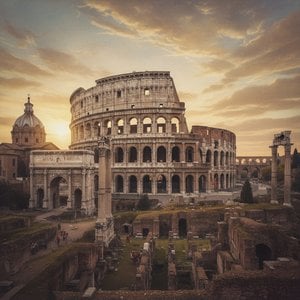
Explore the profound beauty of Roman architecture through art history. From Piranesi's evocative engravings to classical masterpieces, discover how the grandeur of ancient Rome continues to inspire collectors and art enthusiasts worldwide.

 Preview
 Send
Send Share
Share
 Details
 Guide
Guide

 Download
 Similars
 X-Ray
X-Ray Diaporama
 Stats
Stats


 Read More







 Glass option is only available in size under 110 CM


