

Museum-quality giclée or canvas print with fast production and flexible finish options. ( Buy Hand Made Painting Switch to Digital Image)





























Pick from our preset sizes that match the artwork's original proportions.

Type the width and the height you need, to fit your frame or your wall. A print can only be cut, never made bigger than the picture, so a size with a different shape loses a part of the image. We send you a digital mockup to approve before we print anything. The picture shown on this page does not show the real cut — only the mockup does.
Worldwide Delivery () in 2 weeks instead of standard 4/5 weeks. (22 October)
Interior
Reproduction Size

Donato Bramante stands as one of the most transformative figures in the history of Western architecture, a visionary who bridged the gap between the late Gothic traditions and the luminous dawn of the High Renaissance. Born as Donato di Pascuccio d'Antonio in Fermignano, Italy, his journey through the artistic landscapes of Milan and Rome allowed him to reshape the very fabric of sacred and secular spaces. While he was also a painter, his true legacy lies in his ability to translate humanist ideals into stone, introducing a sense of mathematical grace and classical harmony that would define an entire era of European design.
His early career in Milan served as a fertile ground for experimentation, where he began to move away from the rigid, vertical structures of the Gothic period toward a more balanced, rhythmic approach. In works such as his depictions of the Exterior of the Church for Santa Maria delle Grazie, one can observe the emergence of a profound dialogue between the earthly and the divine. Bramante utilized the language of antiquity—Corinthian capitals, sturdy classical columns, and intricate geometric marvels like rose windows—to create structures that felt both monumental and intimately serene. His architectural philosophy was deeply rooted in the rediscovery of Greek and Roman wisdom, employing precise mathematical ratios and the golden section to achieve a sense of celestial order.
As Bramante’s influence expanded toward Rome, he became a central figure in the development of the High Renaissance style. His mastery was not limited to mere construction; he possessed an uncanny ability to manipulate space and perception. This is perhaps most brilliantly realized in his work at Santa Maria presso San Satiro, where he employed architectural magic to dissolve the boundaries between reality and art, creating illusions that transcended physical limitations. His talent for orchestration is also evident in the Tempietto, a small, freestanding chapel that serves as a masterpiece of proportion and a symbolic tribute to the site of Saint Peter’s martyrdom.
Beyond his structural achievements, Bramante's work often embodied the spiritual aspirations of his age. His designs for the Vatican, including the breathtaking Bramante Staircase with its double helix design, were intended to elevate the papal residence into a symbol of divine authority. Even in his rarer known paintings, such as Christ at the Column, there is a palpable sense of the psychological depth and meticulous observation that characterized his entire oeuvre. Through his ability to blend the heavy weight of stone with the lightness of spirit, Donato Bramante did more than build monuments; he crafted a visual language for the soul of the Renaissance.

1444 - 1514 , Italy
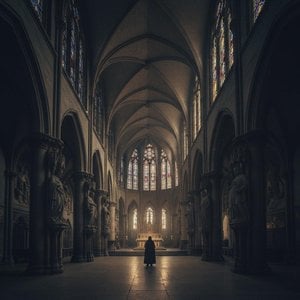
Embark on a journey through the dramatic era of Gothic art. Discover the profound beauty of illuminated manuscripts, sacred gold leaf masterpieces, and the transition to naturalism in this expert-led exploration of medieval artistry and historical grandeur.
Explore the exquisite elegance of International Gothic art. Discover the mastery of illuminated manuscripts, the brilliance of gold leaf, and the legacy of the Limbourg Brothers in this expert guide to Europe's sophisticated medieval dawn.

Embark on a scholarly journey through the spiritual grandeur of Late Medieval art. Discover the intricate symbolism, technical mastery, and profound religious narratives that define the Gothic era in this expert-led guide for art enthusiasts and collectors.

Embark on a scholarly journey through the sacred beauty of High Medieval art. Discover the profound symbolism, luminous iconography, and spiritual depth of Gothic masterpieces in this expert guide for classical art enthusiasts.

 Preview
 Send
Send Share
Share
 Details
 Guide
Guide

 Download
 Similars
 X-Ray
X-Ray Diaporama
 Stats
Stats


 Read More









 Glass option is only available in size under 110 CM


