

 OilWallArtMexican Muralism
 1924Modern
 106.0 x 121.0 cm
Hand-painted oil on canvas in your size and frame, made to order by our artists. ( Switch to Print Switch to Digital Image)





























Pick from our preset sizes that match the artwork's original proportions.

You may enter your own dimensions to fit a specific frame or space. If your selected size does not match the original image's proportions, we will either crop the artwork or extend the painting with additional hand-painted elements. A digital mockup will be sent for your approval before production begins.
Please note that the on-screen preview does not reflect the actual cropping or extension. Only the mockup will accurately show the final composition.
While custom sizes are available, we recommend selecting a dimension from the predefined list to preserve the original proportions.
Worldwide Delivery () in 3/4 weeks instead of standard 5 weeks. (22 September). No compromise on quality.


Woman Grinding Maize
Reproduction Size
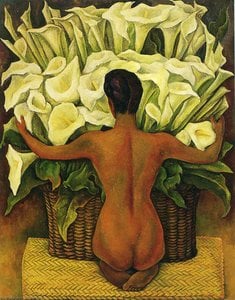
In the quiet, rhythmic labor of Woman Grinding Maize, we encounter one of the most profound expressions of Diego Rivera’s early mastery. Painted in 1924, this evocative work serves as a window into the soul of Mexico, capturing a moment of domestic ritual that transcends simple portraiture. The subject, a woman dressed in a pristine white gown, is captured in a state of deep concentration, her body bowed toward the earth as she engages in the ancient, essential task of processing corn. There is a sacredness to her movement; the way her hands interact with the stone tool suggests a connection to the land that is both physical and spiritual. Through Rivera’s eyes, this mundane act of survival is elevated to a monumental ceremony of life and sustenance.
The composition is masterfully balanced, utilizing a grounded, earthy palette that reflects the very soil from which the maize grows. Rivera employs a technique that blends the structural solidity of his academic training with a burgeoning sense of Mexican Modernism. The heavy, sculptural quality of the woman’s form gives her an almost statuesque presence, making her appear as much a part of the landscape as the stones themselves. Subtle details, such as the soft drape of her scarf and the placement of humble bowls in the background, add layers of narrative depth, suggesting a life defined by tradition, patience, and the quiet dignity of manual labor.
Beyond its visual beauty, the painting is rich with symbolic resonance. Maize, the lifeblood of Mesoamerican civilizations, acts as the central protagonist alongside the woman. By focusing on the grinding process, Rivera pays homage to the ancestral lineage of Mexican culture, celebrating the continuity of indigenous traditions in a rapidly changing world. The white of her dress offers a striking contrast against the more muted, organic tones of the environment, symbolizing purity and the enduring strength of the feminine spirit. For the discerning collector, this piece offers more than just aesthetic pleasure; it provides a profound meditation on identity, resilience, and the unbreakable bond between humanity and nature.
For interior designers and art enthusiasts, Woman Grinding Maize presents a magnificent opportunity to introduce a sense of historical weight and soulful tranquility into a space. As a high-quality reproduction, this artwork brings the commanding presence of Rivera’s vision into the modern home, acting as a focal point that invites contemplation. Whether placed in a sunlit gallery or a sophisticated living area, the painting’s earthy textures and emotive power create an atmosphere of timeless elegance and cultural depth, making it an incomparable addition to any curated collection.

Diego Rivera, born Diego María de la Concepción Juan Nepomuceno Estanislao de la Rivera y Barrientos Acosta y Rodríguez in Guanajuato, Mexico, on December 8, 1886, entered a world already imbued with artistic sensibility. From the tender age of three, an undeniable fascination with art blossomed within him, nurtured by parents who recognized and encouraged his burgeoning talent. His early years were marked by a formal education at the Academy of San Carlos in Mexico City, where he diligently honed his skills in traditional painting and sculpture. A pivotal moment arrived in 1907 when Teodoro A. dehesa Méndez generously sponsored Rivera’s studies abroad, launching him into the heart of Europe's artistic ferment.
His initial sojourn took him to Madrid, Spain, where he studied under Eduardo Chicharro, absorbing the tenets of Realism. However, it was Paris that truly ignited his creative evolution. Immersed in the vibrant Montparnasse community, Rivera encountered a kaleidoscope of artistic perspectives, most notably the revolutionary principles of Cubism after 1912. The influence of Pablo Picasso and Georges Seurat became palpable in his work, as he began to deconstruct forms and explore intersecting planes—a departure from traditional representation that would define a significant phase of his artistic journey.
A profound shift occurred in 1921 when Rivera returned to his homeland, a nation grappling with the aftermath of revolution. This homecoming wasn’t merely a geographical relocation; it was an ideological awakening. He became a central figure in the burgeoning Mexican Mural Movement, a powerful artistic response to the social and political upheaval of the time. The movement aimed to democratize art, bringing it out of elite circles and into public spaces accessible to all citizens.
Rivera’s murals weren't simply decorative; they were potent narratives of Mexican history, culture, and societal struggles. His early masterpieces, such as “Creation” (1922), showcased his innovative use of encaustic technique, while the monumental works at the Secretaría de Educación Pública in Mexico City revealed a distinctive style characterized by large, simplified figures and bold colors—a deliberate homage to Aztec art and pre-Columbian aesthetics. These murals weren’t just paintings; they were visual manifestos, proclaiming a new national identity forged from its indigenous roots and revolutionary spirit.
Diego Rivera's artistic style is instantly recognizable—a monumental scale that commands attention, simplified forms that convey powerful messages, vibrant colors that evoke the richness of Mexican culture, and an unwavering focus on social and historical narratives. His work wasn’t confined to aesthetic concerns; it was deeply intertwined with his political beliefs, particularly his Marxist convictions.
The “Dreams of a Sunday in the Alameda” is perhaps one of his most iconic works, though also controversial for its depiction of atheism. The Detroit Industry Murals (1933), commissioned for the Detroit Institute of Arts, stand as a testament to his ability to capture the dynamism and complexity of industrial life, portraying both the power of machinery and the dignity of the workers who operated it. He seamlessly blended elements of Mexican folk art with pre-Columbian imagery, creating a visual language that was uniquely his own—a powerful synthesis of tradition and modernity.
Diego Rivera’s impact on 20th-century art is immeasurable. He isn't merely remembered as one of Mexico’s most important artists, but as a global icon whose work continues to resonate with audiences today. His murals are not just artistic achievements; they are significant examples of social realism and public art—powerful statements about the human condition and the struggle for social justice.
He played a pivotal role in establishing Mexican Muralism as an influential artistic movement, inspiring generations of artists to use their work as a vehicle for social commentary. His personal life, particularly his passionate and often tumultuous relationship with Frida Kahlo, has further cemented his place in popular culture, adding another layer of intrigue to his already captivating legacy.
Rivera’s commitment to portraying the lives and struggles of ordinary people, combined with his innovative artistic techniques, ensures that his work will continue to inspire and provoke thought for generations to come. He left behind a body of work that is not only visually stunning but also deeply meaningful—a testament to the power of art to shape our understanding of history, culture, and ourselves.

1886 - 1957 , Mexico

Embark on a visual journey through the soul of Mexican art. Explore the profound legacy of muralism, folk traditions, and revolutionary masters like Rivera and Orozco in this deep cultural exploration of color, symbolism, and identity.

Elevate your hospitality projects with our expert trend forecast on luxury murals. From biophilic botanical jungles to opulent gold leaf geometry, discover how bespoke large-scale wall art and custom frescoes can transform hotel interiors into unforgettable architectural statements.

Explore the profound impact of Mexican Muralism, a visual revolution born from social struggle. Delve into the monumental works of Rivera, Orozco, and Siqueiros, uncovering how these powerful frescoes redefined identity and ignited a lasting legacy of resistance in art history.

Discover how bespoke mural art transforms empty spaces into soulful sanctuaries. Explore the luxury of large-scale architectural frescoes, geometric abstractions, and custom oil paintings designed to elevate high-end interiors with unparalleled artistry and emotional depth.

 Preview
 Send
Send Share
Share
 Details
 Guide
Guide

 Download
 Similars
 X-Ray
X-Ray Diaporama
 Stats
Stats Read More







 Glass option is only available in size under 110 CM


![Seated Nude With Raised Arms [desnudo Sentado Con Brazos Levantados (frida Kahlo)] — Diego Rivera, Social Realism](/media/artworks/images-thumb/64/7a/647aa47374e4603dc3a49d246d953b33.jpg)


