
x


 Acrylic On CanvasWallArtContemporary Abstract Expressionism
 2017Modern
 122.0 x 122.0 cm
 The Broad
Hand-painted oil on canvas in your size and frame, made to order by our artists. ( Buy Print Buy Image)





























Pick from our preset sizes that match the artwork's original proportions.

You may enter your own dimensions to fit a specific frame or space. If your selected size does not match the original image's proportions, we will either crop the artwork or extend the painting with additional hand-painted elements. A digital mockup will be sent for your approval before production begins.
Please note that the on-screen preview does not reflect the actual cropping or extension. Only the mockup will accurately show the final composition.
While custom sizes are available, we recommend selecting a dimension from the predefined list to preserve the original proportions.
Worldwide Delivery () in 3/4 weeks instead of standard 5 weeks. (27 August). No compromise on quality.


Just in
Reproduction Size
David Michael Hinnebusch's "Just in," created in 2017, is more than simply a depiction of a man with glasses; it’s an arresting meditation on the complexities of modern existence. Measuring 122 x 122 cm, this painting immediately draws the viewer into its scene – a solitary figure, seemingly lost in thought, positioned within a subtly rendered urban backdrop. The subject, clad in a vibrant red shirt, occupies the central focus, his open mouth suggesting either fervent speech or a poignant song, inviting us to contemplate the unspoken narratives that shape our lives.
"Just in" exemplifies Hinnebusch's approach to figurative painting, blending elements of realism with expressive brushwork. The artist utilizes a technique reminiscent of Neo-Expressionism, characterized by bold strokes and a deliberate rejection of purely representational accuracy. This isn’t about photographic precision; it’s about conveying feeling and atmosphere through the manipulation of color and texture. Notice the loose application of paint, particularly in the background, which creates a sense of movement and uncertainty – mirroring perhaps the subject's own disorientation or contemplation.
The artist’s use of impasto—thickly applied paint—adds to the painting’s tactile quality, inviting the viewer to engage with the surface on a deeper level. This technique further emphasizes the emotional intensity of the scene and contributes to its overall dynamism. The guitar present in the composition adds another layer of complexity, hinting at themes of creativity, expression, and perhaps even melancholy.
Born in Pittsburgh in 1968, David Michael Hinnebusch’s artistic practice is rooted in a lineage of American artists who challenged traditional notions of representation. While his work doesn't explicitly reference specific movements like Surrealism or Abstract Expressionism – as seen in the biography of Robert Rauschenberg – there are echoes of these influences in his approach to combining recognizable figures with abstract elements and exploring themes of identity and alienation. The painting’s urban setting speaks to a broader trend in mid-20th century art, reflecting the anxieties and uncertainties of a rapidly changing world.
"Just in" resonates with powerful emotional currents. The solitary figure's posture suggests vulnerability and introspection, prompting viewers to consider their own experiences of isolation or contemplation. The open mouth, whether representing speech or song, symbolizes the human desire for connection and expression. Ultimately, Hinnebusch’s painting is a poignant reminder of the universal themes of identity, emotion, and the search for meaning in an increasingly complex world. It's a piece that invites quiet reflection and offers a glimpse into the soul of a single individual within the vastness of urban life.

Born Milton Ernest Rauschenberg in Port Arthur, Texas, on October 22, 1925, Robert Rauschenberg’s artistic journey was one of constant experimentation and a deliberate blurring of boundaries. His early life, shaped by a fundamentalist Christian household and a father working for Gulf States Utilities, provided an unexpected foundation for his later radical approach to art. This seemingly disparate background fueled a restless curiosity that would propel him through diverse educational paths – from the University of Texas at Austin to the Chelsea School of Art in London – before ultimately establishing him as one of the most influential figures of mid-20th century American art.
Rauschenberg’s formative years were marked by a deep engagement with various artistic movements. He initially explored Surrealism and Abstract Expressionism, absorbing the energy of artists like Jackson Pollock and Mark Rothko. However, he quickly moved beyond these established frameworks, developing his own unique language characterized by a playful juxtaposition of materials, techniques, and concepts. This shift culminated in the development of the “Combine” paintings – works that began to dismantle traditional notions of painting and sculpture, incorporating everyday objects such as tires, fabric scraps, photographs, and even human hair into layered compositions. These early pieces, like *Monogram* (1955) and *Canyon* (1959), demonstrated a willingness to challenge the very definition of art and its relationship to the world around it.
The “Combine” paintings represent a pivotal moment in Rauschenberg’s career, effectively bridging the gap between painting and sculpture. He deliberately avoided rigid categorization, preferring to describe his work as “paintings with objects.” This approach wasn't simply about adding elements; it was a fundamental rethinking of the artistic process. He often used found objects – remnants from industrial processes or discarded materials – imbued with their own histories and narratives. These objects weren’t merely decorative additions but integral components, contributing to the overall meaning and visual impact of the work.
Following the success of the Combines, Rauschenberg continued to innovate, exploring printmaking, papermaking, and performance art. His 1968 monumental print, *Autobiography*, stands as a particularly significant achievement. Printed on three sheets of paper using a billboard press – a technique typically reserved for commercial advertising – it was an ambitious undertaking that synthesized his personal history with references to places of significance and recurring motifs like umbrellas and wheels. The sheer scale of the work—over sixteen feet tall—and its intricate layering of images, text, and found objects created a complex and layered meditation on selfhood and artistic practice.
Rauschenberg’s influence extends far beyond his own body of work. He played a crucial role in shaping the trajectory of Pop Art, Minimalism, and Conceptual art, demonstrating a willingness to embrace popular culture while simultaneously pushing the boundaries of traditional artistic conventions. His use of found objects paved the way for artists like Andy Warhol and Jeff Koons, who similarly incorporated everyday materials into their creations.
Throughout his career, Rauschenberg received numerous accolades, including the National Medal of Arts in 1993 and the Leonardo da Vinci World Award of Arts in 1995. His work is held in major museums worldwide, a testament to its enduring significance. Robert Rauschenberg’s legacy lies not only in his groundbreaking artistic innovations but also in his unwavering commitment to experimentation, collaboration, and a profound engagement with the complexities of contemporary life. He died on May 12, 2008, leaving behind a body of work that continues to challenge and inspire artists and viewers alike.
Robert Rauschenberg’s work has been consistently praised by critics for its originality, inventiveness, and intellectual depth. Early reviews often focused on the shock value of his “Combine” paintings, highlighting their unconventional use of materials and techniques. However, over time, critics have recognized the profound philosophical implications of his work, emphasizing its exploration of themes such as identity, perception, and the relationship between art and everyday life. Works like *Autobiography* are frequently cited for their complex layering of imagery and text, inviting viewers to engage in a sustained dialogue with the artist’s personal history and artistic vision.

1968 - , United States of America
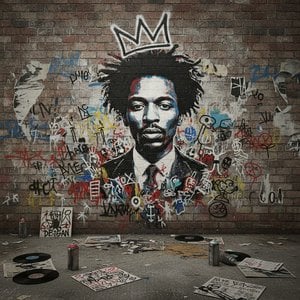
Explore the raw energy of Jean-Michel Basquiat and Neo-Expressionism. Discover how urban rebellion redefined modern art through a lens of luxury, identity, and profound emotional intensity for the discerning collector.

Discover the profound power of Expressionist art. From the raw intensity of Edvard Munch to the visceral textures of Neo-Expressionism, explore how subjective emotion and distorted reality define this movement. An expert guide for discerning collectors seeking depth and soul in fine art.


Stay updated with the latest art news, exclusive offers, and decoration ideas.
Tell us about your project and our art experts will provide you with 3 personalized art suggestions.
Let Us Curate 3 Options Just for You - Free!

 Preview
 Send
Send Share
Share
 Details

 Download
 Similars
 X-Ray
X-Ray Diaporama
 Read More







 Glass option is only available in size under 110 CM


