Museum-quality giclée or canvas print with fast production and flexible finish options. ( Buy Hand Made Painting Switch to Digital Image)
Pick from our preset sizes that match the artwork's original proportions.

You may enter your own dimensions to fit a specific frame or space. If your selected size does not match the original image's proportions, we will either crop the artwork or extend the image with a mirrored or solid-fill edge. A digital mockup will be sent for your approval before production begins.
Please note that the on-screen preview does not reflect the actual cropping or extension. Only the mockup will accurately show the final composition.
While custom sizes are available, we recommend selecting a dimension from the predefined list to preserve the original proportions.
Worldwide Delivery () in 2 weeks instead of standard 4/5 weeks. (23 September)


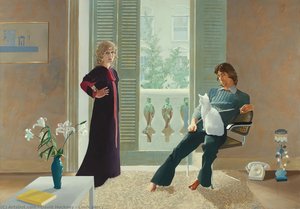
Man in Shower in Beverly Hills
Reproduction Size
David Hockney's 1964 painting, 'Man in Shower in Beverly Hills,' isn’t merely a depiction of a domestic scene; it’s a vibrant, almost hallucinatory capture of the burgeoning glamour and anxieties of early 1960s Los Angeles. Executed with Hockney’s signature use of acrylic paint on canvas, the work immediately draws the viewer into its saturated palette – bold pinks, greens, and yellows dominate, reflecting not just the physical environment but also a heightened sense of artificiality and desire that characterized the era. The painting's power lies in its deceptively simple composition: a solitary figure, seemingly lost in thought, stands beneath a showerhead within a meticulously rendered bathroom. This unassuming subject becomes a potent symbol of modern life, exploring themes of isolation, luxury, and the performance of identity – all hallmarks of Hockney’s artistic vision.
Created during a period of immense social and cultural change in America, 'Man in Shower' reflects the rise of Hollywood as a global phenomenon. The painting emerged against the backdrop of burgeoning consumerism, the influence of European modern art (particularly Matisse and Bacon), and the emergence of Pop Art. Hockney’s decision to depict this seemingly mundane scene – a man showering – was deliberately provocative. It challenged traditional notions of artistic subject matter, elevating everyday life to the level of high art. The painting's location in Beverly Hills, a symbol of wealth and aspiration, further amplifies its commentary on the American Dream and the anxieties surrounding success and status.
Hockney’s technique is instantly recognizable – characterized by his confident brushstrokes, vibrant color choices, and a deliberate flattening of perspective. He eschews traditional realism in favor of an expressive style that prioritizes sensation over precise representation. The use of acrylic paint allowed for rapid layering and blending, contributing to the painting's luminous quality. Notice how Hockney uses light and shadow not to create depth but to emphasize form and color. This technique creates a sense of immediacy and almost photographic realism, despite the stylized rendering. The composition is carefully balanced, with the figure occupying a central position while the surrounding elements – the chair, sink, and showerhead – are rendered with meticulous detail.
'Man in Shower' transcends its literal subject matter to evoke a deeper emotional response. The solitary figure embodies feelings of isolation and introspection within a world of excess. The shower itself can be interpreted as a metaphor for cleansing, both physically and psychologically – a desire to escape the pressures of modern life. The painting’s bright colors contribute to this sense of unease, creating a visually stimulating yet emotionally detached atmosphere. It's a work that invites contemplation on themes of identity, alienation, and the pursuit of happiness in an increasingly complex world. The image continues to resonate today, offering a fascinating glimpse into a pivotal moment in American art history and culture.


1937 - , United Kingdom
Explore the groundbreaking work of David Bomberg, a pivotal figure in British abstraction. Discover his artistic evolution, influences, and lasting legacy through insightful analysis & expert commentary.

Explore the luminous landscapes of Thomas Hill, a pivotal figure in the Hudson River School & Luminism movements. Discover his artistic journey, philosophical depth, and enduring legacy with WahooArt.

Explore the life & work of David Hockney, Pop Art's master chronicler. Discover his iconic paintings, Californian landscapes, and lasting influence on modern art. Expert analysis for collectors.

Explore the captivating world of Gerard David, a pivotal figure bridging late medieval artistry with the Early Renaissance. Discover his innovative techniques, religious masterpieces, and enduring legacy – a must-read for discerning art collectors.

Explore the life & art of Jacques-Louis David, leading Neoclassical painter of the French Revolution. Discover iconic works like 'The Death of Marat' and his lasting impact on art history. Expert analysis & high-quality reproductions at WahooArt.

 Preview
 Send
Send Share
Share
 Details
 Guide
Guide

 Download
 Similars
 X-Ray
X-Ray Diaporama
 Stats
Stats

 Read More




































 Glass option is only available in size under 110 CM