x


 Oil On CanvasWallArtNorthern Mannerism
 1670Early Modern
 97.0 x 85.0 cm
 Szépmûvészeti Múzeum
Hand-painted oil on canvas in your size and frame, made to order by our artists. ( Buy Print Buy Image)





























Pick from our preset sizes that match the artwork's original proportions.

You may enter your own dimensions to fit a specific frame or space. If your selected size does not match the original image's proportions, we will either crop the artwork or extend the painting with additional hand-painted elements. A digital mockup will be sent for your approval before production begins.
Please note that the on-screen preview does not reflect the actual cropping or extension. Only the mockup will accurately show the final composition.
While custom sizes are available, we recommend selecting a dimension from the predefined list to preserve the original proportions.
Worldwide Delivery () in 3/4 weeks instead of standard 5 weeks. (28 August). No compromise on quality.


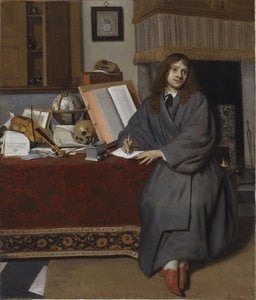
The Chess Players
Reproduction Size

In the vibrant tapestry of the Dutch Golden Age, few threads are as intricately woven as those left by Cornelis de Man. Born in the historic city of Haarlem around 1562, De Man emerged during a transformative era when the rigid structures of the late Renaissance were beginning to soften into the expressive fluidity of Northern Mannerism. As a pivotal figure of his time, he acted as a vital bridge between the classical ideals of the past and the burgeoning realism that would later define the works of masters like Frans Hals. His life and artistry represent a profound dialogue between the disciplined techniques of the Flemish tradition and a uniquely Dutch sensibility for capturing the soul within the subject.
The foundation of De Man’s extraordinary skill was laid through a rigorous and diverse apprenticeship. His early years in Haarlem were spent under the watchful eye of Pieter Pietersz, an artist whose mastery of landscape and portraiture provided De Man with a fundamental understanding of naturalism. However, it was his subsequent journey to Antwerp that truly expanded his artistic horizons. By studying under Gillis Coignet, De Man immersed himself in the sophisticated world of Flemish Mannerism. This period of intense training allowed him to absorb complex compositional structures and a refined approach to pigment handling, blending the architectural precision of the Southern Netherlands with the atmospheric depth characteristic of the Northern tradition.
To observe a work by Cornelis de Man is to witness a masterful manipulation of light, shadow, and texture. His style is defined by an exquisite balance between realism and mannerist elegance. While he drew inspiration from the idealized forms of the Italian Renaissance, De Man eschewed hollow perfection in favor of an unflinching honesty. He possessed a rare ability to capture the subtle nuances of human emotion—the slight furrow of a brow, the quiet intensity of a gaze, or the delicate tension in a hand—thereby imbuing his portraits and genre scenes with a profound psychological depth.
His technical repertoire was remarkably versatile, allowing him to navigate various thematic territories with ease:
The historical importance of Cornelis de Man lies not only in the beauty of his individual canvases but in his role as a precursor to the great Dutch masters of the 17th century. He helped cultivate an artistic language that prioritized the observation of nature and the emotional resonance of the human condition. His work served as a vital link in the evolution of Northern European art, moving away from the stylized distortions of late Mannerism toward the luminous realism of the Baroque period.
Though time has occasionally obscured the names of many artists from this era, De Man’s contribution remains etched in the development of the Haarlem School. His dedication to meticulous detail and his ability to harmonize vibrant color palettes with dramatic chiaroscuro ensured that his legacy would endure. Today, as we reflect on the transition from the Renaissance to the Golden Age, Cornelis de Man stands as a testament to the enduring power of an artist who could capture both the grandeur of the divine and the intimate truth of the human spirit.

1562 - 1638 , Netherlands

Embark on a sophisticated journey through the Dutch Golden Age. Unveil the dramatic brilliance of Rembrandt’s chiaroscuro and the expressive landscapes of 17th-century masters in this authoritative exploration of light, shadow, and enduring artistic legacy.

Explore the breathtaking mastery of Dutch Golden Age landscapes. From Italianate light to atmospheric realism, discover the techniques of 17th-century masters and learn how to bring these timeless, museum-quality masterpieces into your home through expert oil reproductions.


Stay updated with the latest art news, exclusive offers, and decoration ideas.
Tell us about your project and our art experts will provide you with 3 personalized art suggestions.
Let Us Curate 3 Options Just for You - Free!

 Preview
 Send
Send Share
Share
 Details

 Download
 Similars
 X-Ray
X-Ray Diaporama
 Read More







 Glass option is only available in size under 110 CM