


Museum-quality giclée or canvas print with fast production and flexible finish options. ( Buy Hand Made Painting Switch to Digital Image)





























Pick from our preset sizes that match the artwork's original proportions.

Type the width and the height you need, to fit your frame or your wall. A print can only be cut, never made bigger than the picture, so a size with a different shape loses a part of the image. We send you a digital mockup to approve before we print anything. The picture shown on this page does not show the real cut — only the mockup does.
Worldwide Delivery () in 2 weeks instead of standard 4/5 weeks. (18 November)
Colonel William Leete Stone
Reproduction Size
A single quill pen rests against a stack of papers, its tip poised as if caught in a moment of sudden thought. The light strikes the white linen of a cravat, a sharp contrast against the heavy, dark tones of the background. This is the world of Colonel William Leete Stone, rendered in oil on canvas in 1839. He does not look at the viewer. Instead, his gaze is directed upward and toward the left, toward an unseen idea or a distant conviction. The face is etched with the quiet intensity of a man accustomed to the weight of words and the gravity of public service.
The brushwork is controlled and precise, following the academic realism of the mid-19th century. Every fold in his formal attire and every contour of his skin is defined by a deliberate hand. The shadows are deep, swallowing the edges of the room to push the subject forward into the light. It is a portrait of intellectual focus, where the texture of the fabric meets the smooth, pale skin of the neck in a silent dialogue of light and dark.
The portrait captures more than a likeness; it captures a specific, restless energy. The subject was a man of significant influence in New York, a writer and editor whose life was defined by the pursuit of reform. His presence in the frame suggests a man of action through thought.
History remembers him as a man who campaigned for the abolition of slavery and supported the independence of Greece. He was a man who sought to shape the social fabric of his time, much like the ink he once spilled. The painting holds this tension between the stillness of the pose and the movement of his spirit.
There is a stillness here that feels temporary. The light catches the edge of a hand, a pale shape against the dark void of the room. It is the quiet moment before the next sentence is written, or the moment of reflection after a long day of advocacy. The shadows do not merely surround him; they define the space he occupies, carving his silhouette out of the darkness. The ink is dry, but the intent remains.
The copyright status of "Colonel William Leete Stone" by William Page is clear: the work is in the public domain - its copyright has expired. Its presence at the Cleveland Museum of Art does not change that status.
Behind "Colonel William Leete Stone" stand William Page and the Academic Realism movement.
"Colonel William Leete Stone" by William Page can be previewed on your own wall with the artwork's AR Preview page, using augmented reality on a compatible device.

Born in Albany, United States, William Page was a versatile American painter and portrait artist. His early training began in the office of Frederick de Peyster, followed by studies in the studio of James Herring. He eventually became a pupil of Samuel F. Morse and enrolled at the National Academy of Design, where his drawings in the antique class earned him a silver medal. After a brief period studying theology at the Andover Theological Seminar and Amherst College, he returned to the world of art.
Page's career saw him move between New York and Boston, eventually spending eleven years residing in Florence and Rome. During his time in Italy, he painted portraits of notable figures such as Robert and Elizabeth Browning. He was deeply inspired by the works of the great masters, particularly Titian, whose painting method he sought to discover. His copies of Titian's works were so remarkable that one was once seized by Florentine authorities under the belief that it was an original.
Throughout his career, Page executed a wide array of subjects, from religious scenes like "Moses and Aaron on Mount Horeb" and "The Holy Family" to portraits of prominent individuals. His portraiture included likenesses of:
In addition to his painting, Page was a man of diverse interests; he wrote A New Geometrical Method of Measuring the Human Figure and held patents for various improvements in guns and boats. He died on Staten Island.

1811 - 1885 , United States

Explore the emotional power of Delacroix and French Romanticism through expert analysis. Discover the revolution of color and movement now.

Explore how military art evolved from imperial propaganda to raw realism. Discover the profound human truth behind every brushstroke.

Step into the dramatic world of Gustave Doré. Explore 25 iconic masterpieces of light and shadow, from epic biblical engravings to gothic tales. Find museum-quality art reproductions and timeless decor inspiration. Discover all masterpieces on WahooArt.com.
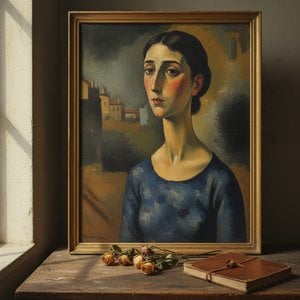
Delve into the haunting beauty of Amedeo Modigliani's portraits. Explore the intersection of Expressionism and Modernism through an expert analysis of his iconic elongated forms, melancholic gazes, and profound influence on art history.
 Preview

 Send
 Share
 Details
 Guide


 Download
 Similars
 X-Ray
 Diaporama
 Q&A

 Stats


 Read More









 Glass option is only available in size under 110 CM


