

 Acrylic On CanvasWallArtAbstract Expressionism
 1971
1971 202.0 x 165.0 cm
 Metropolitan Museum of Art
The artwork displayed on this page is protected by copyright law, which means we cannot legally create or sell an identical reproduction. This protection is enforced under international agreements such as the Berne Convention and by national laws, including those outlined by the U.S. Copyright Law - Title 17.
This method fully complies with copyright regulations because it does not involve copying or duplicating the protected artwork. Instead, it is a creative reinterpretation - a new painting that is influenced by the original but not identical to it.
Museum-quality giclée or canvas print with fast production and flexible finish options. ( Buy Hand Made Painting Switch to Digital Image)





























Pick from our preset sizes that match the artwork's original proportions.

Type the width and the height you need, to fit your frame or your wall. A print can only be cut, never made bigger than the picture, so a size with a different shape loses a part of the image. We send you a digital mockup to approve before we print anything. The picture shown on this page does not show the real cut — only the mockup does.
Worldwide Delivery () in 2 weeks instead of standard 4/5 weeks. (21 October)
Untitled
Reproduction Size
Clyfford Still’s 1971 painting, “Untitled,” isn’t a landscape to be observed or a figure to be deciphered. Instead, it’s an experience—a visceral plunge into the heart of abstract expressionism, rendered with a deliberate roughness and a profound sense of urgency. The work immediately commands attention through its dominant verticality; these stark lines, painted in deep black against a bruised crimson backdrop, create a powerful division within the canvas, suggesting both containment and explosive release. This isn’t an attempt to mimic nature or represent recognizable forms; rather, Still utilizes color and line as primary languages of feeling, conveying a complex emotional state through their interaction.

What initially appears as a simple color field painting reveals itself to be remarkably tactile upon closer inspection. Still’s technique is deliberately unrefined, eschewing the smooth, blended surfaces favored by some of his contemporaries. Thick, visible brushstrokes—evidence of application with palette knives or similar tools—build up layers of paint that possess an almost sculptural quality. The edges aren't neatly finished; instead, they exhibit signs of wear and tear – peeling paint, a deliberate rejection of the pristine aesthetic. This roughness isn’t accidental; it speaks to the artist’s process, his engagement with the materiality of the canvas itself, and perhaps even a reflection of the emotional turmoil he sought to express. The varying thickness of the paint—thicker in the central lines, thinner around the edges—creates subtle shifts in tone and texture, adding depth and dynamism to the composition.
Clyfford Still emerged as a pivotal figure within Abstract Expressionism, yet his approach was markedly distinct. Unlike the gestural energy of Jackson Pollock or the meditative color fields of Mark Rothko, Still’s work is characterized by its stark geometry and raw emotional intensity. Born in 1904 amidst the vast landscapes of North Dakota, his early life instilled a deep connection to the natural world – a connection that subtly informs the painting's underlying tension. His shift towards non-figurative abstraction occurred earlier than many of his peers, forging a path toward a new visual language rooted in personal experience and emotional expression. The 1971 “Untitled” exemplifies this approach, moving beyond mere color to explore the very essence of form and feeling. It’s important to note that Still deliberately distanced himself from the commercial art world later in his career, prioritizing artistic integrity over market appeal – a stance reflected in the painting's unpolished surface and uncompromising emotional directness.
While devoid of explicit imagery, “Untitled” is profoundly evocative. The stark vertical lines can be interpreted as barriers—divisions between states of being, perhaps—while the crimson background suggests both passion and danger. The green areas, applied more thinly, might represent moments of respite or vulnerability within this turbulent landscape. Still’s work resists easy interpretation; it invites viewers to project their own emotions and experiences onto its surface. It's a painting that demands engagement, prompting reflection on themes of isolation, struggle, and the fundamental nature of human experience. The deliberate lack of resolution—the unfinished edges, the raw texture—suggests an ongoing process, a perpetual state of becoming rather than a fixed representation.
Artworks similar to "Untitled" by Clyfford Still are gathered on the artwork's Similars page.
"Untitled" is classified as recognized.
"Untitled" by Clyfford Still is still protected by copyright. Copyright terms are measured from the artist's death, and Clyfford Still died in 1980.

1904 - 1980 , United States of America

Explore 10 defining Abstract Expressionism masterpieces by Pollock, Rothko & de Kooning. Discover the stories behind these iconic paintings and find museum-quality art reproductions to elevate your home decor on .
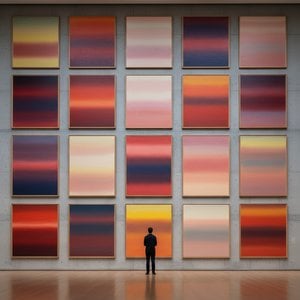
Explore 25 iconic Mark Rothko paintings that define Abstract Expressionism. Discover the stories, colors & emotions behind these masterpieces. Find museum-quality art reproductions and curated decor ideas at WahooArt.com.

Explore the profound world of Clyfford Still's Abstract Expressionism with WahooArt. Discover his unique style, existential themes & investment potential. Expert analysis for discerning collectors.

Journey through Wassily Kandinsky's 25 most iconic abstract paintings. Explore his revolutionary use of color, form & spiritual expressionism. Find museum-quality Kandinsky reproductions and elevate your home decor with WahooArt.com. Discover all masterpieces on WahooArt.com!

Explore the profound emotional world of Abstract Expressionism with WahooArt. Discover key artists like Pollock & Rothko, learn about collecting, and find museum-quality reproductions to inspire your space.

 Preview
 Send
Send Share
Share
 Details
 Guide
Guide

 Download
 Similars
 X-Ray
X-Ray Diaporama
 Stats
Stats Read More









 Glass option is only available in size under 110 CM


![PH-233 [formerly Self-Portrait]](/media/artworks/images-thumb/ee/8d/ee8d64fde49d8167a8ef180934d1231c.jpg)


