Preview AR preview Buy Hand Made Painting Switch to Digital Image Send
Details Guide Add to favorites Download Similars X-Ray Diaporama Stats

Potro Rojo

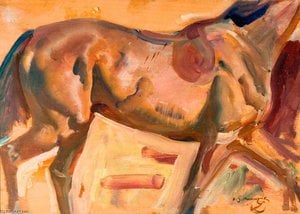
A striking hyperrealist study of a grazing brown horse by Chilean master Claudio Bravo captures profound stillness and meticulous detail, offering a timeless opportunity to bring this classic beauty into your collection.

Chilean hyperrealist Claudio Bravo (1936-2011) blended Renaissance & Surrealist influences, creating stunning portraits & still lifes celebrated for their meticulous detail and evocative beauty.

The artwork displayed on this page is protected by copyright law, which means we cannot legally create or sell an identical reproduction. This protection is enforced under international agreements such as the Berne Convention and by national laws, including those outlined by the U.S. Copyright Law - Title 17.

This method fully complies with copyright regulations because it does not involve copying or duplicating the protected artwork. Instead, it is a creative reinterpretation - a new painting that is influenced by the original but not identical to it.

Giclée / Art Print

Museum-quality giclée or canvas print with fast production and flexible finish options. ( Buy Hand Made Painting Switch to Digital Image)

Corner sample of the P118B picture frame: moulded polystyrene, 5 cm wide and 3 cm thick
P118B $10
Corner sample of the P118H picture frame: moulded polystyrene, 5 cm wide and 3 cm thick
P118H $10
Corner sample of the P118W picture frame: moulded polystyrene, 5 cm wide and 3 cm thick
P118W $10
Corner sample of the P438Z picture frame: moulded polystyrene, 5.5 cm wide and 3.5 cm thick
P438Z $10
Corner sample of the P508JH picture frame: moulded polystyrene, 7 cm wide and 3.5 cm thick
P508JH $12
Corner sample of the P508YH picture frame: moulded polystyrene, 7 cm wide and 3.5 cm thick
P508YH $12
Corner sample of the P805H picture frame: moulded polystyrene, 5 cm wide and 3.5 cm thick
P805H $10
Corner sample of the P805Z picture frame: moulded polystyrene, 5 cm wide and 3.5 cm thick
P805Z $10
Corner sample of the P919BZ picture frame: moulded polystyrene, 7 cm wide and 3.5 cm thick
P919BZ $10
Corner sample of the P919G picture frame: moulded polystyrene, 7 cm wide and 3.5 cm thick
P919G $10
Corner sample of the P919XJ picture frame: moulded polystyrene, 7 cm wide and 3.5 cm thick
P919XJ $10
Corner sample of the P959ZH picture frame: moulded polystyrene, 5 cm wide and 3 cm thick
P959ZH $10
Corner sample of the P968JZ picture frame: moulded polystyrene, 6 cm wide and 4 cm thick
P968JZ $12
Corner sample of the W106C picture frame: solid wood, 5 cm wide and 3 cm thick
W106C $8
Corner sample of the W218G picture frame: solid wood, 5 cm wide and 3 cm thick
W218G $10
Corner sample of the W218JH picture frame: solid wood, 5 cm wide and 3 cm thick
W218JH $8
Corner sample of the W218Y picture frame: solid wood, 5 cm wide and 3 cm thick
W218Y $10
Corner sample of the W307PJ picture frame: solid wood, 6 cm wide and 3 cm thick
W307PJ $10
Corner sample of the W316G picture frame: solid wood, 6 cm wide and 3 cm thick
W316G $10
Corner sample of the W316PJ picture frame: solid wood, 6 cm wide and 3 cm thick
W316PJ $8
Corner sample of the W316Y picture frame: solid wood, 6 cm wide and 3 cm thick
W316Y $10
Corner sample of the W398PJ picture frame: solid wood, 5 cm wide and 3 cm thick
W398PJ $8
Corner sample of the W4111J picture frame: solid wood, 6.5 cm wide and 3.5 cm thick
W4111J $10
Corner sample of the W500HY picture frame: solid wood, 7 cm wide and 5 cm thick
W500HY $15
Corner sample of the W500JH picture frame: solid wood, 7 cm wide and 5 cm thick
W500JH $15
Corner sample of the W692G picture frame: solid wood, 8 cm wide and 4 cm thick
W692G $12
Corner sample of the W849H picture frame: solid wood, 5 cm wide and 3 cm thick
W849H $8
Corner sample of the W940BG picture frame: solid wood, 7.5 cm wide and 4.5 cm thick
W940BG $15
Corner sample of the W953PJ picture frame: solid wood, 6 cm wide and 3.5 cm thick
W953PJ $8

Standard
custom
CM
INCH

Pick from our preset sizes that match the artwork's original proportions.

width
height

Type the width and the height you need, to fit your frame or your wall. A print can only be cut, never made bigger than the picture, so a size with a different shape loses a part of the image. We send you a digital mockup to approve before we print anything. The picture shown on this page does not show the real cut — only the mockup does.

Worldwide Delivery () in 2 weeks instead of standard 4/5 weeks. (25 October)

Free Worldwide Express Shipping
High-Quality Linen Canvas
Full Shipping Insurance
Customs Tax Refund Guarantee
True Color Matching Guarantee
100-Day Return Policy (Defects Only)
100% Money-Back Guarantee
Bulk Discount Offer

Total Price

$ 69

Potro Rojo

Giclée / Art Print

Reproduction Size

-

Total Price

$ 69

Quick Facts

  • Year: 1997
  • Title: Potro Rojo
  • Notable elements or techniques: Hyperrealism, black and white tones

The Quiet Majesty of Claudio Bravo’s Potro Rojo

In the realm of hyperrealism, few artists possess the ability to capture the profound stillness of a single moment as masterfully as the Chilean visionary Claudio Bravo. His work Potro Rojo serves as a breathtaking testament to this skill, presenting a scene that transcends mere representation to reach a state of poetic meditation. The painting depicts a solitary brown horse, its powerful form anchored firmly within a landscape of soft, grassy terrain. As the creature bows its head toward the earth, there is an intimate sense of vulnerability and peace, as if the viewer has stumbled upon a private ritual of nature. Though the title suggests a vibrant warmth, the execution invites us into a monochromatic or desaturated world where light and shadow perform a delicate dance, stripping away the distractions of color to reveal the raw, structural elegance of the subject.

The technique employed in Potro Rojo is nothing short of miraculous, showcasing Bravo’s legendary command over texture and luminosity. Every strand of the horse's mane and every subtle contour of its muscular anatomy is rendered with a meticulous precision that blurs the line between painting and photography. This hyperrealist approach does not merely aim for accuracy; it seeks to heighten our sensory perception. One can almost feel the coarse texture of the coat and the dampness of the earth beneath the hooves. By utilizing a palette that leans into the classic, timeless feel of black and white tones, Bravo elevates the subject matter from a simple pastoral scene to an iconic study of form. The way light catches the curve of the horse's neck creates a sculptural quality, making the figure appear almost three-dimensional within its frame.

Beyond its technical brilliance, the artwork carries a deep emotional resonance that makes it a profound choice for discerning collectors and interior designers alike. There is a rhythmic, breathing quality to the composition; the downward gaze of the horse creates a circularity of movement that draws the eye inward, fostering a sense of tranquility and introspection. For those looking to curate a space of sophistication and calm, this piece offers an anchor of quiet strength. It does not shout for attention but rather commands it through its dignified presence. Whether placed in a contemporary gallery setting or integrated into a classic, richly textured room, Potro Rojo acts as a window into a world of serene beauty, reminding us of the profound grace found in the simplest movements of the natural world.

Questions & Answers

Which room is "Potro Rojo" by Claudio Bravo recommended for, given its colors?

With its dark palette, "Potro Rojo" by Claudio Bravo is recommended for a living room. The colors are part of the reason for this suggestion.

What use and space are recommended for "Potro Rojo" by Claudio Bravo?

Use (neutral) and space (living room) are the two recommendations recorded for "Potro Rojo" by Claudio Bravo.

How do the colors of "Potro Rojo" by Claudio Bravo relate to its emotion?

In "Potro Rojo", dark colors accompany a tranquil feeling.


Artist Biography

A Chilean Visionary: The Life and Art of Claudio Bravo

Claudio Bravo, a name synonymous with hyperrealism, emerged from the vibrant cultural landscape of Valparaíso, Chile, in 1936. His journey was one of remarkable dedication to his craft, evolving from early portrait commissions undertaken to excel in school to becoming an internationally celebrated artist whose works bridge European traditions and Latin American sensibilities. Born into a family where artistic inclination wasn’t immediately encouraged – his father, a businessman, initially viewed art as impractical – Bravo nonetheless found support that nurtured his burgeoning talent. This came through the guidance of Miguel Venegas Cifuentes, who provided Bravo's sole formal training for nearly a decade, instilling in him a foundational realist style that would become the hallmark of his oeuvre. Even as a young man, Bravo’s skill was evident; he quickly gained recognition as a portraitist within Chile, but an insatiable desire to explore the wider art world beckoned him towards Europe.

From Madrid Society to the Allure of Packages

The late 1950s saw Bravo embark on a transformative period in Madrid, Spain. Establishing himself as a sought-after portraitist among high society, he honed his technical skills and developed an acute understanding of light and form – influences deeply rooted in the works of Renaissance and Baroque masters like Velázquez, Zurbarán, and Cotán. These artists weren’t merely admired; they were studied intensely, informing Bravo's meticulous approach to composition, lighting, and subject matter. He painted prominent figures—from Franco’s daughter to Ferdinand and Imelda Marcos—but a shift was brewing within his artistic vision. Around 1963, inspired by the simple beauty of wrapped packages brought home by his sisters and the abstract color fields of artists like Mark Rothko, Bravo began incorporating these everyday objects into his paintings. This marked the beginning of his iconic “package” period, an exploration of concealment, mystery, and the inherent aesthetic qualities found in the mundane. His first major exhibition at Galería Fortuny showcased this new direction, captivating audiences with its unexpected subject matter and breathtaking realism.

Tangier’s Embrace: A Synthesis of Influences

In 1972, Bravo sought a change of scenery, relocating to Tangier, Morocco, where he would reside for much of the remainder of his life. This move proved pivotal, allowing him to synthesize the diverse influences that had shaped his artistic journey. While continuing to accept portrait commissions and create meticulously detailed still lifes, he expanded his creative repertoire to include drawings, lithographs, engravings, and even figural bronze sculptures. Tangier’s unique light, vibrant culture, and proximity to both Europe and Africa infused his work with a new energy and spiritual depth. The influence of Surrealism became increasingly apparent in his compositions, characterized by dreamlike juxtapositions and ethereal backgrounds. Bravo wasn't simply replicating reality; he was interpreting it through a lens informed by Renaissance technique, Baroque drama, and the evocative power of the subconscious.

A Legacy of Hyperrealism and Enduring Impact

Claudio Bravo’s death in 2011 marked the end of an era, but his artistic legacy continues to resonate with collectors and art enthusiasts worldwide. He is rightfully recognized as a leading figure in hyperrealism, celebrated for his unparalleled technical mastery, meticulous attention to detail, and ability to imbue even the most ordinary subjects with profound emotional resonance. His paintings are held in prestigious collections such as The Metropolitan Museum of Art, the Museo Nacional de Bellas Artes in Santiago, and the Museum Ludwig in Cologne, a testament to his enduring significance within art history. Bravo’s work transcends mere imitation; it is an exploration of perception, symbolism, and the beauty inherent in both the tangible and the intangible. He demonstrated that hyperrealism wasn't simply about replicating reality but about revealing its hidden depths and evoking a powerful emotional response in the viewer.
  • His influence can be seen in contemporary artists who strive for similar levels of technical precision and evocative storytelling.
  • Bravo’s ability to elevate everyday objects into works of art challenges conventional notions of beauty and artistic merit.
  • He remains a source of inspiration for those seeking to master the fundamentals of painting while pushing the boundaries of realism.
Claudio Bravo's contribution to the art world is not merely technical brilliance, but a profound exploration of what it means to see and interpret the world around us.
Claudio Bravo

Claudio Bravo

1936 - 2011 , Chile

Quick Facts

  • Artistic Movement Or Style: Hyperrealism
  • Artists Or Movements Influenced By This Artist: Hyperrealism
  • Artists Who Influenced This Artist:
    • Velázquez
    • Zurbarán
    • Sánchez Cotán
    • Dalí
  • Date Of Birth: 1936
  • Date Of Death: 2011
  • Full Name: Claudio Bravo
  • Nationality: Chilean
  • Notable Artworks:
    • Untitled (509)
    • Untitled (401)
    • Untitled (426)
  • Place Of Birth: Valparaíso, Chile
Explore artworks organized by themes, styles, and characteristics.