

Museum-quality giclée or canvas print with fast production and flexible finish options. ( Buy Hand Made Painting Switch to Digital Image)





























Pick from our preset sizes that match the artwork's original proportions.

You may enter your own dimensions to fit a specific frame or space. If your selected size does not match the original image's proportions, we will either crop the artwork or extend the image with a mirrored or solid-fill edge. A digital mockup will be sent for your approval before production begins.
Please note that the on-screen preview does not reflect the actual cropping or extension. Only the mockup will accurately show the final composition.
While custom sizes are available, we recommend selecting a dimension from the predefined list to preserve the original proportions.
Worldwide Delivery () in 2 weeks instead of standard 4/5 weeks. (21 September)


Alaïa Fashion Drawing
Reproduction Size
Claude Parent's 2016 sketch, “Alaïa Fashion Drawing,” isn’t merely a depiction of clothing; it’s a distilled essence of movement, an architectural impulse captured on paper. Born in Neuilly-sur-Seine, France, in 1923 and passing away in 2016, Parent was a radical architect who fundamentally challenged the rigid geometries of Modernism, advocating instead for spaces that responded organically to human experience – a philosophy vividly embodied in this deceptively simple drawing. It’s a testament to his belief that architecture should be dynamic, not static, and that clothing, too, could embody this principle of constant flux.
The piece immediately commands attention with its stark simplicity: a predominantly black-and-white composition dominated by a vertical form suggestive of a flowing dress or gown. Yet, within this apparent minimalism lies a complex interplay of lines and gestures. Parent eschews precise representation, opting instead for a loose, gestural style reminiscent of fashion illustration but imbued with the intellectual rigor of an architect. The drawing isn’t about replicating a garment; it's about capturing its *feeling*, its inherent movement as it drapes and flows across the body.
Parent’s technique is characterized by a masterful use of hatching and cross-hatching to create an illusion of texture and volume. Bold, decisive lines delineate the primary form, while delicate, sketchy strokes suggest the folds and wrinkles of fabric. The varying line weights contribute significantly to the drawing's dynamism, creating a sense of depth and movement that transcends mere representation. Notice how the lines don’t simply outline the garment; they *become* its essence – a visual embodiment of its flowing form.
The composition itself is deliberately asymmetrical, reflecting Parent’s core architectural principle: the “Oblique Function.” Rather than adhering to strict horizontal and vertical alignments, he sought to introduce angles and curves into space, creating a sense of disorientation and surprise. This principle is mirrored in the drawing; the figure extends vertically, yet its lines curve and twist, disrupting any expectation of static equilibrium. The deliberate imbalance creates visual tension and invites the viewer to actively engage with the image.
Parent’s collaboration with Azzedine Alaïa in creating this sketch reveals a fascinating dialogue between two creative minds. Alaïa, a renowned fashion designer known for his sculptural silhouettes and innovative use of materials, provided the subject matter – a representation of his designs. Parent, in turn, translated these forms into a visual language that reflected his architectural philosophy. The drawing isn’t simply a portrait of a dress; it's an architectural interpretation of fashion, demonstrating how design principles can be applied to both clothing and space.
The monochrome palette – shades of black on white – further emphasizes the drawing’s conceptual core. By stripping away color, Parent focuses entirely on form and texture, allowing the viewer to appreciate the intricacies of line and gesture. It's a deliberate choice that elevates the sketch beyond a mere illustration, transforming it into a study in spatial relationships and dynamic movement.
Claude Parent’s work was often provocative, challenging conventional notions of architecture and design. He sought to disrupt established norms, creating spaces that were unsettling yet exhilarating – spaces that demanded active engagement from their occupants. “Alaïa Fashion Drawing” serves as a poignant example of this approach, offering a glimpse into the mind of an architect who dared to question everything. It’s a reminder that true innovation often lies in embracing discomfort and challenging the status quo.


1923 - 2016 , France

Embark on a visual journey through the evolution of fashion photography. Discover how masters like Gianfranco Ferré blended geometry, surrealism, and texture to redefine high-fashion art for collectors and connoisseurs of luxury imagery.
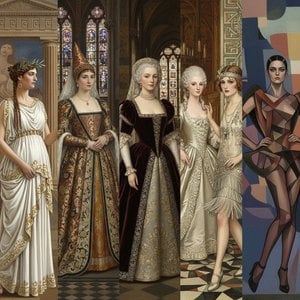
Explore the breathtaking intersection of fine art and high fashion. Discover how iconic masterpieces from Art Deco to Impressionism have shaped the world of luxury couture and timeless design in this curated visual journey.
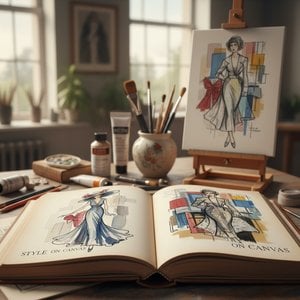
Discover the exquisite world of fashion illustration art. From Art Deco elegance to bespoke oil reproductions, explore how timeless sartorial beauty transforms luxury interiors through masterfully crafted canvas works and curated historical masterpieces.

Explore the profound artistry of graphite drawing. Discover professional techniques for mastering depth, texture, and detail through a lens of art history, from classical sketches to modern masterpieces. Elevate your understanding of the pencil medium with our expert guide.

Elevate your artistic practice with this expert guide to mastering the line. Discover advanced techniques in graphite, charcoal, and contour drawing designed for art students seeking technical precision and expressive depth in their fine art studies.

 Preview
 Send
Send Share
Share
 Details
 Guide
Guide

 Download
 Similars
 X-Ray
X-Ray Diaporama
 Stats
Stats


 Read More







 Glass option is only available in size under 110 CM


