

Museum-quality giclée or canvas print with fast production and flexible finish options. ( Buy Hand Made Painting Switch to Digital Image)





























Pick from our preset sizes that match the artwork's original proportions.

Type the width and the height you need, to fit your frame or your wall. A print can only be cut, never made bigger than the picture, so a size with a different shape loses a part of the image. We send you a digital mockup to approve before we print anything. The picture shown on this page does not show the real cut — only the mockup does.
Worldwide Delivery () in 2 weeks instead of standard 4/5 weeks. (23 October)
Waterloo Bridge
Reproduction Size
Claude Monet's "Waterloo Bridge," painted in 1903, isn’t merely a depiction of an iconic London landmark; it’s a profound meditation on light, atmosphere, and the ephemeral beauty of a fleeting moment. Captured during his prolific Parisian period, this work exemplifies the core tenets of Impressionism – a radical shift away from academic realism towards capturing the subjective experience of seeing. The painting invites us not just to *look* at the bridge, but to *feel* its presence within the vibrant tapestry of London’s riverside.
The scene unfolds with remarkable immediacy. Monet masterfully employs broken brushstrokes and a layering technique, applying paint in short, distinct dabs – a hallmark of his style. These strokes aren't blended smoothly; instead, they retain their individual character, creating a shimmering effect that mimics the play of light on water and across the textured surfaces of the bridge’s arches. The dominant orange hue of the sky, intensified by the reflection in the Thames, dominates the composition, lending an almost dreamlike quality to the scene. Notice how Monet subtly shifts the color palette – warmer tones near the foreground, cooler hues receding into the distance – creating a sense of depth and atmospheric perspective.
1903 marked a pivotal moment in London’s history. The city was undergoing rapid industrialization and modernization, yet it retained a romantic allure, particularly along its waterways. Monet's visit to England during this period coincided with a renewed interest in the country’s artistic heritage, fueled by the Pre-Raphaelite movement and the burgeoning Impressionist circle. He sought inspiration from the English countryside, but found himself equally captivated by the energy and dynamism of London. “Waterloo Bridge” reflects this duality – a blend of traditional subject matter (a recognizable landmark) with an intensely modern approach to painting.
The bridge itself holds historical significance. Completed in 1843, it was originally known as Blackfriars Bridge. Its imposing structure, constructed primarily of cast iron and stone, became a symbol of Victorian engineering prowess. However, Monet’s portrayal transcends mere documentation; he transforms the bridge into an emblem of urban life, capturing its essence within the broader context of the city's evolving landscape.
Beyond its visual appeal, “Waterloo Bridge” is rich in symbolic meaning. The bridge itself can be interpreted as a link between past and present, connecting the Victorian era with the burgeoning modernity of the early 20th century. The boats scattered across the Thames represent movement, commerce, and the ceaseless flow of life within the city. The orange sky, often associated with sunrise or sunset, evokes feelings of warmth, transition, and perhaps even a hint of melancholy – a common theme in Monet’s work.
Monet's deliberate use of light is particularly poignant. He wasn’t simply recording what he saw; he was attempting to capture the *impression* of light—its fleeting quality, its transformative power. The painting invites us to contemplate the beauty of everyday moments and the transient nature of experience. It speaks to a sense of nostalgia for a bygone era while simultaneously embracing the dynamism of the present.
Reproductions of “Waterloo Bridge” offer an exceptional opportunity to bring this iconic artwork into your home or office. The meticulous detail and vibrant colors of the original are faithfully reproduced, allowing you to appreciate Monet’s genius in stunning clarity. Whether displayed as a statement piece in a contemporary space or incorporated into a classic interior design scheme, “Waterloo Bridge” remains a timeless testament to the power of Impressionism and the enduring beauty of light and reflection.
In "Waterloo Bridge" by Claude Monet, the Impressionism movement meets the 19th-Century era.
In a living room, "Waterloo Bridge" is suggested at a medium print size.
The AR Preview page of "Waterloo Bridge" by Claude Monet uses augmented reality to show the artwork in your own space, on a compatible device.

The story of Oscar-Claude Monet begins in the streets of Paris, though his heart was often found wandering the salt-misted air of Le Havre. As a young boy, he moved to Normandy, where his father initially hoped he would follow a path in commerce. Yet, the boy possessed a restless eye for detail, finding early success by selling charcoal caricatures to local acquaintances. It was during these formative years that a chance encounter with Eugène Boudin changed everything. Boudin did not merely offer lessons in oil paint; he introduced the young man to the practice of painting en plein air, teaching him to set his easel directly within the unpredictable elements of nature.
This early training instilled a lifelong obsession with the fleeting moment. When the Franco-Prussian War forced him into the streets of London, Monet found himself absorbing the atmospheric effects seen in the works of J.M.W. Turner. He returned to France with a new understanding of how mist and light could dissolve solid forms. In Paris, he sought formal instruction under Charles Gleyre, where he formed deep bonds with fellow painters like Auguste Renoir. These friendships were forged in a shared desire to break away from the rigid, dark constraints of the academic Salon, seeking instead a way to record the world as it was actually perceived by the eye.
The year 1874 marked a turning point for this group of rebels. Dissatisfied with conservative standards, they organized their own independent exhibitions. It was during one such showing that his painting, Impression, Sunrise, gave a name to a movement that many initially viewed with derision. The term "Impressionism" emerged from the very criticism meant to mock his loose brushstrokes and unfinished appearance. Monet did not recoil from this label; he embraced it, using it to define a style centered on the subjective sensation of a scene.
His technique became a study in optical truth. He applied unmixed colors side-by-side, a method known as broken color, allowing the viewer's eye to blend the hues. He rejected traditional dark grounds, opting instead for light-colored primers that added a new brightness to his canvases. His work often focused on the following elements:
In 1883, Monet settled in Giverny, creating a sanctuary that would become his most profound subject. He transformed his property into an elaborate garden, complete with a water lily pond and a Japanese bridge. This was no mere landscape; it was a living laboratory where he could observe the interplay of light on water and foliage under controlled conditions. The gardens at Giverny provided him with a steady stream of inspiration for decades.
The later years of his life were defined by the monumental Water Lilies series. These vast canvases, often painted while he struggled with cataracts, moved toward a near-abstract state where the horizon line vanished entirely. He painted the same pond repeatedly, documenting the way shadows danced across the surface at dusk or how morning mist clung to the lilies. Through these works, he achieved a sense of immersion, inviting anyone who looked upon them to lose themselves in a world of pure, shifting color. He left behind a legacy that fundamentally altered the trajectory of modern art, proving that the most transient moment could be captured through the power of paint.

1840 - 1926 , France
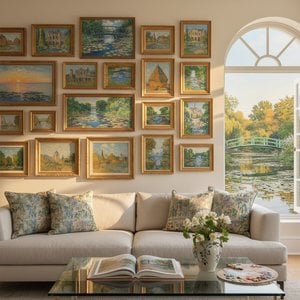
Journey through 25 iconic Claude Monet masterpieces! Explore Impressionism’s beauty, from Water Lilies to Rouen Cathedral. Discover stunning art reproductions & curated decor ideas – explore the full collection online at WahooArt.com.

Journey into the heart of Impressionism! Explore 10 masterpieces by Monet, Renoir & Degas that revolutionized landscape art. Discover their stories, techniques & find museum-quality reproductions to elevate your home decor on WahooArt.com.

Journey through John Constable's 25 most celebrated landscapes. Explore Romanticism, Dedham Vale & his masterful use of light in iconic paintings like 'Hay Wain'. Find museum-quality art reproductions and elevate your home decor on WahooArt.com.
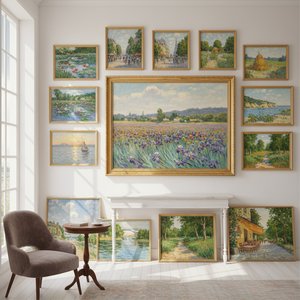
Journey through 10 iconic Impressionist landscapes by Monet, Renoir & Degas. Explore the history, techniques & emotions behind these masterpieces. Find museum-quality reproductions for your home at WahooArt.com – where art comes to life! Discover all masterpieces on WahooArt.com

Journey through 25 iconic artworks by Paul Cézanne – a master of Impressionism and Post-Impressionism. Explore his landscapes, still lifes, and the stories behind these timeless masterpieces. Discover museum-quality reproductions & curated decor at WahooArt.com.

 Preview
 Send
Send Share
Share
 Details
 Guide
Guide

 Download
 Similars
 X-Ray
X-Ray Diaporama
 Stats
Stats

 Read More









 Glass option is only available in size under 110 CM


