

Hand-painted oil on canvas in your size and frame, made to order by our artists. ( Switch to Print Switch to Digital Image)





























Pick from our preset sizes that match the artwork's original proportions.

Type the width and the height you need, to fit your frame or your wall. This is hand-painted, so for a size with a different shape the artist can paint a bit more around the picture, or cut a bit — you choose. We send you a digital mockup to approve before the painting starts. The picture shown on this page does not show the real result — only the mockup does.
Worldwide Delivery () in 3/4 weeks instead of standard 5 weeks. (22 October). No compromise on quality.
Sunset
Reproduction Size
Claude Monet's 'Sunset,' painted in 1865, is more than just a depiction of a picturesque evening; it’s a profound meditation on the ephemeral beauty of light and atmosphere – a cornerstone of the Impressionist movement. This captivating artwork captures a serene moment at dusk, rendered with a sensitivity to color and texture that would become synonymous with Monet's legacy. The scene unfolds within a tranquil field, dotted with trees that recede into the distance, creating a sense of depth and inviting the viewer to step into this fleeting tableau. The painting’s power lies not in precise detail but in the artist’s masterful manipulation of light, transforming ordinary elements – clouds, water, and foliage – into shimmering pools of color.
Painted during a pivotal moment in art history, ‘Sunset’ reflects Monet's radical departure from traditional academic painting. Influenced profoundly by Eugène Boudin, Monet embraced the revolutionary concept of *en plein air* – working outdoors directly from nature. This approach demanded an immediate response to light conditions, prioritizing observation and capturing fleeting impressions over meticulous representation. Notice the loose brushstrokes, characteristic of Impressionism, which avoid sharp outlines and instead blend colors optically, creating a vibrant, almost vibrating effect. Monet’s technique relies heavily on broken color – applying small dabs of pure pigment that mix in the viewer's eye, resulting in an unparalleled luminosity. The use of complementary colors—the fiery reds and oranges of the sunset juxtaposed against the blues and purples of the sky—intensifies the visual impact and heightens the sense of drama.
Sunsets have long held symbolic significance across cultures, representing endings, transitions, and the promise of renewal. In ‘Sunset,’ Monet doesn’t simply record a natural phenomenon; he imbues it with emotional resonance. The vibrant colors evoke feelings of warmth, tranquility, and perhaps even melancholy – a recognition of the transient nature of beauty. The clouds themselves become vessels for light, their shifting forms mirroring the constant flux of time. Monet's deliberate focus on this specific moment captures the essence of a fleeting experience, inviting contemplation about our own relationship to the passage of time.
‘Sunset,’ created in 1865, represents an early example of Monet’s groundbreaking approach. It foreshadowed his later explorations of light and color at various times of day and year – a series of paintings that would solidify his place as one of the most influential artists of the 19th century. This reproduction offers a unique opportunity to own a piece of art history, experiencing firsthand the brilliance of Monet’s vision and appreciating the enduring power of Impressionism. Its serene composition and masterful use of color make it an ideal addition to any interior space, bringing a touch of timeless beauty and tranquility.
A slideshow is available: the Diaporama page of "Sunset" by Claude Monet.
The creation of "Sunset" by Claude Monet is dated 1865.
"Sunset" by Claude Monet is recommended for accent, ideally in a living room. Use and space together guide where a reproduction fits.

The story of Oscar-Claude Monet begins in the streets of Paris, though his heart was often found wandering the salt-misted air of Le Havre. As a young boy, he moved to Normandy, where his father initially hoped he would follow a path in commerce. Yet, the boy possessed a restless eye for detail, finding early success by selling charcoal caricatures to local acquaintances. It was during these formative years that a chance encounter with Eugène Boudin changed everything. Boudin did not merely offer lessons in oil paint; he introduced the young man to the practice of painting en plein air, teaching him to set his easel directly within the unpredictable elements of nature.
This early training instilled a lifelong obsession with the fleeting moment. When the Franco-Prussian War forced him into the streets of London, Monet found himself absorbing the atmospheric effects seen in the works of J.M.W. Turner. He returned to France with a new understanding of how mist and light could dissolve solid forms. In Paris, he sought formal instruction under Charles Gleyre, where he formed deep bonds with fellow painters like Auguste Renoir. These friendships were forged in a shared desire to break away from the rigid, dark constraints of the academic Salon, seeking instead a way to record the world as it was actually perceived by the eye.
The year 1874 marked a turning point for this group of rebels. Dissatisfied with conservative standards, they organized their own independent exhibitions. It was during one such showing that his painting, Impression, Sunrise, gave a name to a movement that many initially viewed with derision. The term "Impressionism" emerged from the very criticism meant to mock his loose brushstrokes and unfinished appearance. Monet did not recoil from this label; he embraced it, using it to define a style centered on the subjective sensation of a scene.
His technique became a study in optical truth. He applied unmixed colors side-by-side, a method known as broken color, allowing the viewer's eye to blend the hues. He rejected traditional dark grounds, opting instead for light-colored primers that added a new brightness to his canvases. His work often focused on the following elements:
In 1883, Monet settled in Giverny, creating a sanctuary that would become his most profound subject. He transformed his property into an elaborate garden, complete with a water lily pond and a Japanese bridge. This was no mere landscape; it was a living laboratory where he could observe the interplay of light on water and foliage under controlled conditions. The gardens at Giverny provided him with a steady stream of inspiration for decades.
The later years of his life were defined by the monumental Water Lilies series. These vast canvases, often painted while he struggled with cataracts, moved toward a near-abstract state where the horizon line vanished entirely. He painted the same pond repeatedly, documenting the way shadows danced across the surface at dusk or how morning mist clung to the lilies. Through these works, he achieved a sense of immersion, inviting anyone who looked upon them to lose themselves in a world of pure, shifting color. He left behind a legacy that fundamentally altered the trajectory of modern art, proving that the most transient moment could be captured through the power of paint.

1840 - 1926 , France

Journey through the Musée d'Orsay’s 25 most iconic artworks! Explore Impressionist & Post-Impressionist masterpieces by Monet, Van Gogh, Degas & more. Find museum-quality art reproductions and curated decor ideas to bring timeless beauty home. Discover all masterpieces on WahooArt.com

Journey into the heart of Impressionism! Explore 10 masterpieces by Monet, Renoir & Degas that revolutionized landscape art. Discover their stories, techniques & find museum-quality reproductions to elevate your home decor on WahooArt.com.
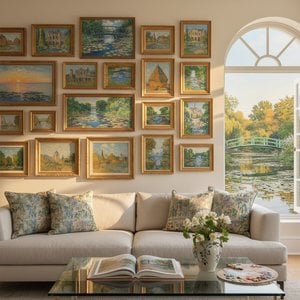
Journey through 25 iconic Claude Monet masterpieces! Explore Impressionism’s beauty, from Water Lilies to Rouen Cathedral. Discover stunning art reproductions & curated decor ideas – explore the full collection online at WahooArt.com.
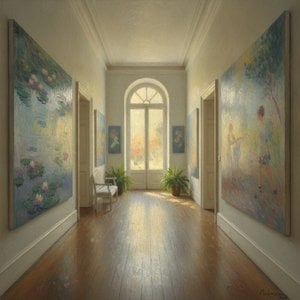
Transform your hallways with the luminous beauty of Impressionist masterpieces. Discover expert tips on selecting Monet-inspired palettes and multi-panel landscapes to create a breathtaking, light-filled gallery walk in your home. Elevate your space with timeless, hand-painted elegance.
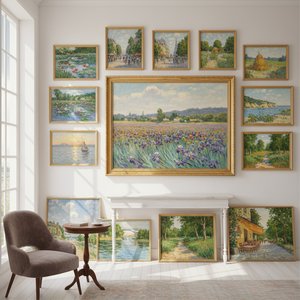
Journey through 10 iconic Impressionist landscapes by Monet, Renoir & Degas. Explore the history, techniques & emotions behind these masterpieces. Find museum-quality reproductions for your home at WahooArt.com – where art comes to life! Discover all masterpieces on WahooArt.com

 Preview
 Send
Send Share
Share
 Details
 Guide
Guide

 Download
 Similars
 X-Ray
X-Ray Diaporama
 Stats
Stats

 Read More









 Glass option is only available in size under 110 CM


