

 Oil On CanvasWallArtRomantic Landscape
 1760Early Modern
 95.0 x 131.0 cm
 Fitzwilliam College
Hand-painted oil on canvas in your size and frame, made to order by our artists. ( Switch to Print Switch to Digital Image)





























Pick from our preset sizes that match the artwork's original proportions.

You may enter your own dimensions to fit a specific frame or space. If your selected size does not match the original image's proportions, we will either crop the artwork or extend the painting with additional hand-painted elements. A digital mockup will be sent for your approval before production begins.
Please note that the on-screen preview does not reflect the actual cropping or extension. Only the mockup will accurately show the final composition.
While custom sizes are available, we recommend selecting a dimension from the predefined list to preserve the original proportions.
Worldwide Delivery () in 3/4 weeks instead of standard 5 weeks. (21 September). No compromise on quality.


Noon
Reproduction Size
In the quietude of Claude Joseph Vernet’s “Noon,” time seems to suspend its forward march, offering the viewer a rare moment of absolute serenity. Completed in 1760, this oil on canvas is far more than a mere topographical record of a riverside landscape; it is an exquisite encapsulation of Enlightenment aesthetics. As the midday sun reaches its zenith, Vernet captures a palpable stillness, where the river flows languidly beneath a hazy, luminous sky. The scene invites a deep, meditative contemplation, drawing the eye through a meticulously crafted atmosphere that feels both physically present and dreamlike. For the discerning collector or interior designer, this piece offers a window into an era of rational beauty, providing a focal point of tranquility that can anchor any sophisticated space with its soft, atmospheric depth.
The brilliance of the work lies in Vernet’s masterful command of light and color. Utilizing techniques honed during his formative years in Rome, the artist employs atmospheric perspective to create an illusion of infinite distance. Notice how the distant hills recel into soft, ethereal blues and purples, mirroring the tranquil expanse of the heavens above. This subtle gradation of tone is not merely a technical feat but a visual metaphor for the intellectual clarity and serenity characteristic of the Age of Reason. The light does not strike the landscape with harshness; rather, it bathes the scene in a diffused, golden glow that softens the edges of reality, making the bridge and the riverbank appear as if they are part of a beautifully composed memory.
Beyond the sweeping vistas, Vernet’s brushwork reveals a delicate precision that anticipates the subtle nuances of later movements. His technique involves layering thin, translucent glazes of pigment to achieve a luminous surface texture that captures the ephemeral quality of sunlight hitting water. While his approach prioritizes tonal harmony over the bold, expressive strokes seen in later Impressionism, there is an undeniable vitality in the small details. The figures scattered along the riverbank—some tending to fishing rods, others simply resting—are imbued with a quiet dignity. Even the presence of two dogs, wandering near the water's edge, adds a layer of domestic peace and natural realism to the composition.
The structural element of the bridge serves as a vital anchor for the eye, providing depth and dimension to the landscape while connecting the human elements to the natural world. This careful rendering of architecture alongside organic forms demonstrates Vernet’s ability to balance the structured and the wild. For those seeking to decorate a room with art that evokes peace, "Noon" provides an unparalleled emotional impact. It is a painting that does not demand attention through noise or drama, but rather earns it through a persistent, gentle beauty that rewards prolonged observation. Owning a high-quality reproduction of this masterpiece allows one to bring the restorative power of a summer afternoon into the modern home, creating an environment of timeless elegance and calm.


1714 - 1789 , France
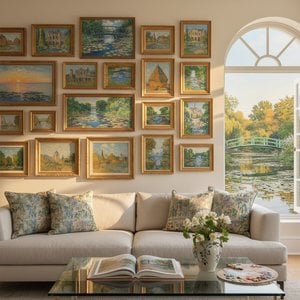
Journey through 25 iconic Claude Monet masterpieces! Explore Impressionism’s beauty, from Water Lilies to Rouen Cathedral. Discover stunning art reproductions & curated decor ideas – explore the full collection online at WahooArt.com.
Explore the history of serene landscape art & discover artists who evoke tranquility. Find the perfect calming artwork for your home with expert guidance from WahooArt.

Explore the history of serene art & discover how landscape paintings evoke tranquility across movements. Find inspiration for calming home decor & museum-quality reproductions at WahooArt.

Journey through John Constable's 25 most celebrated landscapes. Explore Romanticism, Dedham Vale & his masterful use of light in iconic paintings like 'Hay Wain'. Find museum-quality art reproductions and elevate your home decor on WahooArt.com.

Explore the luminous landscapes of Claude Lorrain, a Baroque master renowned for his masterful use of light & atmosphere. Discover his life, techniques, key works & enduring influence on art history.

 Preview
 Send
Send Share
Share
 Details
 Guide
Guide

 Download
 Similars
 X-Ray
X-Ray Diaporama
 Stats
Stats Read More







 Glass option is only available in size under 110 CM


