Hand-painted oil on canvas in your size and frame, made to order by our artists. ( Switch to Print Switch to Digital Image)
Pick from our preset sizes that match the artwork's original proportions.

Type the width and the height you need, to fit your frame or your wall. This is hand-painted, so for a size with a different shape the artist can paint a bit more around the picture, or cut a bit — you choose. We send you a digital mockup to approve before the painting starts. The picture shown on this page does not show the real result — only the mockup does.
Worldwide Delivery () in 3/4 weeks instead of standard 5 weeks. (24 October). No compromise on quality.
McIntyre Mountain
Reproduction Size

In the rich tapestry of nineteenth-century American culture, few figures embody the era's intellectual and aesthetic synthesis as gracefully as Christopher Pearse Cranch. Born in 1813 in Columbia, Maryland, into a distinguished legal family, Cranch was destined for a life where the boundaries between the spiritual and the material would perpetually blur. While his early path led him toward the pulpit and the rigorous study of theology at Harvard Divinity School, his soul remained deeply tethered to the visual world. This unique duality—the disciplined mind of a Unitarian minister paired with the observant eye of an artist—allowed him to approach the canvas not merely as a surface for depiction, but as a medium for profound philosophical inquiry.
Cranch’s creative identity was profoundly shaped by his proximity to the Transcendentalist movement. As a contemporary and participant in Ralph Waldo Emerson’s inner circle, he breathed the same intellectual air that celebrated the divinity found within nature. His involvement with Emerson’s transcendental club provided him with a conceptual framework that would forever inform his landscapes. To Cranch, a waterfall or a morning mist was not just a meteorological event; it was a manifestation of the sublime, a visible sign of the underlying spiritual unity of the universe. This connection to the Hudson River School ethos allowed his work to transcend mere topographical accuracy, reaching instead for an emotional and spiritual resonance that mirrored the era's optimism and reverence for the American wilderness.
The brilliance of Cranch lay in his refusal to be confined to a single discipline. He was a true Renaissance man of the American nineteenth century, weaving together a legacy that spanned painting, poetry, and prose. His literary contributions were as diverse as they were impactful, ranging from the whimsical charm of his "Huggermugger Books"* for children to the sophisticated, contemplative verses found in publications like Emerson’s Dial. This versatility extended into the realm of visual satire, where his caricatures for Harper's Weekly demonstrated a keen wit and an ability to capture the social nuances of his time.
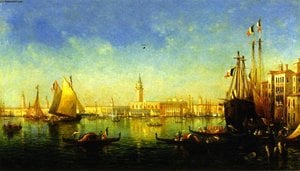
In his paintings, Cranch achieved a delicate balance between the grandiosity of the landscape tradition and a more intimate, impressionistic sensitivity. His works, such as "Landscape with Waterfall" and his evocative depictions of Venice, reveal an artist capable of capturing both the rugged majesty of the New World and the luminous, atmospheric light of the Old. Through his brush, one can trace the evolution of a man who sought to translate the intangible truths of his faith into the tangible beauty of color and form.
The historical significance of Christopher Pearse Cranch resides in his role as a bridge between eras and ideologies. He stood at the intersection of:
Ultimately, Cranch’s life serves as a testament to the power of integrated thought. He did not see art and intellect as opposing forces, but as two halves of a single, harmonious pursuit of truth. His enduring contribution to American art remains a luminous example of how the observation of nature can become an act of profound spiritual devotion.

1813 - 1892 , United States of America

 Preview
 Send
Send Share
Share
 Details
 Guide
Guide

 Download
 Similars
 X-Ray
X-Ray Diaporama
 Stats
Stats
 Read More






































 Glass option is only available in size under 110 CM