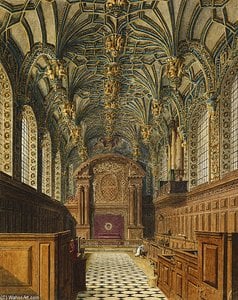
The Ethereal Vision of Charles Wild
In the tapestry of British art history, certain names whisper of a bygone era of profound serenity and refined elegance. Charles Wild, a painter born in London in 1781, belongs to this evocative tradition. Though the historical record offers only glimpses into his formative years, his presence in the late 18th and early 19th centuries remains unmistakable. Wild emerged during a period of immense transition in the United Kingdom, a time when the burgeoning Romanticism movement began to reshape the artistic consciousness, moving away from rigid neoclassicism toward a more emotive and atmospheric appreciation of the natural world.
Wild’s artistry was defined by a unique ability to capture the ephemeral qualities of light and landscape. His works often possess a poetic stillness, inviting the viewer into a space of quiet contemplation. This mastery of atmosphere is perhaps most evident in his celebrated 1805 masterpiece, The Serene Vista. In this work, Wild demonstrates an extraordinary skill for rendering the British countryside not merely as a physical location, but as an ethereal experience. The painting evokes the dreamlike, visionary landscapes of William Blake, where the boundaries between reality and the sublime begin to blur, leaving the observer lost in the soft, luminous textures of the rolling hills and sky.
Portraiture and the Nuance of Expression
While his landscapes captured the soul of the land, Wild’s portraiture sought to capture the intricate nuances of the human spirit. He possessed a delicate touch that allowed him to navigate the complexities of facial expression and character, much like the celebrated miniaturist Andrew Plimer. A notable example of this technical prowess is his Portrait of Lady Elizabeth (1810), a work that stands as a testament to his ability to imbue his subjects with both dignity and a sense of intimate vulnerability.
His approach to portraiture was never merely about the recording of features; it was an exploration of the sitter's inner life. Through subtle shifts in shadow and a masterful command of light, Wild could suggest the weight of thought or the lightness of a fleeting smile. This ability to marry technical precision with emotional depth ensured that his portraits remained timeless, transcending the era in which they were painted to offer a window into the social and psychological fabric of the Regency period.
Legacy and Artistic Significance
The enduring significance of Charles Wild lies in his contribution to the Romantic aesthetic within British art. His work serves as a vital link in the evolution of landscape and portrait painting, bridging the gap between classical tradition and the more subjective, emotional styles that would come to dominate the 19th century. The presence of his works in prestigious institutions, such as The National Gallery in the United Kingdom, underscores his recognized importance within the canon of British masters.
Today, the legacy of Wild continues to resonate through both historical archives and modern appreciation. His ability to evoke a sense of peace and timelessness makes his paintings particularly captivating for contemporary audiences seeking an escape into the romanticized beauty of the past. Through platforms like WahooArt.com, his vision remains accessible, allowing art enthusiasts to reconnect with the subtle elegance and profound tranquility that defined his illustrious career.


 Preview
 Send
Send Share
Share
 Details
 Guide
Guide

 Download
 Similars
 X-Ray
X-Ray Diaporama
 Q&A
Q&A
 Stats
Stats
 Read More
 Switch to Print





































 Glass option is only available in size under 110 CM