

Museum-quality giclée or canvas print with fast production and flexible finish options. ( Buy Hand Made Painting Switch to Digital Image)
Pick from our preset sizes that match the artwork's original proportions.

Type the width and the height you need, to fit your frame or your wall. A print can only be cut, never made bigger than the picture, so a size with a different shape loses a part of the image. We send you a digital mockup to approve before we print anything. The picture shown on this page does not show the real cut — only the mockup does.
Worldwide Delivery () in 2 weeks instead of standard 4/5 weeks. (8 November)
Xi ^ W. Scott
Reproduction Size

In the tapestry of early New Zealand art history, few figures possess the haunting allure of Charles Hancock. A pivotal presence during the country's formative years, Hancock’s life was as brief as his artistic impact was profound. Born in 1802 in the Marlborough District, his existence spanned a mere quarter of a century, leaving behind a legacy that feels both intimate and monumental. Though much of his biography remains shrouded in mystery—his story often inferred more from the evocative traces of his brushwork than from direct historical accounts—he stands as an enigmatic pioneer whose work captures the very soul of a developing landscape.
Hancock’s artistic journey is characterized by a sense of profound connection to the natural world. His paintings, noted for their ethereal landscapes and intricate portraiture, offer a rare window into the untouched beauty of New and Zealand's early era. There is a certain magic in his ability to render the unseen, creating vistas that seem to breathe with the vitality of an era long passed. Through his eyes, we glimpse a world of untapped potential and quiet majesty, where every stroke of paint serves as a testament to the enduring spirit of the land.
The body of work left by Hancock, while limited in quantity due to his short life, showcases an artist standing on the precipice of innovation. His notable pieces continue to reside in some of the most prestigious institutions, serving as cornerstones of New Zealand's cultural heritage. For instance, The Unseen Horizons is a masterpiece that encapsulates the essence of the nation's early beauty, and it is currently preserved within the Auckland Art Gallery Toi o Tāmaki. Similarly, his work Whispers from the Past offers a poignant exploration of historical narrative, finding its home at the Te Papa Museum.
The influence of Hancock extends far beyond his own canvases, rippling through subsequent generations of New Zealand artists. His ability to capture light and atmosphere provided a foundation for others to build upon. We see his echoes in the works of contemporaries like Charles James Blomfield, who drew inspiration from Hancock’s landscapes to develop his own celebrated series. Even the early photographic contributions of the Burton Brothers reflect the influence of Hancock's portraiture techniques. This enduring connection ensures that while the man himself passed away early, his vision remains an indelible part of the artistic consciousness.
To study the work of Charles Hancock is to engage in a dialogue with the past. His paintings are more than mere depictions; they are emotional vessels that carry the weight of history and the lightness of dreamlike landscapes. As we continue to uncover the mysteries surrounding this enigmatic figure, his contributions remain vital. He reminds us that the impact of an artist is not measured by the length of their life, but by the depth of the impression they leave upon the world. Through his ethereal visions, Hancock continues to inspire awe and curiosity, securing his place as a foundational pillar of New Zealand's artistic identity.

1802 - 1827 , New Zealand
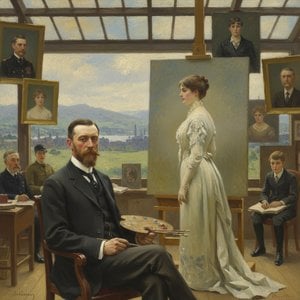
Explore the life & art of Sir John Lavery, a master of Scottish Impressionism and renowned portraitist. Discover his captivating works, Irish heritage, and lasting legacy with WahooArt.

Explore the elegant world of Charles-André van Loo, a master of Rococo portraiture at the French court. Discover his life, techniques, and enduring influence on 18th-century art. Hand-painted reproductions available.

Explore the profound evolution of Chinese calligraphy from oracle bones to fluid cursive styles. Discover the soul of the brush today.
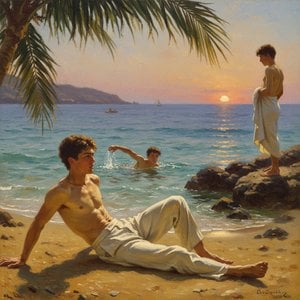
Explore the captivating world of Henry Scott Tuke's paintings – a master of British Impressionism renowned for his intimate depictions of youth and sunlit maritime scenes. Discover his legacy & aesthetic influence.
 Preview
 Send
Send Share
Share
 Details
 Guide
Guide

 Download
 Similars
 X-Ray
X-Ray Diaporama
 Q&A
Q&A
 Stats
Stats Read More






































 Glass option is only available in size under 110 CM


