

 Acrylic On CanvasWallArtBaroque Classicizing Style
 1681
1681 221.0 x 224.0 cm
 Musées Royaux des Beaux-Arts
Hand-painted oil on canvas in your size and frame, made to order by our artists. ( Switch to Print Switch to Digital Image)





























Pick from our preset sizes that match the artwork's original proportions.

Type the width and the height you need, to fit your frame or your wall. This is hand-painted, so for a size with a different shape the artist can paint a bit more around the picture, or cut a bit — you choose. We send you a digital mockup to approve before the painting starts. The picture shown on this page does not show the real result — only the mockup does.
Worldwide Delivery () in 3/4 weeks instead of standard 5 weeks. (25 October). No compromise on quality.
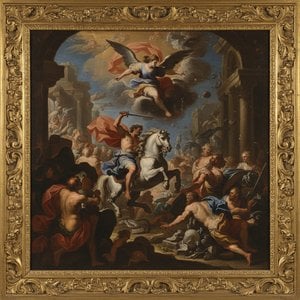
Apollo Chasing Daphne
Reproduction Size
Carlo Maratta’s “Apollo Chasing Daphne,” completed in 1681, isn't merely a depiction of Greek mythology; it’s an exquisitely crafted distillation of humanist ideals within the Baroque aesthetic. Hanging proudly at the Musées Royaux des Beaux-Arts in Brussels—a testament to Belgian cultural heritage—the canvas commands attention with its serene composure and subtle dynamism.
The painting recounts the legendary pursuit of Apollo—god of music, poetry, and archery—by Daphne, a nymph who embodies feminine resilience. Driven by desire, Apollo relentlessly pursues Daphne, attempting to seduce her with his divine charisma. However, Daphne refuses his advances, recognizing the danger posed by his obsession. Faced with imminent capture, she pleads for her father’s intervention, resulting in a miraculous transformation: Daphne is metamorphosed into laurel—a symbol of honor and victory—precisely as Apollo reaches for her.
Maratta's masterful technique exemplifies the Baroque style’s commitment to realism blended with theatrical illusion. He employs a pyramidal composition, anchoring the figures in stability while simultaneously directing the viewer’s gaze upwards towards Apollo and Daphne. The artist utilizes chiaroscuro—the dramatic interplay of light and shadow—to heighten emotional intensity and sculpt the forms of his subjects. Notice how the luminous glow illuminates Daphne's face, conveying her vulnerability and determination.
Beyond its retelling of a classic tale, “Apollo Chasing Daphne” resonates with deeper symbolic meanings. The laurel wreath represents Daphne’s triumph over Apollo’s desire—a visual affirmation of feminine autonomy and spiritual fortitude. Furthermore, the bird circling above Daphne underscores the fleeting nature of beauty and the inevitability of change. Maratta skillfully integrates these motifs into a harmonious whole, elevating the painting beyond mere narrative illustration.
Despite the palpable tension between Apollo and Daphne—expressed through their postures and gestures—the overall mood of “Apollo Chasing Daphne” is remarkably tranquil. Maratta achieves this effect by prioritizing balance and restraint, avoiding excessive ornamentation or flamboyant color palettes. Instead, he invites contemplation, prompting viewers to consider themes of love, loss, and transformation. It’s a painting that speaks to the human condition—a reminder that even in moments of vulnerability, grace and dignity can prevail.
The recorded dimensions of "Apollo Chasing Daphne" by Carlo Maratta are 221 x 224 cm. Reproductions can be ordered in other sizes while keeping the same proportions.
"Apollo Chasing Daphne" by Carlo Maratta is in the public domain - its copyright has expired. Copyright terms are measured from the artist's death, and Carlo Maratta died in 1713.
"Apollo Chasing Daphne" was created by Carlo Maratta, born in Italy, within the Baroque Classicizing Style movement. The artist's origin links the work to Baroque Classicizing Style as practiced by artists from Italy.


1625 - 1713 , Italy

Explore the breathtaking drama of the Baroque era. From the mastery of chiaroscuro to epic mythological narratives, discover a definitive guide to art's most powerful period of light, shadow, and emotion for the true classical art enthusiast.

Embark on a sophisticated journey through Italian Baroque art. Discover the dramatic interplay of light and emotion in Caravaggio’s masterpieces and explore how to bring this timeless grandeur into your collection with expert art insights.
Explore the breathtaking power of Baroque art. Delve into the dramatic interplay of light, shadow, and motion through the works of masters like Caravaggio. Discover how the era's intense emotional realism continues to inspire collectors and connoisseurs of classical grandeur.

 Preview
 Send
Send Share
Share
 Details
 Guide
Guide

 Download
 Similars
 X-Ray
X-Ray Diaporama
 Stats
Stats Read More









 Glass option is only available in size under 110 CM


