Preview AR preview Buy Hand Made Painting Switch to Digital Image Send
Details Guide Add to favorites Download Similars X-Ray Diaporama Stats

Self-Portrait

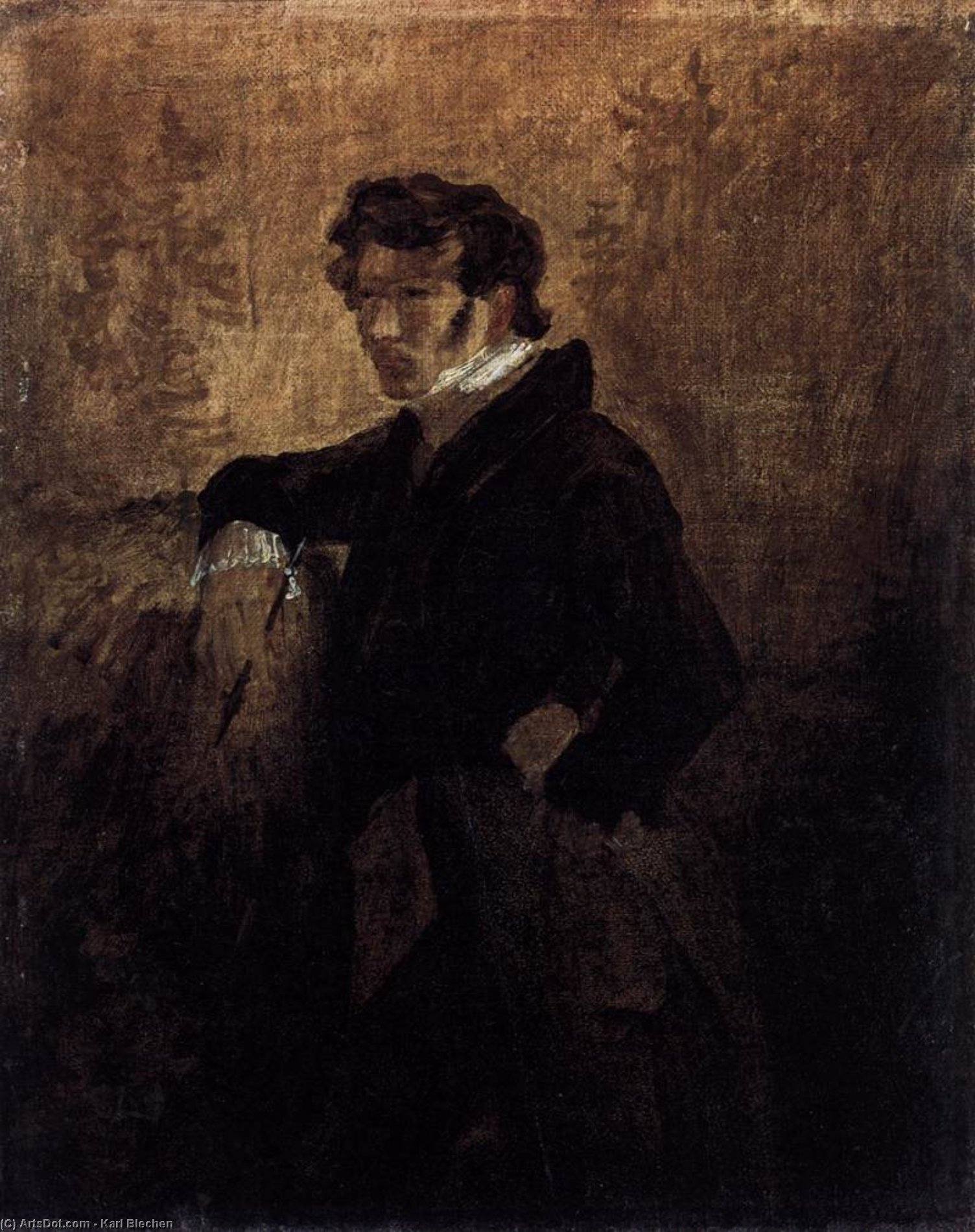
Carl Blechen’s ‘Self-Portrait,’ created in 1823 exemplifies Romanticism’s fascination with industrial landscapes. This poignant depiction captures a contemplative gaze amidst formal attire—a testament to Blechen's pioneering exploration of artistic expression within the burgeoning era of industrialization.

Carl Blechen (1798-1840) was a German Romantic painter celebrated for his evocative landscapes & pioneering depictions of early industrialization. Explore his Italian sketches and lasting influence.

Giclée / Art Print

Museum-quality giclée or canvas print with fast production and flexible finish options. ( Buy Hand Made Painting Switch to Digital Image)

Corner sample of the P118B picture frame: moulded polystyrene, 5 cm wide and 3 cm thick
P118B $10
Corner sample of the P118H picture frame: moulded polystyrene, 5 cm wide and 3 cm thick
P118H $10
Corner sample of the P118W picture frame: moulded polystyrene, 5 cm wide and 3 cm thick
P118W $10
Corner sample of the P438Z picture frame: moulded polystyrene, 5.5 cm wide and 3.5 cm thick
P438Z $10
Corner sample of the P508JH picture frame: moulded polystyrene, 7 cm wide and 3.5 cm thick
P508JH $12
Corner sample of the P508YH picture frame: moulded polystyrene, 7 cm wide and 3.5 cm thick
P508YH $12
Corner sample of the P805H picture frame: moulded polystyrene, 5 cm wide and 3.5 cm thick
P805H $10
Corner sample of the P805Z picture frame: moulded polystyrene, 5 cm wide and 3.5 cm thick
P805Z $10
Corner sample of the P919BZ picture frame: moulded polystyrene, 7 cm wide and 3.5 cm thick
P919BZ $10
Corner sample of the P919G picture frame: moulded polystyrene, 7 cm wide and 3.5 cm thick
P919G $10
Corner sample of the P919XJ picture frame: moulded polystyrene, 7 cm wide and 3.5 cm thick
P919XJ $10
Corner sample of the P959ZH picture frame: moulded polystyrene, 5 cm wide and 3 cm thick
P959ZH $10
Corner sample of the P968JZ picture frame: moulded polystyrene, 6 cm wide and 4 cm thick
P968JZ $12
Corner sample of the W106C picture frame: solid wood, 5 cm wide and 3 cm thick
W106C $8
Corner sample of the W218G picture frame: solid wood, 5 cm wide and 3 cm thick
W218G $10
Corner sample of the W218JH picture frame: solid wood, 5 cm wide and 3 cm thick
W218JH $8
Corner sample of the W218Y picture frame: solid wood, 5 cm wide and 3 cm thick
W218Y $10
Corner sample of the W307PJ picture frame: solid wood, 6 cm wide and 3 cm thick
W307PJ $10
Corner sample of the W316G picture frame: solid wood, 6 cm wide and 3 cm thick
W316G $10
Corner sample of the W316PJ picture frame: solid wood, 6 cm wide and 3 cm thick
W316PJ $8
Corner sample of the W316Y picture frame: solid wood, 6 cm wide and 3 cm thick
W316Y $10
Corner sample of the W398PJ picture frame: solid wood, 5 cm wide and 3 cm thick
W398PJ $8
Corner sample of the W4111J picture frame: solid wood, 6.5 cm wide and 3.5 cm thick
W4111J $10
Corner sample of the W500HY picture frame: solid wood, 7 cm wide and 5 cm thick
W500HY $15
Corner sample of the W500JH picture frame: solid wood, 7 cm wide and 5 cm thick
W500JH $15
Corner sample of the W692G picture frame: solid wood, 8 cm wide and 4 cm thick
W692G $12
Corner sample of the W849H picture frame: solid wood, 5 cm wide and 3 cm thick
W849H $8
Corner sample of the W940BG picture frame: solid wood, 7.5 cm wide and 4.5 cm thick
W940BG $15
Corner sample of the W953PJ picture frame: solid wood, 6 cm wide and 3.5 cm thick
W953PJ $8

Standard
custom
CM
INCH

Pick from our preset sizes that match the artwork's original proportions.

width
height

You may enter your own dimensions to fit a specific frame or space. If your selected size does not match the original image's proportions, we will either crop the artwork or extend the image with a mirrored or solid-fill edge. A digital mockup will be sent for your approval before production begins.
Please note that the on-screen preview does not reflect the actual cropping or extension. Only the mockup will accurately show the final composition.
While custom sizes are available, we recommend selecting a dimension from the predefined list to preserve the original proportions.

Worldwide Delivery () in 2 weeks instead of standard 4/5 weeks. (10 October)

Free Worldwide Express Shipping
High-Quality Linen Canvas
Full Shipping Insurance
Customs Tax Refund Guarantee
True Color Matching Guarantee
100-Day Return Policy (Defects Only)
100% Money-Back Guarantee
Bulk Discount Offer

Total Price

$ 69

Self-Portrait

Giclée / Art Print

Reproduction Size

-

Total Price

$ 69

Quick Facts

  • Dimensions: 26 x 20 cm
  • Medium: Oil on canvas
  • Artistic style: Psychological realism
  • Influences: Romanticism
  • Title: Self-Portrait
  • Artist: Carl Blechen
  • Location: Alte Nationalgalerie, Berlin, Germany

Art Quiz

There is only one correct answer for each question.

Question 1:
What artistic movement is Carl Blechen’s ‘Self-Portrait’ associated with?
Question 2:
The painting depicts a man in what attire?
Question 3:
What is notable about Blechen's approach to landscape painting compared to many of his contemporaries?
Question 4:
In what year was ‘Self-Portrait’ created?
Question 5:
Where is ‘Self-Portrait’ currently housed?

A Visionary Encounter with Industry’s Dawn

  • Subject Matter: This striking self-portrait by Carl Blechen captures a contemplative gaze directed downwards, presenting an image of intellectual introspection amidst the burgeoning industrial landscape. The artist's posture exudes seriousness and thoughtfulness—a deliberate contrast to the prevailing Romantic preoccupation with sublime landscapes.
  • Style: Blechen’s work exemplifies the Romantic Industrialization movement, marking a pivotal shift away from traditional artistic conventions. While rooted in Romantic ideals of emotion and imagination, he simultaneously confronts the realities of industrial progress with unflinching honesty. The portrait eschews idealized beauty for a psychologically nuanced depiction.
  • Technique: Executed in black and white lithograph printing, Blechen skillfully employs tonal gradation to convey depth and texture. Lithography, a relatively new technique at the time, allowed for precise reproductions of detail—a testament to Blechen’s artistic vision and his willingness to experiment with innovative methods.
  • Historical Context: Created in 1823, this portrait emerged during a period of intense social and intellectual ferment. The Industrial Revolution was reshaping Europe, prompting artists like Blechen to grapple with questions of modernity, alienation, and the human condition. It reflects a broader artistic dialogue concerning how nature and humanity coexist within an evolving world.
  • Symbolism: Beyond its formal representation, the self-portrait carries symbolic weight. The downward gaze suggests introspection and contemplation—a desire to reconcile Romantic idealism with the tangible pressures of industrial society. Furthermore, the suit symbolizes professionalism and social responsibility, mirroring Blechen’s own aspirations as he navigated his artistic career.

Lithograph Printing: A Revolutionary Medium

The choice of lithograph printing was particularly significant for Blechen's time. Unlike oil paints or watercolor—the dominant mediums of the Romantic era—lithography offered unparalleled precision and tonal control. Developed in France during the preceding decade, it allowed artists to achieve photographic realism without resorting to camera obscura techniques. This method ensured that Blechen’s portrait would retain its intricate detail and expressive atmosphere for generations to come.

Romantic Industrialization: Bridging Imagination and Reality

Blechen's artistic trajectory represents a fascinating intersection between Romantic idealism and the burgeoning realities of industrialization. While acknowledging the sublime beauty of nature—a hallmark of Romantic art—he simultaneously recognized its vulnerability to encroachment by technological advancements. This duality is powerfully conveyed in his self-portrait, prompting viewers to consider the complexities inherent in reconciling aesthetic ideals with societal transformations.

Emotional Resonance: A Portrait of Quiet Contemplation

Ultimately, Blechen’s self-portrait transcends mere visual representation; it communicates a profound emotional resonance. The artist's gaze—directed downwards—suggests a preoccupation with internal reflection and a yearning for understanding amidst the turbulent currents of his era. It invites contemplation on themes of identity, purpose, and the enduring human spirit—a timeless message that continues to captivate audiences today.

Questions & Answers

Where does "Self-Portrait" fall in Carl Blechen's career?

"Self-Portrait" belongs to the Early Romanticism of Carl Blechen's career. This classification relates the work to the artist's development.

In what year was "Self-Portrait" by Carl Blechen created?

The creation of "Self-Portrait" by Carl Blechen is dated 1823.

How old was Carl Blechen when creating "Self-Portrait" in 1823?

When "Self-Portrait" was created in 1823, Carl Blechen - born in 1798 - was 25 years old.

Where is "Self-Portrait" by Carl Blechen on display today?

The original "Self-Portrait" by Carl Blechen is held at the Nationalgalerie, Berlin, Germany. A reproduction allows the work to be displayed at home.

What size is "Self-Portrait" by Carl Blechen in real life?

The recorded dimensions of "Self-Portrait" by Carl Blechen are 26 x 20 cm. Reproductions can be ordered in other sizes while keeping the same proportions.

What art movement does "Self-Portrait" by Carl Blechen belong to?

The movement associated with "Self-Portrait" by Carl Blechen is Romantic Industrialization. This classification situates the work among related artists and artworks.

Who created "Self-Portrait"?

The artist behind "Self-Portrait" is Carl Blechen. The work is catalogued under Carl Blechen's name.


Artist Biography

A Pioneer of Romantic Industrialization: The Life and Art of Carl Blechen

Carl Eduard Ferdinand Blechen, born in Cottbus, Germany, in 1798, occupies a unique and often overlooked position within the landscape painting tradition. His life was marked by both artistic brilliance and personal turmoil, a duality that profoundly shaped his evocative and groundbreaking work. Initially destined for a pragmatic career in banking due to familial financial constraints, Blechen’s inherent artistic inclinations ultimately prevailed. He pursued studies at the Berlin Academy of Arts in 1822, embarking on a path that would see him become one of the first artists to grapple with the aesthetic challenges—and possibilities—presented by early industrialization.

Blechen's formative years were steeped in the Romantic ideals sweeping across Europe. However, unlike many of his contemporaries who focused solely on idealized natural beauty or historical grandeur, Blechen’s gaze was drawn to a changing world. A pivotal journey to Italy in 1828-1829 proved transformative. Immersed in the light and atmosphere of the Italian countryside, he honed his skills in plein air sketching, capturing fleeting moments and dramatic effects with remarkable sensitivity. These sketches weren't merely preparatory studies; they were imbued with a vibrant energy that would characterize his mature style. He returned to Berlin not simply as a technically proficient painter but as an artist with a distinct vision—one that sought to reconcile the sublime beauty of nature with the encroaching realities of modernity.

Navigating Tradition and Transformation

Blechen’s artistic output is characterized by a compelling tension between Romantic sensibility and a nascent realism. He didn't shy away from depicting the burgeoning industrial landscape, but neither did he celebrate it uncritically. Works like Bau der Teufelsbrücke (Construction of the Devil's Bridge), painted between 1830 and 1832, exemplify this approach. The painting doesn’t glorify the engineering feat; instead, it presents a scene of arduous labor set against a dramatic backdrop, hinting at both human ambition and the potential for disruption of the natural order. This willingness to confront the complexities of his time sets him apart from many of his contemporaries.

His landscapes are often imbued with a melancholic atmosphere, reflecting not only the changing physical environment but also his own internal struggles. Waldweg bei Spandau (Forest Path near Spandau), for instance, evokes a sense of solitude and introspection, while simultaneously showcasing Blechen’s mastery of light and shadow. He skillfully employed atmospheric perspective to create depth and mood, drawing the viewer into the scene and inviting contemplation. He wasn't merely recording what he saw; he was conveying an emotional response to it.

A Troubled Genius and Lasting Legacy

Despite his artistic achievements, Blechen’s life was tragically cut short by mental illness. Appointed Professor of Landscape Painting at the Berlin Academy in 1831—a testament to his growing reputation—his condition began to deteriorate rapidly after 1835. Forced to take leave and eventually hospitalized, he continued to create art even amidst his suffering, producing poignant drawings that offer a glimpse into his troubled inner world. He died in Berlin in 1840 at the age of 41.

Though his career was relatively brief, Carl Blechen’s influence on subsequent generations of artists is undeniable. His pioneering depictions of industrial landscapes paved the way for later Realist and Impressionist painters who sought to capture the changing face of modern life. He demonstrated that it was possible to find beauty—and meaning—even in the midst of transformation, a lesson that continues to resonate with artists today. His work remains a powerful reminder of the complex relationship between humanity, nature, and progress.

Key Works & Collections

  • Im Berliner Tiergarten (The Berlin Zoo), 1825: An early example of his ability to capture atmospheric effects and everyday scenes with a Romantic sensibility.
  • Waldweg bei Spandau (Forest Path near Spandau): A haunting landscape that exemplifies his mastery of light, shadow, and mood.
  • Bau der Teufelsbrücke (Construction of the Devil's Bridge), 1830–32: A groundbreaking depiction of early industrialization, showcasing both human ambition and its impact on the natural world.

Today, Blechen’s works can be found in prominent museum collections worldwide, including the Kunsthalle Bielefeld in Germany, The Fitzwilliam Museum in Cambridge, and the National Gallery in London. These institutions preserve his legacy for future generations, ensuring that his innovative vision continues to inspire and challenge viewers.

Carl Blechen

Carl Blechen

1798 - 1840 , Germany

Quick Facts

  • Full Name: Carl Eduard Ferdinand Blechen
  • Nationality: German
  • Date Of Birth: 1798
  • Date Of Death: 1840
  • Place Of Birth: Cottbus, Germany
  • Notable Artworks:
    • Im Berliner Tiergarten
    • Waldweg bei Spandau
    • Bau der Teufelsbrücke
  • Artistic Movement Or Style: Romanticism
  • Artists Who Influenced This Artist:
    • Caspar David Friedrich
    • Johann Christian Dahl
Explore artworks organized by themes, styles, and characteristics.