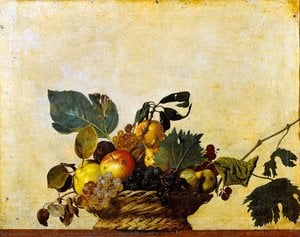
A Life Forged in Shadow and Light
Milan, 1571. The air is heavy with the scent of plague. Young Michelangelo Merisi watches as death claims his father and grandfather in a single day. He grows up in the grip of poverty, a reality that later finds its way onto his canvases through the faces of ordinary people. By 1584, he begins an apprenticeship under Simone Peterzano, a former pupil of Titian. This training provides the technical foundation, but the spirit of the boy from Milan is already restless.
Rome, around 1592. The city is a crucible of religious fervor and intense competition. Caravaggio arrives without fixed address or provision, a penniless migrant in a landscape of grand ambitions. He finds footing through the patronage of Cardinal Francesco Maria del Monte. In the shadows of the Palazzo Madama, the artist begins to strip away the artificial elegance of Mannerism. He replaces elongated, idealized forms with something far more visceral.
The Architecture of Darkness
He rejects the polished surfaces of his contemporaries. Instead, he embraces tenebrism, a style where darkness is a physical presence rather than a mere absence of light. In works like The Cardsharps, light does not simply illuminate; it strikes. It carves figures out of an impenetrable black void. This technique, often called chiaroscuro, creates a stage-like intensity that forces the viewer to confront the raw textures of silk, skin, and bone.
His method is direct. He works alla prima, applying paint directly to the canvas without the safety net of preparatory drawings. This immediacy allows for a startling realism. He uses the people of the Roman streets—the drunks, the laborers, the outcasts—as models for the sacred. When he paints the Holy Family, they possess the dirt and weariness of the living. The divine becomes profoundly human.
- Tenebrism: The use of violent contrasts between light and dark to command attention.
- Realism: A commitment to depicting the physical and emotional truth of the human condition.
- Direct Observation: Working from live models to capture unadorned, naturalistic detail.
Flight and Finality
The brilliance of his art is matched by the volatility of his temperament. A brawl in 1606 leads to a murder charge and a death sentence. The artist becomes an outlaw. He flees Rome, moving through Naples, Malta, and Sicily. Even in exile, the work continues. In Malta, he joins the Order of St. John, but his turbulent nature leads to imprisonment after a quarrel with a superior.
The end comes in 1610. While traveling from Naples back toward Rome in search of a papal pardon, he dies in Porto Ercole. The cause remains a subject of debate—fever, wounds, or perhaps lead poisoning. He leaves behind a legacy that fundamentally altered the course of Western art. His followers, the Caravaggisti, carry his shadows across Europe, ensuring that the darkness he mastered would never truly fade.



 Preview
 Buy Hand Made Painting
 Send
Send Share
Share
 Details
 Guide
Guide

 Download
 Similars
 X-Ray
X-Ray Diaporama
 Q&A
Q&A Stats
Stats
 Read More






































 Glass option is only available in size under 110 CM