

The artwork displayed on this page is protected by copyright law, which means we cannot legally create or sell an identical reproduction. This protection is enforced under international agreements such as the Berne Convention and by national laws, including those outlined by the U.S. Copyright Law - Title 17.
This method fully complies with copyright regulations because it does not involve copying or duplicating the protected artwork. Instead, it is a creative reinterpretation - a new painting that is influenced by the original but not identical to it.
Museum-quality giclée or canvas print with fast production and flexible finish options. ( Buy Hand Made Painting Switch to Digital Image)
Pick from our preset sizes that match the artwork's original proportions.

Type the width and the height you need, to fit your frame or your wall. A print can only be cut, never made bigger than the picture, so a size with a different shape loses a part of the image. We send you a digital mockup to approve before we print anything. The picture shown on this page does not show the real cut — only the mockup does.
Worldwide Delivery () in 2 weeks instead of standard 4/5 weeks. (22 October)
Group sheltering.
Reproduction Size
In the vast canon of American documentary photography, few images possess the quiet, haunting intimacy of Bruce Davidson’s “Group Shelting,” captured in 1959. This is not merely a photograph of men seeking refuge from a downpour; it is a profound window into the human condition, a snapshot that transcends its mid-century urban setting to touch upon universal themes of vulnerability and shared resilience. When one gazes upon this work, there is an immediate sense of being a silent witness to a fleeting moment of truth, caught in the delicate balance between the chaos of the city and the stillness of human connection.
The composition is masterfully executed, utilizing a tight, central focus that pulls the viewer directly into the huddle of three men beneath a rain-soaked awning. Davidson employs a shallow depth of field, intentionally blurring the background elements—the passing cars, the silhouettes of buildings, and the rhythmic pulse of city traffic—to isolate his subjects. This technique creates a powerful psychological effect; the urban world recedes into an impressionistic haze, leaving only the raw, unshielded presence of the men. The resulting intimacy is palpable, making the viewer feel as though they are standing on that very sidewalk, breathing in the damp, heavy air of a New York afternoon.
Executed in the timeless medium of black and white film, the photograph relies on a rich, monochromatic palette to convey its emotional weight. The 35mm grain provides a gritty, tactile texture that mirrors the atmospheric reality of the rain-slicked streets. Davidson’s use of light is nothing short of poetic; soft, diffused illumination filters through the gloom, catching the wet surfaces of clothing and highlighting the subtle, weary expressions on the men's faces. This interplay of deep blacks and luminous grays creates a sense of depth and drama, transforming an unremarkable street scene into a cinematic tableau.
Beyond its technical brilliance, the work carries significant historical and symbolic resonance. Produced during an era of profound social shifts in America, the image was originally part of a larger investigation into juvenile delinquency within Harlem and Brooklyn. While the photograph avoids overt political messaging, it serves as a poignant metaphor for the challenges faced by marginalized communities. The rain acts as a symbol of adversity—a persistent, soaking force that must be weathered—while the act of huddling together represents the strength found in camaraderie. For the collector or the designer, this piece offers more than just aesthetic beauty; it provides a narrative depth that invites contemplation and conversation.
For those looking to curate a space with intellectual and emotional gravity, “Group Sheltering” serves as an extraordinary focal point. Its monochromatic elegance allows it to integrate seamlessly into a variety of sophisticated interior styles, from the minimalist rigor of a contemporary gallery-style loft to the textured warmth of a classic study. The photograph’s ability to command attention through subtle nuance rather than loud color makes it a versatile choice for high-end decor.
Owning a high-quality reproduction of this masterpiece is an opportunity to bring a piece of photographic history into the home. It is an invitation to pause, to reflect on the resilience of the human spirit, and to appreciate the beauty found in the most unscripted moments of life. Whether displayed as a centerpiece in a living area or as part of a curated gallery wall, Davidson’s work continues to inspire awe, offering a timeless connection to the enduring power of the documentary lens.
"Group sheltering." by Bruce Davidson displays a strong color unity color harmony.
A digital image of "Group sheltering." by Bruce Davidson can be purchased on its Digital Image page: a high-resolution digital image download.
black (#0e0e0e) is the leading color of "Group sheltering." by Bruce Davidson.


1933 - , United States of America

Explore the profound evolution of documentary photography through a cultural lens. From early social realism to modern visual narratives, discover how photographers have captured history, labor, and the human condition to redefine fine art.

Elevate luxury hospitality interiors with the electric energy of street photography. Discover bespoke urban art commissions, from monochrome oil reproductions to large-scale murals, curated for designers seeking impactful architectural statements through expert consultation.

Explore the profound artistry of black and white photography. From historical mastery to the interplay of light and shadow, discover how monochrome captures timeless emotion and form through a sophisticated lens of art history.

Explore the profound emotional depth of documentary photography art. Discover how collectors curate powerful historical narratives through museum-quality black and white prints and fine art reproductions that preserve humanity's most resilient moments.
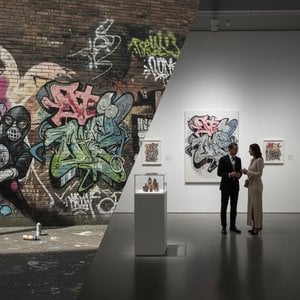
Explore the captivating journey of street art from urban walls to prestigious galleries. Discover how contemporary graffiti has evolved into a high-end collectible movement, redefining modern interior design and global art culture.


 Send
Send Share
Share
 Details
 Guide
Guide

 Download
 Similars
 Diaporama
 Stats
Stats


 Read More






































 Glass option is only available in size under 110 CM


