
x


Hand-painted oil on canvas in your size and frame, made to order by our artists. ( Buy Print Buy Image)





























Pick from our preset sizes that match the artwork's original proportions.

You may enter your own dimensions to fit a specific frame or space. If your selected size does not match the original image's proportions, we will either crop the artwork or extend the painting with additional hand-painted elements. A digital mockup will be sent for your approval before production begins.
Please note that the on-screen preview does not reflect the actual cropping or extension. Only the mockup will accurately show the final composition.
While custom sizes are available, we recommend selecting a dimension from the predefined list to preserve the original proportions.
Worldwide Delivery () in 3/4 weeks instead of standard 5 weeks. (29 August). No compromise on quality.


LE SILENCE
Reproduction Size
Bernardino Luini’s “Le Silence” is not merely a portrait; it's an invitation into the quietude of the human spirit, a remarkably evocative work that speaks volumes through its deliberate restraint. Painted in Milan around 1527-1530, during the twilight years of his prolific career, this piece embodies Luini’s signature style – a graceful blend of Renaissance idealism and a subtly melancholic realism. It's a painting that whispers rather than shouts, inviting prolonged contemplation and revealing layers of meaning with each careful observation.
The subject is a young woman, likely depicted in the guise of a noblewoman or perhaps a pious lady of the court. Her pose—a gentle inclination of her head, a delicate hand resting lightly upon her lips—immediately establishes an atmosphere of profound stillness. The cropped composition, focusing intently on her face and upper torso, draws the viewer into this intimate space of introspection. Luini masterfully employs soft, diffused lighting, casting subtle shadows that enhance the contours of her features without resorting to dramatic contrasts. This deliberate lack of harshness contributes significantly to the painting’s overall sense of serenity.
Luini's technique is characterized by a remarkable mastery of *sfumato*, a subtle blurring of edges that creates an almost dreamlike quality. He achieves this through meticulous layering of thin, translucent glazes of oil paint—a hallmark of his approach. The colors are muted and earthy – warm beiges, browns, and reddish hues dominate the palette, creating a sense of timelessness and understated elegance. There’s no flamboyant display of color here; instead, Luini utilizes a restrained range to amplify the painting's emotional impact.
The use of lines is equally deliberate. They are soft and blended, avoiding sharp outlines that would disrupt the overall feeling of tranquility. The head covering—a triangular shape—adds a touch of visual interest while remaining perfectly integrated within the composition’s harmonious flow. The surface texture suggests a smooth, almost polished quality, achieved through careful blending and manipulation of the paint – an impression of refined elegance and quiet dignity.
The title itself, “Le Silence,” is profoundly symbolic. It immediately establishes the painting’s central theme: introspection, discretion, and perhaps even a plea for quietude. The woman's gesture—placing her finger to her lips—is universally understood as a symbol of secrecy or silence, reinforcing this thematic core. Luini doesn’t explicitly state these meanings; he trusts the viewer to interpret them through careful observation and emotional response.
Beyond the immediate symbolism, “Le Silence” evokes a broader sense of melancholy and contemplation. It's reminiscent of Leonardo da Vinci’s *sfumato* technique, which similarly creates an atmosphere of ambiguity and mystery. The painting invites us to consider the inner life of the subject—her thoughts, her feelings, her unspoken desires. It’s a portrait that transcends mere likeness, offering instead a glimpse into the soul.
Bernardino Luini was a pivotal figure in the artistic landscape of Renaissance Milan, deeply influenced by Leonardo da Vinci. His work represents a unique synthesis of classical ideals and northern European sensibilities. Luini’s style is often described as “Luinesque,” characterized by its graceful figures, elongated eyes, and subtle emotional depth. He worked primarily for religious institutions and private patrons, producing a vast body of paintings that continue to captivate viewers today.
“Le Silence” stands as one of Luini’s most poignant achievements—a testament to his artistic skill and profound understanding of the human condition. It's a painting that rewards careful study and invites repeated contemplation, offering a timeless meditation on beauty, silence, and the mysteries of the inner world.


1480 - 1532 , Italy

Explore the captivating world of muted colors in art & design! Discover historical context, psychological effects, techniques, and inspiration for creating serene spaces. Elevate your aesthetic with WahooArt.

Find peace with 10 serene masterpieces! Explore calming landscapes by Monet & Van Gogh, tranquil Japanese art like Hokusai’s Great Wave, and more. Discover the stories behind these iconic paintings & bring museum-quality art to your home with . Explore the full collection online.
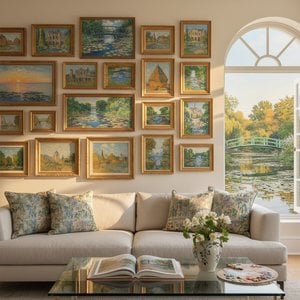
Journey through 25 iconic Claude Monet masterpieces! Explore Impressionism’s beauty, from Water Lilies to Rouen Cathedral. Discover stunning art reproductions & curated decor ideas – explore the full collection online at WahooArt.com.

Explore the power of muted colors in art! Discover the history, psychology & techniques behind serene palettes. Find inspiration & expert advice for creating emotionally resonant spaces with WahooArt.
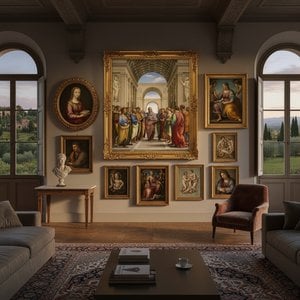
Explore 25 breathtaking Raphael paintings! Journey through the Italian Renaissance with masterpieces like 'School of Athens' & iconic Madonnas. Find museum-quality art reproductions and elevate your home decor on WahooArt.com.


Stay updated with the latest art news, exclusive offers, and decoration ideas.
Tell us about your project and our art experts will provide you with 3 personalized art suggestions.
Let Us Curate 3 Options Just for You - Free!

 Preview
 Send
Send Share
Share
 Details

 Download
 Similars
 X-Ray
X-Ray Diaporama

 Read More







 Glass option is only available in size under 110 CM


