Museum-quality giclée or canvas print with fast production and flexible finish options. ( Buy Hand Made Painting Switch to Digital Image)
Pick from our preset sizes that match the artwork's original proportions.

Type the width and the height you need, to fit your frame or your wall. A print can only be cut, never made bigger than the picture, so a size with a different shape loses a part of the image. We send you a digital mockup to approve before we print anything. The picture shown on this page does not show the real cut — only the mockup does.
Worldwide Delivery () in 2 weeks instead of standard 4/5 weeks. (21 October)
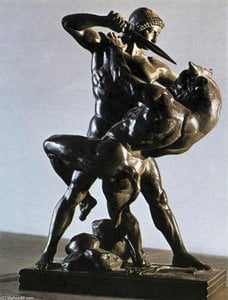
Perseus
Reproduction Size
Benvenuto Cellini’s sculpture “Perseus with the Head of Medusa,” created between 1545 and 1554 for the Loggia dei Lanzi in Florence, stands as a monumental testament to Mannerist artistry—a period characterized by dramatic flair and stylistic complexity that followed the High Renaissance. More than just a depiction of mythic heroism, Cellini’s masterpiece embodies the intellectual fervor and artistic ambition of its time, cementing Cellini's place among the foremost sculptors of his era.
The sculpture portrays Perseus, the legendary hero who slew Medusa—a Gorgon whose gaze turned men to stone—for King Polydectes. Cellini meticulously captured the decisive moment after Perseus decapitated Medusa, holding aloft her severed head by her hair with unwavering strength and determination. The pose itself is imbued with dynamism – Perseus’s raised right arm conveys triumph, while his musculature reflects the physical exertion required for this perilous feat.
Cellini employed bronze—a material prized for its durability and ability to capture intricate detail—to achieve an astonishing level of realism. The sculptor skillfully hammered the metal into form, utilizing techniques honed over decades of experience. Careful observation reveals subtle nuances in musculature and facial expression, demonstrating Cellini’s profound understanding of human anatomy. Furthermore, the sculpture's surface is polished to a gleaming sheen, enhancing its visual impact and conveying an aura of grandeur.
Beyond its narrative depiction of Perseus’s victory, “Perseus with the Head of Medusa” resonates with deeper symbolic meanings. The Gorgon's head represents evil and terror—forces that Perseus vanquishes through courage and intellect. Cellini’s masterful rendering underscores the triumph of reason over primal fear. Moreover, the sculpture is considered to be inspired by classical ideals of beauty and heroism – a reflection of the humanist spirit prevalent during the Renaissance.
“Perseus with the Head of Medusa” remains one of Cellini’s most celebrated works—a cornerstone of Florentine sculpture and an exemplar of Mannerist style. Its enduring appeal lies in its ability to convey both physical prowess and intellectual conviction, capturing the essence of Renaissance ambition and artistic excellence. Today, reproductions of this iconic sculpture continue to inspire admiration for Cellini's unparalleled skill and his contribution to the artistic heritage of Italy.
A print of "Perseus" by Benvenuto Cellini is recommended at a large size in portrait orientation.
"Perseus" by Benvenuto Cellini is described as dramatic in mood. This classification can help match the work to a setting.
"Perseus" dates from 1540. The date places the work within Benvenuto Cellini's career and its era.

Benvenuto Cellini was a remarkable figure of the Italian Renaissance, renowned as an accomplished goldsmith, sculptor, draftsman, soldier, musician, and writer. His multifaceted talents and flamboyant personality are vividly captured in his celebrated autobiography, considered a significant literary work alongside his artistic achievements. He embodies the spirit of Mannerism, a period following the High Renaissance characterized by dramatic flair and stylistic complexity.
Born into a family with musical inclinations – his father was a musician and instrument maker – Cellini initially showed promise in music. However, at fifteen, he passionately pursued a career as a goldsmith, convincing his reluctant father to apprentice him to Antonio di Sandro (known as Marcone). This marked the beginning of his formal artistic training. His early years were not without incident; at sixteen, he became embroiled in an affray with companions, leading to banishment from Florence and a period working in Siena under goldsmith Fracastoro.
Cellini’s style is characterized by its dynamism, realism, and attention to detail. He drew inspiration from classical antiquity and Michelangelo's powerful figures, but infused his work with a distinctly Mannerist sensibility – elongated forms, exaggerated poses, and a sense of theatricality.
Cellini’s life extended far beyond the workshop. He served as a soldier during sieges, claiming to have played a crucial role in defending Rome against imperial forces. He was also an accomplished musician, playing the cornett and flute at papal court. However, it is his autobiography that truly sets him apart.
His autobiography is not merely a recounting of events; it's a carefully constructed self-portrait designed to showcase his talents and justify his actions. While sometimes unreliable due to Cellini’s own biases, it remains an essential primary source for understanding Renaissance life.
Benvenuto Cellini died in Florence in 1571, leaving behind a legacy as one of the most important artists of Mannerism. His technical skill, artistic innovation, and captivating autobiography continue to inspire artists and art enthusiasts alike. He represents the quintessential Renaissance ideal – a polymath skilled in multiple disciplines, driven by ambition, and unafraid to express his individuality. His works are celebrated for their beauty, craftsmanship, and dramatic power, solidifying his place as a pivotal figure in Western art history.

1500 - 1571 , Italy

Discover the enduring elegance of bronze sculpture. From ancient Roman strength to Art Deco sophistication, explore our expert guide on collecting, casting techniques, and integrating timeless metal masterpieces into your fine art collection.

Discover the enduring allure of bronze sculptures at WahooArt.com. From classical lost-wax casting to modern metal masterpieces, explore museum-quality artworks designed to elevate luxury interiors. Expert curation, authenticity guaranteed, and worldwide shipping for discerning collectors.

Discover the enduring allure of bronze sculpture. From the intricate lost-wax process to Neoclassical masterpieces, our expert guide offers connoisseurs deep insights into evaluating patina, historical significance, and integrating metal fine art into sophisticated collections.

 Send
Send Share
Share
 Details
 Guide
Guide

 Download
 Similars
 Diaporama
 Stats
Stats


 Read More






































 Glass option is only available in size under 110 CM