Artist Biography
A Life Immersed in History and Drama
Benjamin Robert Haydon, a name perhaps less instantly recognizable than his Romantic contemporaries, nevertheless occupies a fascinating and poignant position within 19th-century British art. Born in Plymouth in 1786, the son of a printer and publisher, Haydon’s life was one of passionate dedication to historical painting, coupled with relentless financial struggle and ultimately, tragic despair. From an early age, he displayed a remarkable aptitude for study, nurtured by his mother and fueled by a burgeoning fascination with anatomy sparked by the illustrations of Albinus. This anatomical precision would become a hallmark of his work, grounding his dramatic compositions in meticulous detail. His formal education at Plymouth Grammar School and later Plympton Grammar School provided a solid foundation, but it was his move to London in 1804 and subsequent entry into the Royal Academy Schools that truly set him on the path toward becoming a history painter – a genre he championed with unwavering conviction.
The Pursuit of Grand Historical Visions
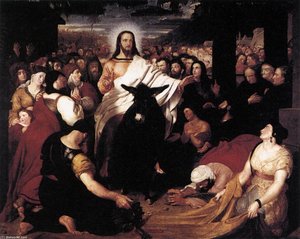
Haydon’s artistic ambition centered firmly on grand historical narratives, though his portfolio also included portraits and contemporary scenes. He debuted at the Royal Academy in 1807 with “The Repose in Egypt,” a work that immediately garnered attention and secured early patronage from Thomas Hope. However, it was his subsequent painting, "Dentatus" (1809), that ignited both acclaim and controversy. The piece, depicting a Roman soldier refusing to surrender his arms, was deemed too politically charged by the Academy’s committee and relegated to a less prominent display location – an act that fueled Haydon's lifelong distrust of the institution. His style evolved as a compelling blend of Neoclassical rigor and Romantic fervor. He embraced dramatic compositions, often employing bold lighting and dynamic poses to convey emotional intensity. He wasn’t merely illustrating history; he was striving to *animate* it, imbuing his canvases with moral weight and civic virtue. Works like “Christ's Entry into Jerusalem,” a monumental canvas teeming with figures – including recognizable portraits of contemporaries such as Wordsworth, Hazlitt, and Keats – exemplify this approach. “The Judgment of Solomon” and “Resurrection of Lazarus” further demonstrate his skill in depicting pivotal moments with both grandeur and psychological depth. Even his portraiture, like that of Thomas Alcock, reveals a neoclassical sensibility tempered by a Romantic sensitivity to character.
A Tumultuous Path Marked by Financial Strain
Despite critical recognition, Haydon’s career was perpetually overshadowed by financial difficulties. His father ceased providing support in 1810, forcing him to rely solely on the income from his art – a precarious existence given the scale and ambition of his projects. Disputes with patrons, notably Lord Mulgrave and Richard Payne Knight, further exacerbated his problems. He possessed a regrettable tendency toward tactless dealings, alienating potential benefactors and hindering his commercial success. The sheer size of his preferred canvases also contributed to the strain; large-scale historical paintings were expensive to produce and difficult to sell in sufficient quantities to sustain him. Consequently, Haydon faced repeated imprisonment for debt – in 1821 and again in 1827 – experiences that deeply scarred him and fueled a growing sense of frustration and resentment. He was a man driven by artistic vision but perpetually hampered by practical realities.
Legacy and the Echoes of a Passionate Voice
Though his life ended tragically, Benjamin Robert Haydon left behind a significant legacy. He was a fervent advocate for historical painting at a time when its popularity was waning, believing it held the power to inspire moral reflection and cultivate civic responsibility. His extensive diaries, published posthumously, offer invaluable insights into the artistic milieu of his era – a candid and often scathing account of the personalities, politics, and challenges faced by artists in 19th-century England. The influence of the “Elgin Marbles” on his work is particularly noteworthy; he meticulously studied their anatomical precision, incorporating that knowledge into his own depictions of the human form. He was a dedicated teacher as well, passing on his knowledge to pupils like Charles Lock Eastlake. While often overlooked today, Haydon’s commitment to depicting significant historical events with dramatic intensity and emotional resonance places him firmly within the Romantic tradition. His paintings remain powerful testaments to an era captivated by history, drama, and the complexities of human emotion. His life serves as a cautionary tale – a reminder that artistic genius does not always equate to financial security or critical acclaim – but also as an inspiration for those who dare to pursue their passions with unwavering dedication, even in the face of adversity.
A Final Descent
The culmination of years of struggle and frustration led Haydon to take his own life in 1846. His diaries provide a harrowing glimpse into the depths of his despair, revealing a man tormented by financial woes and artistic disappointments. The failure of an exhibition mounted shortly before his death – overshadowed by the sensational popularity of General Tom Thumb – proved to be the final blow. His suicide shocked the art world and prompted a belated outpouring of sympathy from some of his former critics. Though he died in despair, Benjamin Robert Haydon is remembered not only for his dramatic canvases but also as a passionate advocate for art education and a chronicler of his time, whose writings continue to illuminate the challenges and triumphs of an artist striving for recognition in a competitive world.



 Preview
 Buy Print
 Send
Send Share
Share
 Details

 Download
 Similars
 X-Ray
X-Ray Diaporama
 Read More






































 Glass option is only available in size under 110 CM