

Museum-quality giclée or canvas print with fast production and flexible finish options. ( Buy Hand Made Painting Switch to Digital Image)
Pick from our preset sizes that match the artwork's original proportions.

Type the width and the height you need, to fit your frame or your wall. A print can only be cut, never made bigger than the picture, so a size with a different shape loses a part of the image. We send you a digital mockup to approve before we print anything. The picture shown on this page does not show the real cut — only the mockup does.
Worldwide Delivery () in 2 weeks instead of standard 4/5 weeks. (24 October)
Composition
Reproduction Size

Born into a working-class Jewish family in Budapest in 1877, Béla Kádár’s journey to becoming a pivotal figure in early 20th-century avant-garde art was one forged through both hardship and an unwavering dedication to artistic exploration. His formal education was limited to six years, yet this lack of traditional schooling seemed to liberate him from conventional constraints, allowing for a uniquely personal visual language to emerge. Kádár began his professional life not with a brush in hand, but as an apprentice iron-turner – a trade that profoundly impacted his artistic sensibilities, instilling within him a deep understanding of form, structure, and the inherent beauty found within industrial materials. Even in these early years, however, his creative spirit shone through; he initially focused on painting murals throughout Budapest, demonstrating an innate inclination towards large-scale visual expression and storytelling. This foundational period laid the groundwork for the bold and dynamic compositions that would later define his oeuvre.
The true catalyst for Kádár’s artistic development arrived with his travels to Paris and Berlin in 1910. These journeys exposed him to the burgeoning avant-garde movements sweeping across Western Europe, irrevocably altering his artistic trajectory. He encountered the radical ideas of Der Blaue Reiter, the fragmented forms of Cubism, the dynamism of Futurism, and the raw energy of Neo-Primitivism – influences that he didn’t simply adopt wholesale, but rather synthesized into a distinctive visual vocabulary all his own. Kádár wasn't content to align himself with any single “school” of thought; instead, he embarked on a constant exploration of form, color, and composition, driven by an insatiable desire to break free from the constraints of traditional representational art. He absorbed elements from Constructivism and even the dreamlike qualities of Metaphysical painting, weaving them together in a complex tapestry that reflected his unique perspective. This period marked a crucial turning point, transforming him from a promising muralist into a truly innovative artist on the cusp of international recognition.
Kádár’s breakthrough moment arrived in October 1923 with an exhibition at Herwarth Walden's prestigious Galerie der Sturm in Berlin. This showcase presented his work in a distinctly Expressionist style, immediately garnering attention and establishing him as a force to be reckoned with within the European art scene. The gallery, known for championing radical new artistic voices, provided Kádár with an ideal platform to connect with collectors and fellow artists who shared his commitment to experimentation. Further bolstering his international profile were two exhibitions organized by Katherine Dreier at the Brooklyn Museum of Art in New York City, in 1926 and 1928. Notably, Kádár attended the second exhibition, solidifying his presence on the American art landscape and fostering valuable connections within the burgeoning modernist movement across the Atlantic. His paintings during this period often depicted scenes drawn from Hungarian folklore, intimate portraits, and glimpses of village life – subjects rendered with a bold color palette and dynamic compositions that captured both the spirit of his homeland and the energy of the modern age.
Béla Kádár’s artistic style is immediately recognizable for its vibrant and expressive use of color, often employing non-naturalistic hues to convey emotion and atmosphere. His compositions are characterized by a palpable sense of movement and energy, achieved through the interplay of lines, shapes, and forms that seem to vibrate on the canvas. He frequently employed an impasto technique – applying thick layers of paint – creating textured surfaces that enhance the visual impact of his work and invite tactile exploration. But perhaps what truly sets Kádár apart is his remarkable ability to synthesize these diverse artistic influences into a cohesive and original style. He represents a crucial link between the Hungarian avant-garde and the broader European movements of his time, reflecting the social and political upheavals of the early 20th century in his art. While not always as widely celebrated during his lifetime as some of his contemporaries, Kádár’s work has experienced a resurgence in recent decades, with scholars increasingly recognizing his significant contributions to modern art. He died in Budapest in 1956, leaving behind a legacy of bold and innovative paintings that continue to inspire artists and captivate audiences today – a testament to the enduring power of an artist who dared to forge his own path.
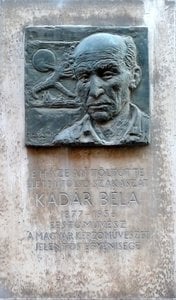
1877 - 1956 , Hungary

 Preview
 Send
Send Share
Share
 Details
 Guide
Guide

 Download
 Similars
 X-Ray
X-Ray Diaporama
 Stats
Stats Read More






































 Glass option is only available in size under 110 CM


