Museum-quality giclée or canvas print with fast production and flexible finish options. ( Buy Hand Made Painting Switch to Digital Image)
Pick from our preset sizes that match the artwork's original proportions.

You may enter your own dimensions to fit a specific frame or space. If your selected size does not match the original image's proportions, we will either crop the artwork or extend the image with a mirrored or solid-fill edge. A digital mockup will be sent for your approval before production begins.
Please note that the on-screen preview does not reflect the actual cropping or extension. Only the mockup will accurately show the final composition.
While custom sizes are available, we recommend selecting a dimension from the predefined list to preserve the original proportions.
Worldwide Delivery () in 2 weeks instead of standard 4/5 weeks. (4 October)


Two Forms
Reproduction Size
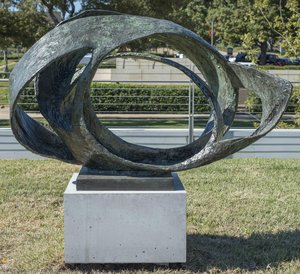
Barbara Hepworth (1903 – 1975), a British sculptor whose career spanned decades of artistic innovation, remains an enduring figure in the history of modern art. Her work embodies a profound exploration of form and space, prioritizing simplicity and conveying a deep connection to the natural world—qualities powerfully realized in “Two Forms,” created in 1937.
The sculpture itself is deceptively straightforward. Constructed from concrete – a material Hepworth favored for its solidity and ability to capture subtle tonal variations – it presents two interlocking forms that ascend vertically, separated by a shallow concave curve. These shapes aren’t representational; they eschew recognizable imagery in favor of pure geometric abstraction. Instead, Hepworth sought to distill the essence of form itself, mirroring the principles championed by the Unit One movement she co-founded alongside fellow artists Ben Nicholson and Paul Nash.
Hepworth's approach aligns closely with the broader aesthetic currents of the time. The Unit One group rejected academic conventions and embraced a radical simplification of artistic expression, influenced heavily by Surrealism’s exploration of subconscious imagery and Dada’s rejection of traditional artistic hierarchies. However, unlike Surrealists who often employed dreamlike juxtapositions, Hepworth focused on achieving visual harmony through precise geometric relationships—a deliberate counterpoint to the prevailing anxieties surrounding societal upheaval.
The curve between the two forms is particularly significant. It isn't merely a structural element; it embodies an organic principle – mirroring the contours of rock formations and suggesting a dynamic interplay between opposing forces. Hepworth herself described her sculptures as “attempts to capture the feeling of stone,” reflecting her fascination with geological textures and shapes. This sensitivity to natural forms distinguishes “Two Forms” from purely intellectual exercises in abstraction.
“Two Forms” continues to resonate today, serving as a cornerstone of minimalist sculpture and demonstrating Hepworth’s unwavering commitment to exploring fundamental visual concepts. Its quiet elegance speaks volumes about the artist's belief that beauty resides in restraint and that art can communicate profound emotional truths without resorting to overt symbolism.
When "Two Forms" was created in 1937, Barbara Hepworth - born in 1903 - was 34 years old.
Statistics about "Two Forms" by Barbara Hepworth are on the artwork's Stats page: monthly visits of the artwork, visits of the artist's works, and country and language breakdowns of recent visitors.
Yes - the artwork is kept in the artist's home country. The creator was born in United Kingdom; the original work is in United Kingdom.
The creation of "Two Forms" by Barbara Hepworth is dated 1937.
gray (#919192) is the leading color of "Two Forms" by Barbara Hepworth.
"Two Forms" is attributed to Barbara Hepworth.
The colors of "Two Forms" by Barbara Hepworth show a balanced harmony harmony. Harmony describes how the colors relate to each other.


1903 - 1975 , United Kingdom

Journey through art history with 10 legendary bronze sculptures – from Michelangelo's David to Rodin’s Thinker. Explore the stories, techniques & timeless beauty of these masterpieces. Find museum-quality reproductions & elevate your home decor on WahooArt.com.

Explore the rich history of sculpture from ancient masterpieces to contemporary innovations. Discover key techniques, influential artists & investment potential for discerning art collectors.

Journey through art history with our Top 10 bronze sculptures! Explore masterpieces by Rodin, Michelangelo & more. Discover stories behind iconic statues and find museum-quality reproductions for your home decor at WahooArt.com.

Explore the profound world of Barbara Hepworth's sculpture. Discover her artistic evolution, iconic forms, and lasting influence on modern art. A guide for collectors & enthusiasts.

Explore the rich history of sculpture with WahooArt. Discover key techniques, influential artists & investment potential for discerning collectors. Expert insights into valuing and collecting timeless masterpieces.

 Send
Send Share
Share
 Details
 Guide
Guide

 Download
 Similars
 Diaporama
 Stats
Stats


 Read More




































 Glass option is only available in size under 110 CM