Early Life, Family and Training
Barbara Hepworth was born on 10 January 1903 in Wakefield, West Riding of Yorkshire, England. She was the eldest child of Gertrude and Herbert Hepworth. Her father worked as a civil engineer for the West Riding County Council, a background that provided a practical, structural foundation to her upbringing. This early environment in Yorkshire shaped the spatial awareness that would later define her approach to three-dimensional form.
Her formal education began at Wakefield Girls' High School. This academic start led her to the Leeds School of Art in 1920, where she began to develop the technical discipline required for serious sculptural inquiry. By the 1920s, she had moved to London to study at the Royal College of Art. This period of training was essential for establishing the intellectual rigor that separates her work from mere decoration. She was not merely learning a craft; she was mastering the relationship between material and void.
The Formative Years and Early Career
Hepworth’s early professional trajectory was defined by a series of significant personal and artistic shifts that mirrored the radical changes occurring in British modernism. In May 1925, she married the sculptor John Skeaping in Florence. This period was marked by a move toward direct carving, a method that demanded a physical, unmediated engagement with stone and wood. By 1931, her personal and creative life underwent another transformation when she fell in love with the painter Ben Nicholson. This connection was part of a larger, intense intellectual circle of modern artists centered on Hampstead, London. These social and romantic intersections were not mere distractions; they were the crucibles in which her approach to space and form was tested against the prevailing trends of the era.
The dissolution of her first marriage in March 1933 signaled a departure from her earlier, more figurative explorations. She eventually married Ben Nicholson in 1938, a union that solidified her position within the vanguard of British abstraction. During these years, her work moved away from representational traditions, seeking instead to distill the essence of form through a more reductive, geometric language. This period of transition saw her moving from the study of ancient monuments toward a sophisticated understanding of how negative space functions as a structural element. Her development was not a linear progression but a series of deliberate, often difficult, breaks from the past.
The Unit One Art Movement
In 1933, Hepworth helped establish the Unit One art movement, a collective that fundamentally altered the trajectory of British modernism. Alongside Ben Nicholson, Paul Nash, and several other artists, she worked to bridge the gap between Surrealism and Abstraction. This was not a mere stylistic preference but a deliberate attempt to unify these two dominant forces within the British art scene. The movement pushed against the traditional boundaries of representation, seeking a new visual language that could accommodate the complexities of the modern era.
The impact of this period is felt in how Hepworth transitioned from her early figurative experiments toward a more rigorous, abstract vocabulary. This shift was not an isolated development; it was part of a broader, coordinated effort by the Unit One group to move British art away from provincialism and toward the international avant-garde. Her involvement in this circle solidified her position as a central figure in a movement that prioritized the essential qualities of form and space over literal depiction.
As the Second World War approached, the focus of this artistic community shifted geographically. Hepworth became a leading figure in the colony of artists who resided in St Ives, Cornwall. This relocation turned the coastal town into a significant hub for modernist thought. The concentration of talent in St Ives allowed for a continued exploration of the relationship between abstract form and the natural landscape, ensuring that the radical ideas championed by Unit One remained central to the development of British sculpture.
Technique and Artistic Style
Hepworth’s approach to modern sculpture is defined by a rigorous commitment to direct carving. Rather than modeling clay to be cast later, she worked directly into the medium, allowing the material to dictate the final form. This method demands an immediate, physical engagement with the substance of the work. She utilized chiselling and carving to shape marble and wood, often painting the hollows of her forms to manipulate how light and shadow interact with the interior surfaces. In many pieces, she went further by binding the sides of her sculptures with wire or string, creating a literal tension between separate parts of a single object.
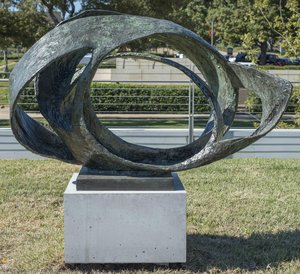
Her most significant contribution to the language of abstraction is the use of negative space. By introducing gaping voids into her sculptures, she transformed the hole from a mere absence into a structural element. These apertures do more than create openings; they establish a connection between the object and the space surrounding it. This technique forces the viewer to acknowledge the air within the form as a tangible part of the composition. The result is a tension between presence and absence that defines her modernist aesthetic.
Key Works and Sculptural Innovations
Hepworth’s most significant contribution to modern sculpture was her radical use of negative space. In 1931, she introduced the pierced form, a technique that transformed the void from an absence into a structural element. This shift moved sculpture away from solid mass and toward an exploration of how light and space interact with material. Her breakthrough arrived in 1937 with Oval Form (Trezion), a work that solidified her command over these geometric, hollowed volumes. By carving into the substance of the work, she forced the viewer to acknowledge the space within as being as vital as the material itself.
Her ability to balance organic themes with rigorous abstraction is evident in her 1930s work Mother and Child. This piece demonstrates how she distilled human relationships into simplified, rounded shapes. Later, her technical range expanded to include the integration of non-sculptural materials. In 1956, she produced Stringed Figure (Curlew), which utilized cotton string to bind the wooden forms, creating a physical tension that mirrored the internal geometry of the sculpture. This method emphasized the connection between different parts of a single object through literal, tactile binding.
The scale of her vision reached a monumental level with Single Form. This twenty-one-foot, five-ton bronze was commissioned as a memorial to Dag Hammarskjöld. It remains a definitive example of how her abstract language could translate into massive, public-facing structures without losing its focus on essential form.
Later Years and Death
The final chapter of Hepworth's career was anchored in St Ives, Cornwall. After purchasing the Trewyn Studio site in September 1949, she remained in this coastal environment for 26 years. This period was defined by a significant expansion in the scale and complexity of her output. To manage the demands of her practice, she worked with 16 assistants from 1949 onwards, a necessity for the physical labor required by her large-scale carvings and bronze casts.
Her life ended abruptly in 1975. A fire at her studio claimed her life at the age of 72. The incident occurred on the premises where she had lived and worked for over two decades. This sudden conclusion left behind a body of work that had moved decisively from the figurative toward a rigorous, stripped-back abstraction.
Legacy and Museum Collections
Hepworth’s influence persists through the institutional structures that preserve her physical output. The Hepworth Wakefield in Wakefield, United Kingdom, bears her name and maintains a significant presence in the region of her birth. This museum holds over 400 of her sculptures and drawings, ensuring her specific approach to form and space remains accessible to the public. The collection provides a direct link to her development as a sculptor, moving from early figurative experiments to her later, more abstract works.
In St Ives, Cornwall, the Barbara Hepworth Museum and Sculpture Garden offers a different kind of preservation. This site maintains her studio and garden in the state they were during her life and work. It functions as a fixed point of reference for her practice, showing how her environment informed her aesthetic. In 1980, her family transferred the museum to the Tate gallery, securing its long-term survival within a major national collection.
- Oval Form (Trezion)
- Two Forms
- Single Form (Chûn Quoit)
- Totem
- Mother and Child
- Spring
Where to See the Works Today
Her physical presence in the art world remains anchored by The Hepworth Wakefield in Wakefield, United Kingdom. This institution holds a significant portion of her output, providing a concentrated look at her sculptural evolution. The collection there allows for a direct confrontation with her handling of material and the way she manipulated space through her characteristic pierced forms.
Beyond the United Kingdom, her influence is distributed across several major international collections. In the United States, the Kimbell Art Museum in Fort Worth holds 'Oval Form (Trezion)'. This piece demonstrates her ability to command volume through bronze. Similarly, the New Orleans Museum of Art contains 'River Form', a work that highlights her engagement with organic, fluid shapes. These locations ensure her work remains part of a global dialogue rather than a localized phenomenon.
The reach of her practice extends to the Auckland Art Gallery Toi o Tāmaki, which houses 'Torso II (Torcello)'. Seeing these works in their respective institutional settings reveals the scale and material reality of her abstraction. Her sculptures demand a specific type of viewing that requires moving around the object to understand the relationship between the solid mass and the void.


 Send
Send Share
Share
 Details
 Guide
Guide

 Download
 Similars
 Diaporama
 Q&A
Q&A
 Stats
Stats


 Read More
 Switch to Print





































 Glass option is only available in size under 110 CM